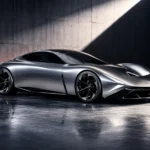

Picture a silver coupé with no doors. You press a button, and the whole roof and bonnet swing forward in one piece, like the lid of a jewellery box. That car is the Renault Trezor, a two-seat electric GT that Renault built for the 2016 Paris Motor Show. It has a Formula E motor, a red wooden dashboard and a cabin you climb into over the sill.
Searches for its price still pop up every year, so we’ll answer that head-on. Below you’ll find the verified specs, what made the design special, what was real engineering, what was pure show, and why you can’t park one in your garage.
Quick answer: The Renault Trezor is a two-seat electric GT concept car revealed at the 2016 Paris Motor Show. It has a carbon-fibre body, a one-piece canopy that replaces the doors, a red wood-and-leather cabin and a 0 to 62 mph time under 4 seconds. It was never priced or sold.
What Is the Renault Trezor?

The Renault Trezor is a fully electric, two-seat grand tourer concept that Renault unveiled at the Paris Motor Show in late September 2016. Renault Design, led by Laurens van den Acker, used it to preview the styling and technology of its future models. It was a show car, built to be seen, and Renault never put it into production.
The Trezor followed the 2010 DeZir concept, which launched Renault’s current design language. Van den Acker was clear about the Trezor’s job. Speaking to designboom, he said it “also marks the beginning of a new cycle of Renault concept cars.”
Here are the key figures in one place. Every number comes from Renault or from reports of Renault’s own figures at the reveal.
| Spec | Renault Trezor (2016 concept) |
| Body style | 2-seat electric GT coupé |
| Revealed | Paris Motor Show, 2016 |
| Power | 260 kW (350 hp) |
| Torque | 380 Nm (about 280 lb-ft) |
| 0 to 62 mph (0 to 100 km/h) | Under 4 seconds |
| Drive | Rear-wheel drive |
| Batteries | 2 packs, one front, one rear |
| Length x width x height | 4,700 x 2,180 x 1,080 mm (185 x 86 x 42.5 in) |
| Wheelbase | 2,776 mm (109.3 in) |
| Weight | 1,600 kg (about 3,530 lb) |
| Top speed, range, price | Never published by Renault |
Source: Renault Kuwait’s official Trezor page for power, torque, batteries and wheelbase; Paul Tan’s Automotive News for dimensions and weight.
What Makes the Renault Trezor Concept Car Unique?
The Renault Trezor stands out because almost every part of it rethinks something you take for granted on a normal car. There are no doors, the glass is red, the fuel flap is a gauge and the body is almost all carbon fibre. Each idea also had a job: to test how Renault’s future cars could look, feel and work as electric vehicles.
A Canopy Instead of Doors
The Trezor’s entire upper front body opens as one piece. The bonnet and roof lift forward together, and you step over a high sill trimmed in red leather, much like climbing into a classic racing car. Renault says the headrests automatically move back as you get in, as if to invite you in.
It’s dramatic, and it’s also the least practical feature on the car. A one-piece canopy needs space in front of the car to open, which is fine on a motor show stand and tricky in a parking garage.
Carbon Body and Honeycomb Air Intakes
Renault built the Trezor around a central carbon cell with tubular steel frames at the front and rear. According to Renault, the body and windows are 100% carbon. That kept the weight to 1,600 kg, even with two battery packs on board.
The bonnet has a honeycomb-shaped air intake that echoes the honeycomb pattern at the rear. The vents open and close to feed cooling air to the batteries. At the 2016 reveal, Renault quoted a drag coefficient of just 0.22, which is very slippery for a car this wide.
Red Glass, C-Shaped Lights and a Laser Tail
All the glazing on the Trezor is tinted red, so the cabin glows warm from the inside and out. Up front, slim headlights carry the C-shaped light signature that you’ll now recognise on many Renault road cars.
The rear lights use fibre optics with a red laser light built in. On a dark show floor, it gives the back of the car a thin, glowing outline.
A Charge Gauge Where the Fuel Flap Should Be
On the driver’s side, where a petrol car has its fuel flap, the Trezor has a round analogue gauge. It shows the battery’s charge level at a glance from outside the car. It’s a small, clever nod to the fact that the Trezor never needs a fuel pump.
What Is Inside the Trezor’s Cabin?
The Trezor’s cabin is red almost everywhere, with deep red leather seats, red wood and a large curved touchscreen. Renault designed it to feel warm and handmade while still being packed with tech. It’s also where the concept hides its luggage, which sits right in the dashboard.
Red Wood Dashboard With Built-In Luggage
The dashboard is made of red-stained wood, built with KEIM Cycles, a French company that makes wooden bicycle frames. Paul Tan’s Automotive News reports that it uses thin layered strips of ash and is said to be as strong as modern composite materials.
Inside that dashboard, Renault fitted a luggage compartment. Tailor-made trunks sit in it, held in place by leather straps. It’s a lovely touch for a grand tourer, a car built for long trips, even if the bags look small enough for a weekend at most.
Rectangular Steering Wheel and Touchscreens
The steering wheel is a flat rectangle made of two aluminium arms wrapped in leather. Small touchscreens on the wheel replace the usual stalks and buttons.
Behind it sits one L-shaped screen that merges the driver’s display and the multimedia screen. According to Renault, it uses OLED technology (a thin screen that lights each pixel by itself) under Gorilla Glass. You can drag apps from your phone onto the display behind the wheel with a swipe.
Neutral, Sport and Autonomous Modes
Renault’s Multi-Sense system gives the Trezor three driving modes: neutral, sport and self-drive. In self-drive mode, the exterior lighting changes and spreads to the side and rear logos, so other drivers can see that the car is driving itself.
The steering wheel also stretches forward in this mode. That clears the view of the dashboard screen so you can watch a film, play a game or look at photos with your passenger. In 2016, this was Renault’s pitch for what a self-driving GT might feel like.
How Fast Is the Trezor?

The Trezor goes from 0 to 62 mph in under 4 seconds, according to Renault. Its electric motor makes 260 kW (350 hp) and 380 Nm of torque and sends that power to the rear wheels. Renault never published a top speed or a driving range for the concept.
The Trezor’s motor has racing roots. Renault’s official Trezor page says it was derived from the motor used by Renault e.dams, the team that won two Formula E championships. The Trezor also borrows Formula E’s RESS (Rechargeable Energy Storage System), which recovers energy when you brake and sends it back to the batteries.
Renault split the batteries into two packs, one at the front and one at the rear, to balance the weight. Wide tracks (2,048 mm front, 2,106 mm rear), a long 2,776 mm wheelbase and a low body help keep the car planted.
On paper, a sub-4-second sprint puts the Trezor in supercar territory. Keep in mind that these are Renault’s own figures for a show car, so read them as the targets Renault set.
How Much Does the Renault Trezor Cost, and Can You Buy One?
The Renault Trezor has no price, because Renault never sold it. It’s a one-off concept car that the company kept as a design study, and there was no order book, no dealer price and no customer cars. Any dollar figure you see online for the Trezor, including “2026 price” estimates, is a guess.
Some 2016 reports said a production version might follow by around 2020. It never happened, and Renault has not announced any plan to build the Trezor.
There’s a practical reason too. Several of the Trezor’s signature features, like the lift-up canopy, the red glass and the wooden dashboard, were built for the show stand. A road car would need doors, clear glass and a crash-tested cabin, which would change the very things that made the Trezor special.
So why do searches for “Renault Trezor price” and “Renault Trezor for sale” keep coming? The car looks finished, with real wheels, a real cabin and real performance figures, so it’s easy to assume you can buy one. You can’t.
If you love the idea of a sleek electric sports car from the Renault Group, the closest thing is a sister brand. Our look at the Alpine Alpenglow Hy4 covers Alpine’s hydrogen-powered take on the same dream, built by Renault’s sports car brand.
How Did the Trezor Shape Renault’s Road Cars?

The Trezor set the design direction for Renault’s next wave of cars: softer, more fluid lines, the C-shaped light signature, warm materials like wood and leather, and bigger connected screens. Renault said its upcoming models would draw on the Trezor’s styling and its cabin ideas, even though the car itself stayed a concept.
Van den Acker said the Trezor’s lines “pave the way for the styling and technologies” of Renault’s upcoming models, in his comments to designboom. Renault’s own page makes the same point about the cockpit, calling it a preview of “even sleeker, more stylish, more connected interiors” in future models.
The easiest way to see what was real and what was theatre is to split the car in two:
| Trezor feature | Real engineering or show piece? | Why |
| 260 kW motor from Renault e.dams | Real engineering | Renault states its Formula E origin |
| RESS brake energy recovery | Real engineering | Formula E technology, named by Renault |
| Carbon cell with steel subframes, 1,600 kg | Real engineering | A working chassis layout |
| Two batteries, front and rear | Real engineering | Chosen for weight balance |
| L-shaped OLED touchscreen | Preview of road cars | Renault called the cockpit a preview of future interiors |
| C-shaped light signature | Preview of road cars | Part of Renault’s redesign across its range |
| One-piece canopy, no doors | Show piece | Needs open space in front to lift |
| Red-tinted glass all round | Show piece | Built for mood on the show stand |
| Wooden dashboard with luggage | Show piece | Hand-built craft detail |
Renault Group kept building bold concepts after the Trezor. The Alpine A424 β concept shows how the group’s design studios keep testing new ideas on show cars.
Why Was the Trezor Named the Most Beautiful Concept Car?
The Trezor won Most Beautiful Concept Car of 2016 at the 32nd Festival Automobile International, held at the Hôtel des Invalides in Paris. The award was announced in early 2017. The jury praised the car for its “extreme beauty, sensuality and elegance,” as designboom reported.
The festival judges design above all, so the win was a strong sign that Renault’s design team was on the right track. Van den Acker thanked the jury and said the award would push the team to continue its design strategy.
The winning details are easy to spot in photos. Designboom’s report singles out the Trezor’s warm, sensuous lines and its assertive front end with C-shaped lights. Inside, it points to the large wraparound touchscreen set against wood and leather. Those are the same three things Renault said its future cars would borrow: the body’s flowing shape, the light signature and the mix of tech with natural materials.
Is the Trezor Still Worth Knowing About?
Yes. The Trezor is one of the clearest snapshots of where Renault’s design was heading in the late 2010s, and its ideas still show up in the brand’s lights and cabins. It’s a design study first, so read its specs as Renault’s ambitions for the future.
It matters most to two groups: design fans who want to see how a carmaker previews its future, and EV enthusiasts curious about what Formula E tech looks like in a road-style car. If concept cars are your thing, our breakdown of the Porsche Vision 920 concept is a good next read. For more reviews, news and dream machines, head over to Autocram’s concept and supercar coverage.
FAQs
Q. What is the price of the Renault Trezor concept car?
A. The Renault Trezor has no price. Renault built it as a concept car for the 2016 Paris Motor Show and never offered it for sale, so it never had a dealer price or a customer order book. Any price you see online, including 2025 or 2026 figures, is a guess.
Q. How fast is the Renault Trezor?
A. Renault says the Trezor goes from 0 to 62 mph (0 to 100 km/h) in under 4 seconds. Its 350 hp electric motor drives the rear wheels. Renault never published a top speed, so any top-speed figure you find online is an estimate.
Q. How much horsepower does the Renault Trezor have?
A. The Renault Trezor has 350 hp (260 kW) and 380 Nm of torque, according to Renault. The electric motor was derived from the one used by the Renault e.dams Formula E team, and it sends its power to the rear wheels.
Q. Is the Renault Trezor for sale?
A. No. The Renault Trezor is a concept car that Renault kept as a design study, and it has never been offered for sale to the public. Renault also never announced a production version. If you want a Renault Group sports car you can buy, look at Alpine’s road cars.
Q. How many Renault Trezor were made?
A. Renault has not published a build count for the Trezor. The company showed it as a concept car, starting at the 2016 Paris Motor Show. Because it was never sold, there are no customer cars or production numbers to count.
Q. Is the Renault Trezor electric?
A. Yes, the Renault Trezor is fully electric. It uses a 260 kW motor with Formula E roots, two battery packs placed at the front and rear for balance, and a system that recovers energy when braking. Renault did not publish the battery size or the driving range.
Q. Who designed the Renault Trezor?
A. The Renault Trezor came from Renault’s design team led by Laurens van den Acker, Renault’s senior vice president of corporate design. He described it as the start of a new cycle of Renault concept cars, following the 2010 DeZir concept that launched the brand’s current look.
Q. When was the Renault Trezor revealed?
A. Renault revealed the Trezor at the Paris Motor Show in late September 2016, as a two-seat electric GT concept. A few months later, in early 2017, it won Most Beautiful Concept Car of 2016 at the Festival Automobile International in Paris.