
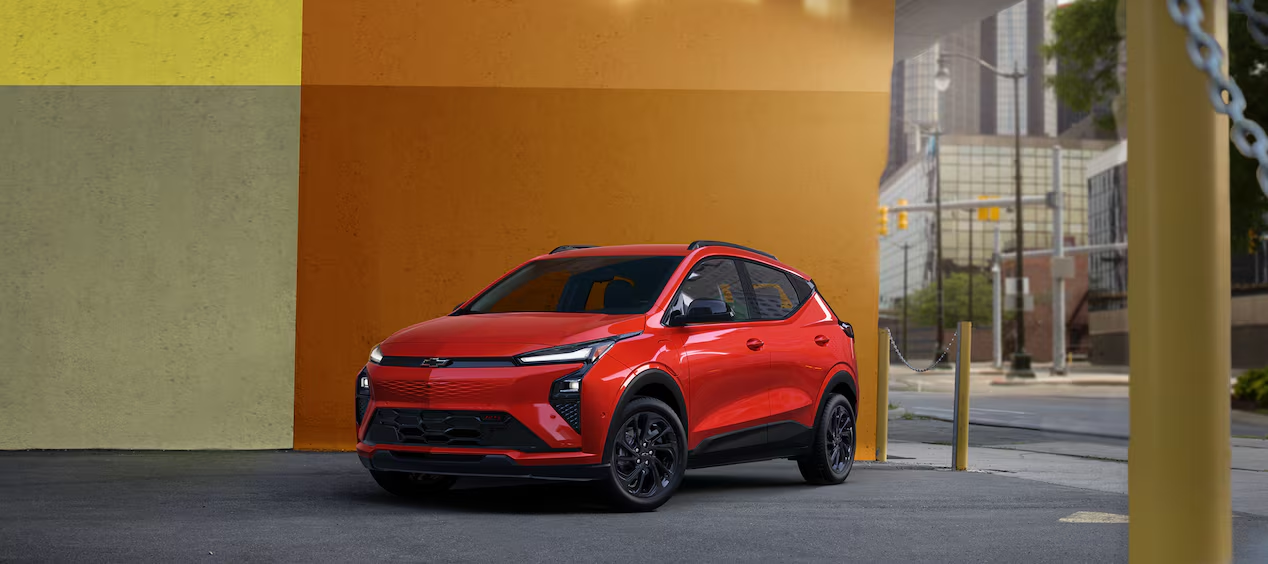
Chevrolet killed the Bolt after 2023, and buyers spent two years asking for it back. The 2027 Chevrolet Bolt answers that demand with a familiar shape, a rebuilt powertrain, and a price that undercuts every other new electric car in the United States. The LT trim starts at $28,995 (about AED 106,500), and Chevy quotes an EPA-estimated 262 miles of range on a full charge. For anyone who wants usable electric range without a luxury payment, this is the car that pulls the segment back toward affordability.
This guide walks through the pricing, the range, the charging setup, the redesigned cabin, and the trim differences, plus five FAQs written for both US and Gulf shoppers.
Why the Bolt Came Back
The original Bolt launched in 2017 as the first mass-market EV to pair a 200-plus-mile range with a genuinely low sticker. It built a loyal following, then disappeared when GM retired the platform after the 2023 model year. Owners kept asking Chevrolet to bring it back, and the company listened.
GM confirmed the return in October 2025 and started shipping cars to dealers early in 2026. The 2027 Chevrolet Bolt rolls out of GM’s Fairfax Assembly Plant in Kansas City, Kansas, and Chevy has labeled it a limited-run, single-model-year vehicle. That last detail matters. If you want one, waiting could cost you the chance, since the company has not committed to a long production window.
This version is not a carryover. Chevrolet moved the Bolt onto the same underlying technology as its newer EVs like the Equinox EV, swapped in a new battery chemistry, and added a charging port the old car never had. The result keeps the Bolt’s core appeal, a small footprint and a small price, while fixing the two complaints owners repeated most: slow charging and an aging interior.
2027 Chevrolet Bolt Price
Chevrolet keeps the lineup simple with two trims. The value-focused LT anchors the range, and the sportier RS sits above it. Both share the same motor, battery, and range, so the jump to RS buys you styling and cabin upgrades rather than more performance.
Here is how the pricing breaks down. AED figures use the fixed peg of roughly 3.67 dirhams to the dollar and are provided for reference only, since Chevrolet has not published official Gulf pricing for this model year.
| Trim | US MSRP (destination included) | Approx. AED equivalent |
| Bolt LT | $28,995 | ~AED 106,500 |
| Bolt LT (before $1,395 destination) | $27,600 | ~AED 101,400 |
| Bolt RS | $32,995 | ~AED 121,200 |
| Bolt with Super Cruise | from $35,655 | ~AED 130,900 |
A few things stand out. At $28,995 with destination baked in, the Bolt LT is the least expensive new EV on sale in the US market, according to GM. The RS costs $4,000 more and adds a sport appearance package rather than a faster drivetrain. And the Super Cruise-equipped Bolt, at $35,655, makes this the cheapest vehicle in America that offers GM’s hands-free highway system.
Buyer’s note: MSRP excludes taxes, title, license, and any dealer-installed extras. Your out-the-door number will land higher, and federal or state EV incentives (where they apply) can pull the effective cost back down. Confirm current incentive eligibility with your dealer before you sign.

Range and Real-World Efficiency
Chevrolet finalized the EPA rating at 262 miles for both the LT and the RS. That number climbed during development. GM first estimated 255 miles at the reveal, then the EPA cycle came back higher. For context, the outgoing Bolt EV managed 259 miles and the Bolt EUV 247, so the 2027 car edges past both of its predecessors.
The 262-mile figure reflects the combined EPA cycle. On the highway alone, the estimate drops to roughly 232 miles, which tracks with how every EV loses efficiency at sustained speed. Around town, where regenerative braking recovers energy at every stop, you may see the trip computer climb well past the rated number.
Efficiency sits near 120 MPGe, or about 3.6 miles per kilowatt-hour once charging losses are counted. That puts it among the most efficient electric cars you can buy, a direct result of its light curb weight and modest frontal area. Cold weather will trim the range, as it does with any EV, so Gulf buyers in the summer and northern buyers in the winter should each plan for a seasonal swing.
Charging: The NACS Switch
The single biggest upgrade over the old Bolt hides in the charge port. The 2027 model is the first Chevrolet to ship with a native NACS (SAE J3400) connector rather than the CCS1 port GM used for years. That change gives the Bolt direct plug-in access to Tesla’s Supercharger network, no adapter required.
DC fast charging now peaks above 150 kW, more than 2.5 times the rate the previous Bolt could sustain. Chevrolet quotes a 10 percent to 80 percent top-up in about 25 minutes, which works out to roughly 183 miles of range added in that window. Drivers who suffered through the old Bolt’s glacial DC speeds will notice the difference on the first road trip.
At home, the car handles 11.5 kW of Level 2 AC charging, enough to refill overnight from a standard wall unit. The car also supports vehicle-to-home (V2H) bidirectional charging, so paired with GM Energy hardware, it can send power back into your house during an outage. The optional GM Energy PowerShift charger delivers up to 19.2 kW.
If you still rely on older CCS1 DC stations or J1772 Level 2 units, a widely available adapter bridges the gap. So the NACS switch opens up the Supercharger network without locking you out of the chargers you already know.

Powertrain and How It Drives
Under the floor sits a 65 kWh lithium iron phosphate (LFP) battery, a chemistry Chevrolet chose for durability and lower cost. LFP packs tolerate frequent full charges better than the older nickel-based chemistry, which suits a commuter car that plugs in nightly.
A single X76 electric motor drives the front wheels and produces 210 horsepower and 169 lb-ft of torque. It is the same drive unit Chevrolet uses in the Equinox EV, and in the lighter Bolt it feels eager off the line thanks to instant torque. This is not a performance EV, and Chevy quotes no towing rating, but for city streets and highway merges, the Bolt has enough shove to keep up with traffic without drama.
Standard one-pedal driving lets you slow and stop the car by lifting off the accelerator, which feeds energy back into the battery and spares the brake pads. There is a short learning curve, and after a week most drivers stop reaching for the brake pedal in normal traffic. The tuning favors comfort and quiet over sharp handling, which fits its brief as an affordable daily runabout.
Exterior Design
The 2027 Bolt keeps the tall-hatchback silhouette that made the original so practical, then borrows sharper detailing from the discontinued Bolt EUV. Short overhangs, a compact 169.6-inch length, and a 105-inch wheelbase let it slip into parking spots that defeat larger EVs while still freeing up a roomy cabin.
Up front, a closed-off fascia signals its electric nature, flanked by slim LED lighting. The LT rides on 17-inch aluminum wheels and gets automatic headlights with intelligent high beams, plus heated power-adjustable mirrors.
The RS is where the design turns up the volume. It adds a gloss black grille treatment, gloss black roof rails, 17-inch gloss black aluminum wheels, and RS badging. If you want the car to look like it costs more than it does, the RS package earns its premium on the street.
Interior and Technology
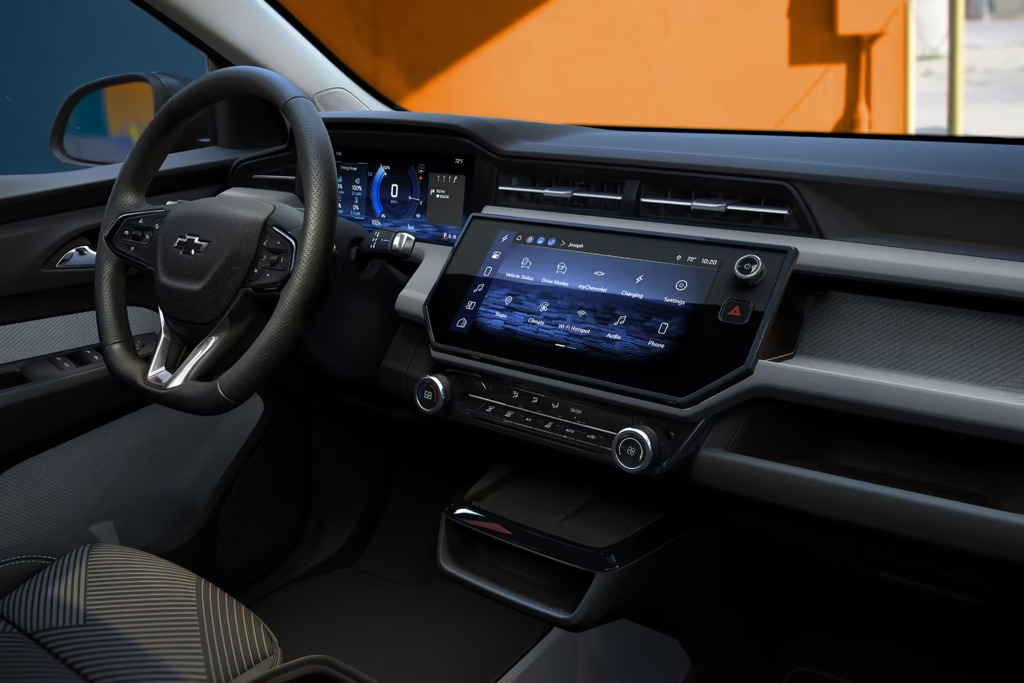
Chevrolet rebuilt the cabin from the ground up, and it shows. The dashboard now centers on an 11.3-inch Google-built-in infotainment touchscreen paired with an 11-inch customizable digital instrument display. Google Maps, Google Assistant, and the Play Store live natively in the system, so navigation and voice control work without tethering your phone. Add 5G connectivity, and the Bolt stays online for over-the-air updates and streaming.
Space is the Bolt’s quiet superpower. Despite the subcompact footprint, five adults fit, with 44.2 inches of front legroom and 39.1 inches in the rear. Cargo runs to 16.2 cubic feet behind the second row and expands to 56.3 cubic feet with the 60/40 seats folded, plus extra storage under the load floor. For a car this small, that is a lot of grocery, luggage, and flat-pack capacity.
The standard comfort kit covers keyless entry and start, remote start, single-zone climate, power windows, and adaptive cruise control. The LT comes with cloth seating, and buyers can step up to Evotex synthetic upholstery. The RS makes Evotex standard, adds red contrast stitching, and layers in multi-color ambient lighting for a sportier mood after dark. A $995 tech package unlocks extras like wireless charging and rain-sensing wipers on either trim, so read the option sheet before you assume a feature is included.
Safety and Driver Assistance
Chevrolet fits the Bolt with more than 20 standard safety and driver-assistance features, which is generous at this price. The standard suite includes enhanced automatic emergency braking with pedestrian and cyclist detection, blind-zone alerts, and rear cross-traffic braking. Adaptive cruise control comes standard too, taking the strain out of highway commutes.
The headline feature costs extra and stays worth mentioning: Super Cruise, GM’s hands-free driver assistance system. A Bolt fitted with Super Cruise starts at $35,655, which makes it the most affordable vehicle in the US to offer the technology. On compatible highways, Super Cruise ties into mapping data to handle steering, acceleration, and braking while a driver-attention system keeps your eyes on the road. Optional camera and detection upgrades round out the package for buyers who want the full driver-assist stack.
LT vs RS: Which Trim to Pick
Both trims deliver identical range, power, and charging, so your choice comes down to looks and cabin trim. This table lays out the differences.
| Feature | Bolt LT | Bolt RS |
| US MSRP (dest. incl.) | $28,995 | $32,995 |
| Approx. AED | ~AED 106,500 | ~AED 121,200 |
| EPA Range | 262 miles | 262 miles |
| Power | 210 hp / 169 lb-ft | 210 hp / 169 lb-ft |
| Battery | 65 kWh LFP | 65 kWh LFP |
| Wheels | 17-inch aluminum | 17-inch gloss black |
| Seating | Cloth (Evotex optional) | Evotex standard, red stitch |
| Exterior Accents | Body color | Gloss black grille + rails |
| Ambient Lighting | Not standard | Multi-color standard |
Pick the LT if your priority is the lowest possible entry into a long-range EV, and you would rather spend the $4,000 difference on options like Super Cruise or the tech package. Choose the RS if the blacked-out styling and upgraded interior speak to you, since that money buys presence rather than speed. Neither choice costs you range nor charging capability.
Who Should Buy It
The Bolt suits commuters, city drivers, and first-time EV buyers who want real range without a $45,000 price tag. If your daily drive is a school run, an office commute, and weekend errands, 262 miles covers a week between charges for most people. The compact size makes it easy to park, and the low running costs (no oil changes, minimal brake wear thanks to one-pedal driving) keep the ownership math friendly.
It also punches above its weight for tech-minded buyers. Google built-in, 5G, V2H home backup, and available Super Cruise are features you usually find on cars costing far more.
The Bolt is a poor match for a few buyers. Anyone who tows, who needs all-wheel drive for snow or sand, or who regularly drives 400-plus miles between stops should look at larger EVs. And drivers chasing performance will find the 210-hp Bolt adequate rather than thrilling. For everyone else, the value proposition is hard to argue with.
Its closest rivals include the Nissan Leaf, the Hyundai Kona Electric, and Chevrolet’s own Equinox EV for buyers who want more space. Few of them match the Bolt’s combination of price, range, and standard tech.
The Bolt in Gulf Markets
Here is the honest picture for UAE, Saudi, Qatar, Kuwait, Bahrain, and Oman shoppers. Previous Bolt generations reached the GCC through official channels, and the Bolt EV and Bolt EUV sold in the UAE in recent years carried prices near AED 171,000 to AED 175,000 in single, loaded trims. Chevrolet has a long dealer presence across the Gulf, so the brand infrastructure is in place.
For the 2027 model, though, Chevrolet has framed the car as a US-market, limited-run vehicle built at Fairfax, and the company has not announced official Gulf availability or GCC pricing at the time of writing. The AED figures in this guide are direct currency conversions of the US MSRP, useful for comparison but not a quote. If prior generations are any guide, an officially imported 2027 Bolt would likely land above its US sticker once shipping, duties, and regional specification are added.
Gulf buyers who want one before an official launch would be looking at grey-market imports, which come with their own trade-offs on warranty coverage, charging compatibility, and service support. The Bolt’s native NACS port is worth a second thought here too, since the GCC’s public charging network leans heavily on CCS2 and Type 2 connectors. An adapter or a home Level 2 setup would be part of the ownership plan. Anyone considering an import should confirm parts and service backing with a local Chevrolet dealer first.
Final Verdict
The 2027 Chevrolet Bolt does the rare thing of making an EV feel accessible again. It pairs 262 miles of range, a redesigned Google-powered cabin, fast NACS charging, and available Super Cruise with a starting price under $29,000. For US commuters and first-time EV buyers, few cars offer this much for the money, and the limited production run gives the whole package a now-or-never edge.
Gulf shoppers should treat it as a car to watch rather than one to order today. Without an official GCC launch, the path to ownership runs through imports and adapters, and the AED figures here are conversions rather than quotes. If Chevrolet confirms regional availability, the Bolt could shake up the affordable EV conversation in the UAE and Saudi Arabia the same way it is doing in the US.
Frequently Asked Questions (FAQs)
1. How much does the 2027 Chevrolet Bolt cost in the US and in AED?
The Bolt LT starts at $28,995 in the US with destination included, which converts to roughly AED 106,500. The RS starts at $32,995 (about AED 121,200), and a Super Cruise-equipped Bolt starts at $35,655 (about AED 130,900). The AED numbers are currency conversions, not official Gulf pricing, since Chevrolet has not confirmed a GCC launch for this model year.
2. What is the 2027 Chevrolet Bolt’s range on a full charge?
Both trims carry an EPA-estimated 262 miles of combined range. Highway range drops to around 232 miles. Real-world figures shift with speed, climate control use, and temperature, so expect summer heat in the Gulf and winter cold in northern markets to each trim the number somewhat.
3. Can I charge the 2027 Bolt in the UAE or Saudi Arabia?
The Bolt ships with a native NACS charge port, which is standard in North America but less common in the GCC, where CCS2 and Type 2 dominate public networks. Charging in the Gulf would rely on adapters and a home-level 2 wall box. Because official GCC sales are not confirmed, buyers importing the car should plan their charging setup and confirm connector compatibility before purchase.
4. Is the 2027 Chevrolet Bolt worth buying if it is a limited-run model?
For US buyers who want the cheapest new long-range EV on the market, the value is strong, and the limited-run label is a reason to act sooner rather than wait. The trade-off is uncertainty over long-term parts availability and resale demand for a single-year model. Gulf buyers face a bigger question mark given the lack of an official launch and should weigh grey-import risks against the discount.
5. How does the 2027 Bolt compare to the older Bolt EV sold in the Gulf?
The 2027 car improves on the previous GCC Bolt in every measurable way: DC fast charging is more than 2.5 times quicker, the interior is fully redesigned with an 11.3-inch Google-built-in screen, the range edges up to 262 miles, and the charge port switches to NACS. Earlier Gulf Bolts sold around AED 171,000 to AED 175,000 in loaded single trims, so pricing for any imported 2027 example would depend on import and specification costs rather than the US MSRP.