
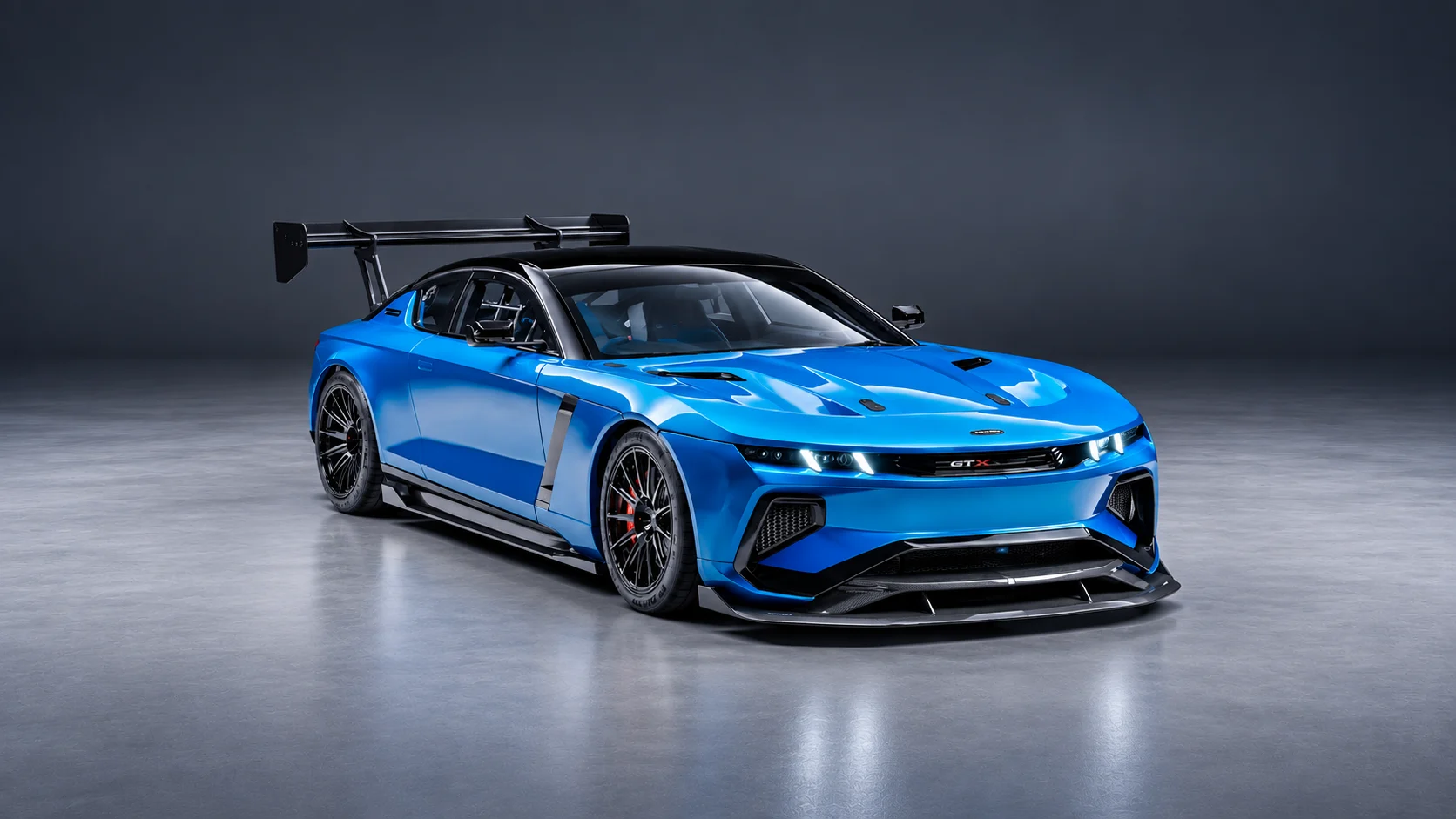
The Jensen Interceptor GTX is the first all-new car to wear the Interceptor badge in almost 50 years, and it arrived in early September 2026 with a supercharged American V8, a massive rear wing, and a plan that runs completely backwards to how most car companies do things. Jensen built the track car first. The road cars come later.
If you grew up loving the fastback Interceptor of the late 1960s, brace yourself. The new Jensen Interceptor GTX shares the name, the long hood, and the attitude, but almost nothing else. Here is a straight, no-hype breakdown of the V8, the specs, the price situation, and what US and Gulf buyers should actually expect.
Jensen Is Back, and It Skipped the Easy Route
Jensen International Automotive (JIA) has spent the last decade or so restoring and modernizing original interceptors out of Oxfordshire in the UK. This is a different move entirely. Instead of another restomod, JIA has built a clean-sheet prototype and used it to announce a full revival of the brand.
Here is the twist that most outlets, from Top Gear to Motor1, latched onto: the Jensen Interceptor GTX is a track-only development car. You can’t register it for the road, and it isn’t homologated to race in any series either. Its job is to be driven hard, tested to failure, and prove out the platform before the street-legal versions arrive.
Managing director David Duerden has described it as the first step in a new era for Jensen, with road cars to follow once the engineering is signed off. A US-based partner, car retailer Jeff Qvale (whose father Kjell was a former Jensen shareholder and a key figure in bringing British sports cars to America), is part of the project, alongside roughly £1.3 million of early investment to get the prototype built.
Jensen Interceptor GTX Design: Same Name, Brand-New Shape
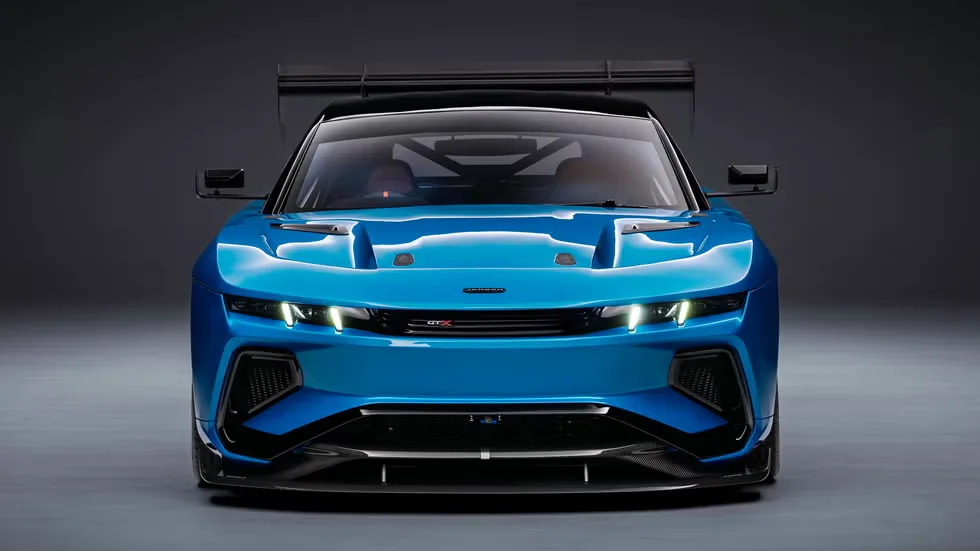
JIA didn’t try to copy the 1966 car. According to Autocar, the designers instead imagined how the Interceptor might look today if Jensen had never stopped building it.
The result keeps a few signatures you’ll recognize:
- A long bonnet and a cabin pushed well back
- A sloping, fastback-style roofline
- A floating C-pillar and a nod to the original’s wraparound rear glass
Then it goes fully modern with a hand-formed aluminum body laid over a bonded aluminum chassis. Several reviewers, including Top Gear, noted the profile looks a lot like the Ford Mustang GTD, which tells you the segment Jensen is aiming at.
The Aero Is the Loud Part
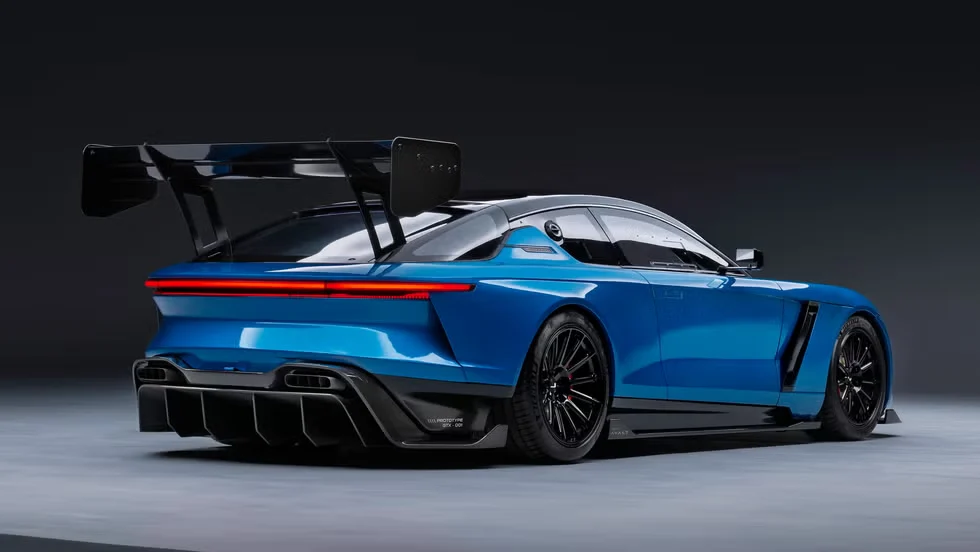
The carbon-fiber aero was developed by British firm Artiglio Automotive Studio, and it’s aggressive:
- A deep front splitter
- A flat floor and a two-stage rear diffuser
- A large, adjustable rear wing that cuts across the rear glass
Together they generate around 350 kg (roughly 771 lb) of downforce. Jensen says about 80% of the Jensen Interceptor GTX exterior form is meant to carry over to the future road cars, so this is a real preview, not just a showpiece. The wing and the most extreme bits will be dialled back for the street.
At roughly 5.2 metres long and 2 metres wide, this is a big two-seater, about the length of a full-size SUV, with a claimed 50/50 weight balance.
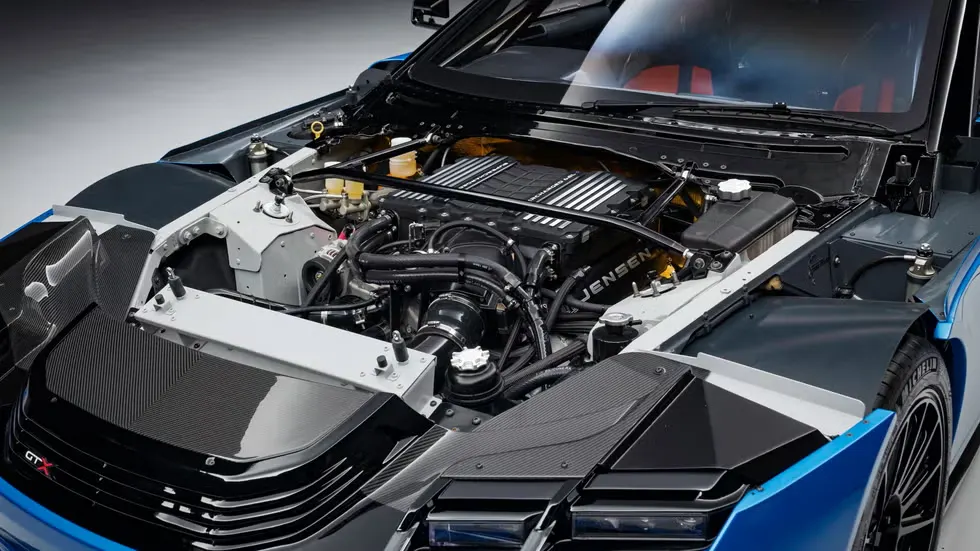
The Jensen Interceptor GTX: A 960-HP Supercharged Small-Block
Here’s where the Jensen Interceptor GTX V8 story gets interesting and a little unexpected. The engine starts life as a General Motors small block (the LS family that powers the Corvette lineage), not the Chrysler V8s the original Interceptor used.
Texas-based Late Model Engines in Houston takes that GM base and rebuilds it almost completely. CarBuzz and TechEBlog report that fewer than 20% of the original components survive the process, which includes:
- Displacement stretched to 6.8 liters
- Forged internals and CNC-machined heads
- Titanium valves, revised valve timing, and direct injection
- A 2.65-liter Roots-type supercharger mounted on top, in plain view
Current output is a stated 960 horsepower (973 PS). Jensen Interceptor GTX adds that the engine can support up to 1,200 hp and more than 1,100 lb-ft of torque, though those bigger numbers are not the GTX’s official figures. Power goes to the rear wheels only, through a six-speed sequential dog-ring transaxle.
Jensen Interceptor GTX Key Specs at a Glance
| Feature | Details |
| Item | Jensen Interceptor GTX |
| Status | Track-only prototype (not road-legal, not race-homologated) |
| Layout | Front engine, rear-wheel drive |
| Engine | GM-based 6.8L supercharged V8 (built by Late Model Engines) |
| Supercharger | 2.65L Roots-type |
| Power | 960 hp (973 PS) |
| Torque | Not officially stated; engine capable of 1,100+ lb-ft |
| Transmission | 6-speed sequential dog-ring transaxle |
| Body / Chassis | Hand-formed aluminum body, bonded aluminum chassis |
| Downforce | ~350 kg (~771 lb) |
| Length / Width | ~5.2 m / ~2.0 m |
| Weight | ~1,650 kg (claimed) |
Note: Jensen has not released official 0–60 mph or top-speed figures. Robb Report specifically pointed out that no performance times have been given, so treat any acceleration numbers you see elsewhere as guesses.
Jensen Interceptor GTX Chassis, Brakes, and Rubber
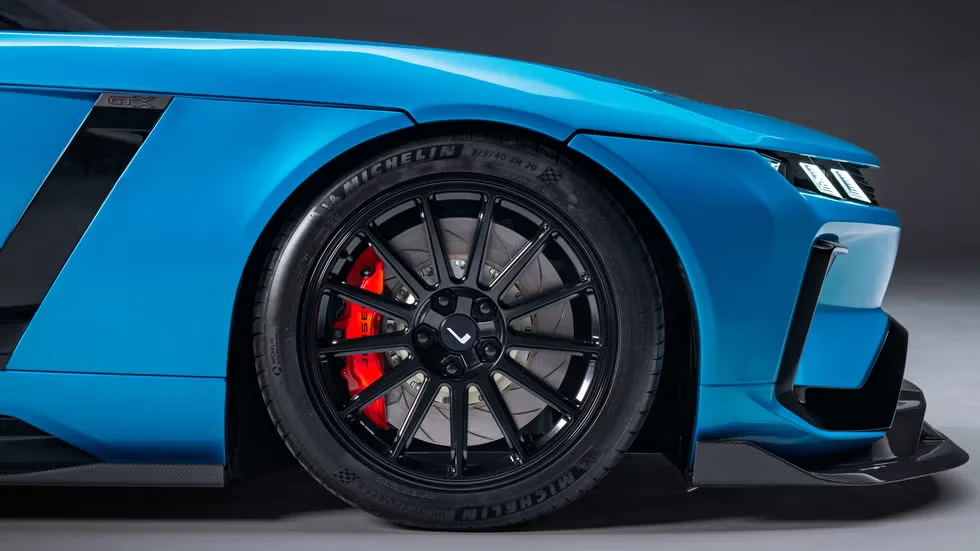
The mechanical package is a proper motorsport kit, sourced from names track-day regulars will know.
- Suspension: Double wishbones at all four corners with Nitron three-way adjustable dampers
- Brakes: An AP Racing steel-disc package (supplied via BG Developments) with six-piston front calipers and four-piston rears
- Wheels: 20-inch forged aluminum Vossen wheels, made specifically for the GTX
- Tyres: Michelin Pilot Sport, 275/40 up front and 345/30 at the rear
The chassis uses some proprietary parts sourced from other manufacturers, a bonded-aluminium approach Jensen notes is also used by the likes of Aston Martin and Lotus. The suspension design, however, is mostly Jensen’s own.
Jensen Interceptor GTX Inside: Built for Laps, Not for Comfort
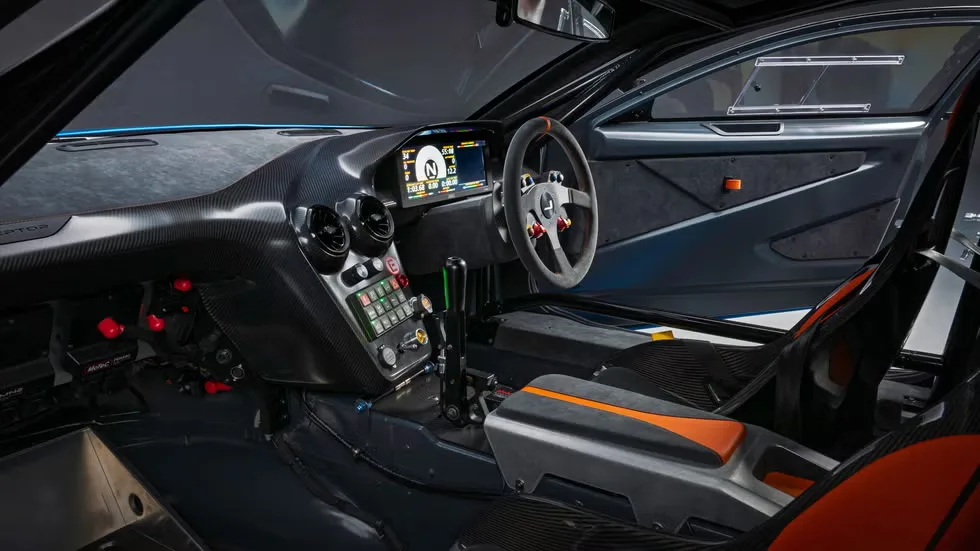
Don’t expect leather and a big touchscreen. The GTX cabin is a race car’s office:
- An FIA-approved roll cage
- Tillett carbon-fiber competition seats with six-point harnesses
- A Lifeline fire-suppression system and a fire extinguisher
- A MoTeC digital display for instrumentation (no big infotainment screen)
- Alcantara trim with orange stitching and polycarbonate windows
It’s a focused, stripped-back space, which makes sense for a car whose entire purpose is durability testing. The luxury cabin arrives later, on the road models.
Jensen Interceptor GTX Price: What’s Real and What’s an Estimate
This is where honesty matters, because there is a lot of guesswork floating around.
Official price: None. Jensen has not published a confirmed price for the GTX.
The working estimate: Multiple UK outlets, including Autocar and CarExpert, report an expected figure of £850,000 to £950,000, depending on final specification. TechEBlog framed the top end at around $1.2 million.
Production is expected to be tiny, with reports suggesting as few as around 15 units, and customer cars aren’t expected before 2028. So the “Jensen Interceptor GTX 2026” you’re reading about is the reveal and the start of testing, not a car you can order and drive this year.
Estimated Price in USD and AED
These are currency conversions of the UK estimate, not local market prices. No official US or Gulf pricing exists yet.
| Market | Figure | Status |
| UK (source estimate) | £850,000 – £950,000 | Reported estimate |
| USA (converted) | ~$1.15M – $1.3M | Unofficial conversion |
| UAE (converted) | ~AED 4.2M – 4.7M | Unofficial conversion |
Conversions use a mid-2026 rate of roughly £1 = $1.34, with AED pegged to the US dollar at about 3.67. Other Gulf currencies (Saudi riyal, Qatari riyal, Kuwaiti dinar, Bahraini dinar, Omani rial) are also dollar-linked, so expect broadly similar dollar-equivalent figures once official pricing lands. Import duties, VAT, and shipping would push the real out-the-door cost higher.
US vs Gulf: Availability and Hot-Weather Notes
Both the United States and the Gulf are obvious targets for a car like this, but the details differ.
United States. The US connection is the strongest signal so far. With Jeff Qvale involved and a GM-based engine built in Texas, the project already has American roots. That said, JIA has not confirmed a US dealer network, homologation plan, or US pricing. And because the GTX is track-only, it wouldn’t need road registration anyway. The street-legal GTR and GT are the models US buyers will eventually care about.
Gulf countries (UAE, Saudi Arabia, Qatar, Kuwait, Bahrain, Oman). There is no official Gulf launch, pricing, or distributor announced yet. Given the region’s appetite for low-volume, high-horsepower machinery, it’s a natural fit, but at this stage any Gulf availability is speculation. Treat it that way.
Hot-weather angle. This is worth flagging honestly. The whole point of building the track car first is durability, and cooling under sustained load is exactly the kind of thing that gets tested. A supercharged 960-hp V8 asked to do repeated hot laps in 45°C Gulf heat is a serious thermal challenge. Jensen’s stated development goal, avoiding the classic British sports-car habit of overheating on track, is directly relevant to Gulf and desert-state buyers. If the road cars land in the region, cooling performance in extreme heat should be near the top of any buyer’s question list.
The Road Cars: Interceptor GTR and GT (2028 and Beyond)
The Jensen Interceptor GTX is a means to an end. Jensen has confirmed two road-going models to follow, and this is where most real-world buyers should focus.
- Interceptor GTR: described by Duerden as a “track-forward road car.” It stays closest to the GTX brief: analogue feel, ultra-high performance, and likely first to market.
- Interceptor GT: the true spiritual successor to the original. A more luxurious, comfort-focused grand tourer positioned against cars like the Aston Martin DB12 and Bentley Continental GT.
A few important points from the launch coverage:
- The road cars are expected to gain four seats and four doors, in a shape Autocar likened to the Aston Martin Rapide.
- They’ll swap the GTX’s sequential race gearbox for more usable transmissions, reportedly including an H-pattern manual and a full automatic. A Tremec dual-clutch unit (the type used in the C8 Corvette and Mustang GTD) has been mentioned as an option.
- Pricing is unconfirmed, but MotorTrend’s reporting (via Yahoo) suggested the fully trimmed road versions could sit north of $2 million.
Timelines for the GTR and GT haven’t been locked in, and JIA has been clear that each stage will only proceed once it’s properly funded. In other words, this is a “watch this space” project, not a done deal.
Pros and Cons
Pros
- Genuine 960-hp supercharged V8 with clear headroom for more
- Serious, name-brand motorsport hardware (AP Racing, Nitron, Michelin, Tillett)
- Handsome, modern take on an icon, with real road-car intentions behind it
- Extremely exclusive, with production reportedly around 15 units
- A US partner and US-built engine suggest America is firmly on the radar
Cons
- Not road-legal and not race-homologated, so its use case is narrow
- No official pricing, and estimates already reach seven figures
- No confirmed US or Gulf availability, dealer, or service network
- Customer cars aren’t expected before 2028
- No official performance figures released at launch
How the Jensen Interceptor GTX Compares
The Jensen Interceptor GTX itself is a track-only oddity, so a direct rival table is tricky. But the road cars it previews will land against established grand tourers and track-focused specials. Here’s the competitive landscape Jensen is aiming at.
| Model | Rough Positioning | Powertrain Style |
| Jensen Interceptor GTX | Track-only prototype / halo | 960-hp supercharged V8, RWD |
| Aston Martin DB12 | Luxury GT (road) | Twin-turbo V8 |
| Bentley Continental GT | Luxury GT (road) | Hybrid V8 |
| Ford Mustang GTD | Track-focused road car | Supercharged V8 |
| Aston Martin Rapide (as a shape reference) | Four-door GT | V-configuration engines |
The eventual Interceptor GT is the one squarely chasing the DB12 and Continental GT crowd, while the GTR leans toward the Mustang GTD end of the spectrum.
Jensen Interceptor GTX Ownership: What to Realistically Expect
Because the GTX is a track-only, ultra-low-volume car, ownership will look nothing like buying a normal performance coupe.
- Buying process: Expect a direct, bespoke relationship with Jensen rather than a showroom purchase. JIA has said it wants to work closely with customers as development continues.
- Usage: Track days and private circuits only. No plates, no public roads.
- Servicing: With hand-built construction and race-grade components, maintenance will be specialist work, not something for a local garage.
- Running costs: A supercharged 6.8-litre V8 driven on track burns fuel, tyres, and brake material quickly. Michelin Pilot Sport rubber and AP Racing pads aren’t cheap.
- Value: With production reportedly capped near 15 units, scarcity could support strong values, but track-only cars are a niche market. Nothing is guaranteed.
For most enthusiasts in the US and the Gulf, the smarter play is to wait for the road-legal GTR or GT, which will actually be usable and, per Jensen, more attainable than the GTX.
Final Verdict: Who the Interceptor GTX Is For
The Jensen Interceptor GTX is not a car most people should be waiting to buy. It’s a track-only halo built to prove a point, and it does that well: 960 hp, serious aero, real motorsport hardware, and a modern shape that respects the original without copying it.
If you’re a collector with deep pockets, a private circuit, and a taste for the rare and the loud, the GTX is a compelling, ultra-exclusive statement piece, assuming you’re comfortable with a seven-figure estimate and a 2028-ish timeline.
For everyone else in the US and the Gulf, the real story is what comes next. The road-legal GTR and GT are the models worth tracking. They promise the same V8 character with usable transmissions, four seats, and grand-touring comfort, at what Jensen says will be a more accessible price than the GTX.
Bottom line: the new Jensen Interceptor GTX is proof the brand is serious again. Watch it closely, but keep your order form ready for the road cars.
Sources referenced for this article include Top Gear, Autocar, Motor1, CarBuzz, Robb Report, MotorTrend (via Yahoo Autos), CarExpert, DailyRevs, and Wikipedia. Specifications, prices, and availability were accurate at the time of writing (September 2026) and are subject to change as Jensen’s development program continues. Estimated prices and currency conversions are clearly marked and are not official figures.
People Also Ask
- Is the Jensen Interceptor GTX road legal? No. It’s a track-only prototype and can’t be registered for public roads.
- Can you race the Interceptor GTX? Not officially. It isn’t homologated for any race series, so it’s built for track use rather than competition.
- What engine does the new Jensen Interceptor GTX use? A GM-based 6.8-litre supercharged V8, heavily rebuilt by Late Model Engines in Texas, making 960 hp.
- When can you buy a Jensen Interceptor? Customer GTX cars aren’t expected before 2028, and the road-going GTR and GT will come after that.
- Is the new Interceptor related to the original? Only in spirit and styling cues. It’s a clean-sheet car, not a restored or modified classic.
FAQs
Q. How much does the Jensen Interceptor GTX cost in the US and the Gulf?
A. There’s no official US or Gulf price yet. The reported UK estimate is £850,000 to £950,000, which converts to roughly $1.15M–$1.3M or about AED 4.2M–4.7M. Those are currency conversions of an estimate, not confirmed local pricing, and taxes and import costs would add to them.
Q. Will the Jensen Interceptor GTX be sold in the UAE, Saudi Arabia, or other Gulf countries?
A. Nothing has been confirmed. Jensen hasn’t announced a Gulf distributor, pricing, or availability. The region is a logical market for a car like this, but at launch it remains speculation.
Q. How powerful is the Jensen Interceptor GTX V8?
A. The V8 produces a stated 960 hp (973 PS). Jensen says the engine can handle up to 1,200 hp and more than 1,100 lb-ft of torque, though those higher figures aren’t the car’s official output.
Q. Is the new Jensen Interceptor GTX good in hot climates like the Gulf?
A. Cooling is a core focus of the track-first development program, which is directly relevant to Gulf heat. Jensen hasn’t published hot-weather test data yet, so buyers in the region should ask specifically about sustained-load cooling before committing to any future road version.
Q. What’s the difference between the GTX, GTR, and GT?
A. The GTX is the track-only prototype. The GTR will be a street-legal, track-focused road car with an analogue feel. The GT will be the luxury grand tourer, the closest in spirit to the original Interceptor, aimed at the Aston Martin DB12 and Bentley Continental GT.