
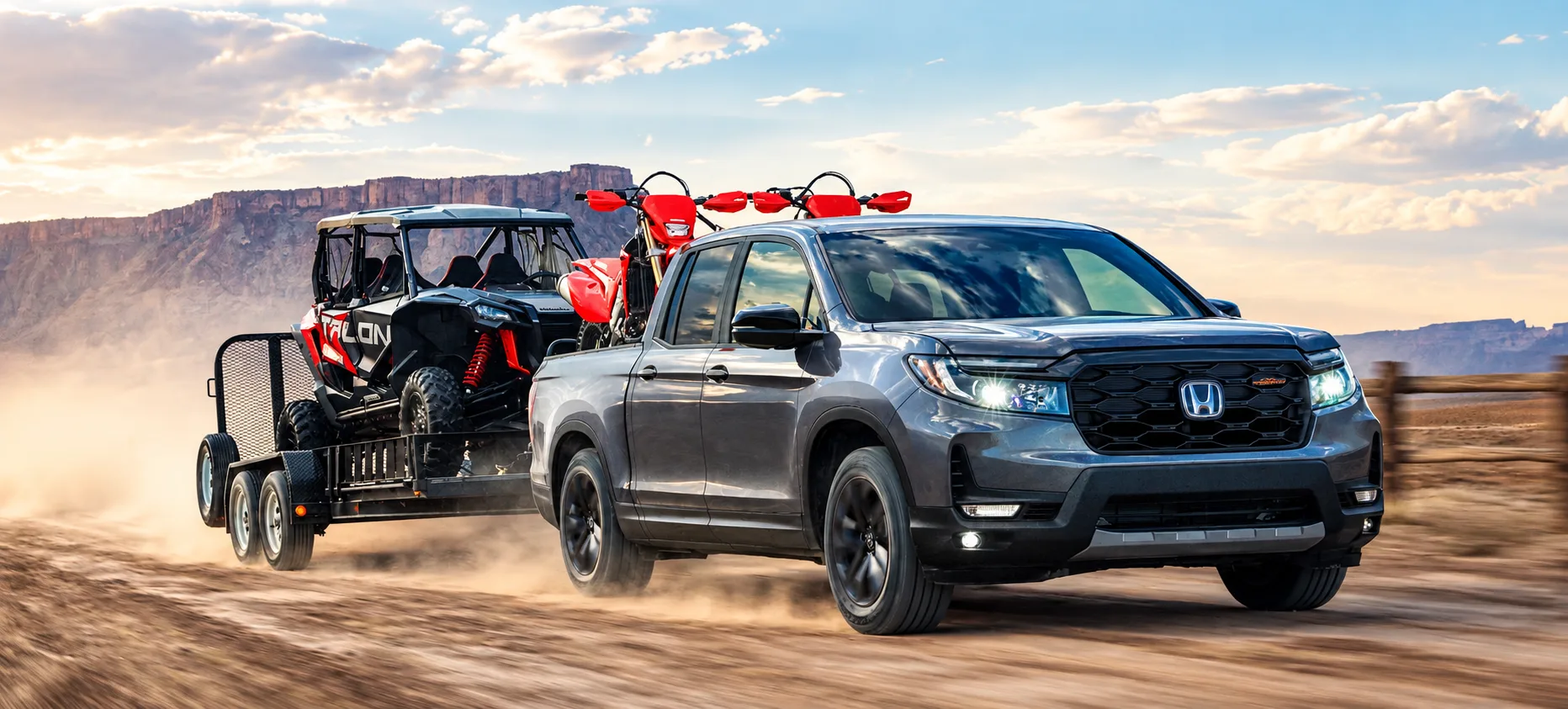
If you want a midsize pickup that drives like a comfortable SUV and skips the truck compromises most people never asked for, the 2026 Honda Ridgeline is the shortcut. It starts around $40,795 in the US, uses a single 280-horsepower V6 across the whole lineup, and comes only as a four-door crew cab with standard all-wheel drive. No stripped-out work-truck version, no confusing engine menu, no rear-wheel-drive base model. You pick a trim, a color, and you’re done.
That simplicity is the whole pitch. It’s also why the Ridgeline splits opinion. Traditional truck buyers see the unibody body (the cab and bed are one piece, car-style) and dismiss it. Families and weekend project people buy it and rarely go back to a body-on-frame rig.
Below is what the 2026 model offers, what it costs in the US and roughly what it lands for in the Gulf, how the trims differ, and the real-world quirks owners keep flagging so you can decide before you sign anything.
2026 Honda Ridgeline at a glance
| Spec | Detail |
| Body style | Crew cab, four-door, unibody |
| Engine | 3.5L V6, naturally aspirated |
| Power | 280 hp @ 6,000 rpm |
| Torque | 262 lb-ft |
| Transmission | 9-speed automatic |
| Drivetrain | Standard i-VTM4 all-wheel drive |
| Towing | Up to 5,000 lbs (Class III hitch standard) |
| Payload | Around 1,544 lbs |
| Bed length | 5 feet 4 inches |
| Fuel economy | 21 mpg combined (20 mpg TrailSport) |
| Fuel tank | 19.5 gallons |
| US starting price | About $40,795 (Sport) |
What’s new for 2026
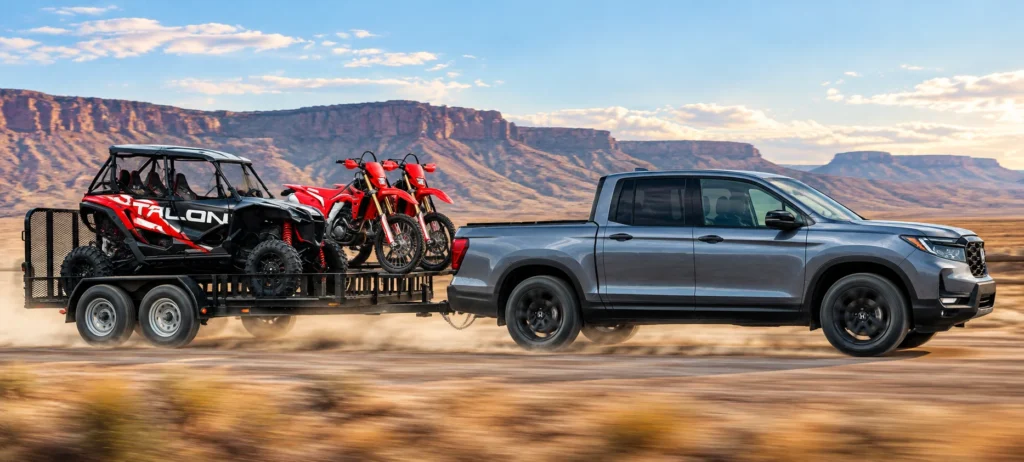
Honda didn’t reinvent the Ridgeline this year, and that’s fine. The bones carry over from the refreshed second generation, so you get the blockier front end, the wider grille, and the tougher stance that arrived with the recent update.
The two changes worth knowing:
- The TrailSport picks up an exclusive Ash Green Metallic paint, a color that suits the truck’s rugged trim far better than the usual grays.
- The Black Edition now offers a contrasting black roof in a two-tone version when paired with certain body colors, which pushes it into a more premium, styled look.
If you were hoping for a 2027 Honda Ridgeline redesign or a Honda Ridgeline Hybrid, neither has been confirmed. Honda offers hybrid power in the CR-V, Accord, and elsewhere, but the Ridgeline stays gas-only V6 for now. Treat any 2027 rumor you see as speculation until Honda says otherwise.
Design: an SUV that grew a bed
Park a Ridgeline next to a Toyota Tacoma and the difference is obvious. The Ridgeline sits lower, its lines are cleaner, and the bed flows into the cab instead of bolting on as a separate box. Some people love that. Some people want the classic truck silhouette. You’ll know which camp you’re in the moment you see one in person.
The practical payoff shows up when you use the thing. The bed sits lower than most midsize rivals, so loading a heavy cooler, a mini fridge, or bags of soil doesn’t turn into a shoulder workout. The dual-action tailgate either drops down like a normal tailgate or swings open sideways, which makes reaching into the bed much easier when you’re parked tight against a wall.
Then there’s the party trick: the lockable In-Bed Trunk. It’s a weatherproof, drainable storage well built into the floor of the bed, big enough for tools, wet gear, groceries, or a couple of bags of ice for a tailgate. No other mainstream midsize pickup gives you secure, hidden, drainable storage like this as standard equipment. During research, this is the feature owners bring up first when explaining why they’d buy another one.
Interior and practicality
Inside, the Ridgeline feels closer to a Honda Passport SUV than a work truck. The dashboard is clean, the buttons are where your hand expects them, and the rear seat is roomy enough for adults on long drives instead of the folding-jump-seat treatment some rivals give you.
The rear seat bottoms flip up to reveal a flat load floor, so you can stand tall items or hide valuables inside the cabin. Total interior space runs around 109 cubic feet. Higher trims add leather-trimmed seats, a moonroof, wireless phone charging, ventilated front seats, heated rear seats, and a premium audio system.
The one honest gripe: the infotainment screen. Owners on the Ridgeline Owners Club forum have long flagged that it can feel quirky, and some report the display pixelating. It works, but it’s not the sharpest system in the class.
Engine and performance
Every 2026 Honda Ridgeline runs the same 3.5-liter V6 making 280 hp and 262 lb-ft of torque, paired with a 9-speed automatic and Honda’s i-VTM4 all-wheel-drive system. There’s no turbo four-cylinder, no diesel, no hybrid. One engine, tuned the same way, across Sport, RTL, TrailSport, and Black Edition.
On the road this powertrain is smooth and quiet. The V6 pulls cleanly, the transmission shifts without drama, and highway cruising is relaxed. It runs on regular unleaded, which owners appreciate given how many powerful engines now demand premium.
The i-VTM4 system deserves a mention because it does more than most part-time truck 4WD setups. It can shuffle torque between the rear wheels (called torque vectoring), which helps the Ridgeline feel planted in corners and confident in rain, snow, or loose sand. It’s not built for hardcore rock crawling, but for the driving 95% of buyers do, it works better than a basic 4WD system that only kicks in when you flip a switch.
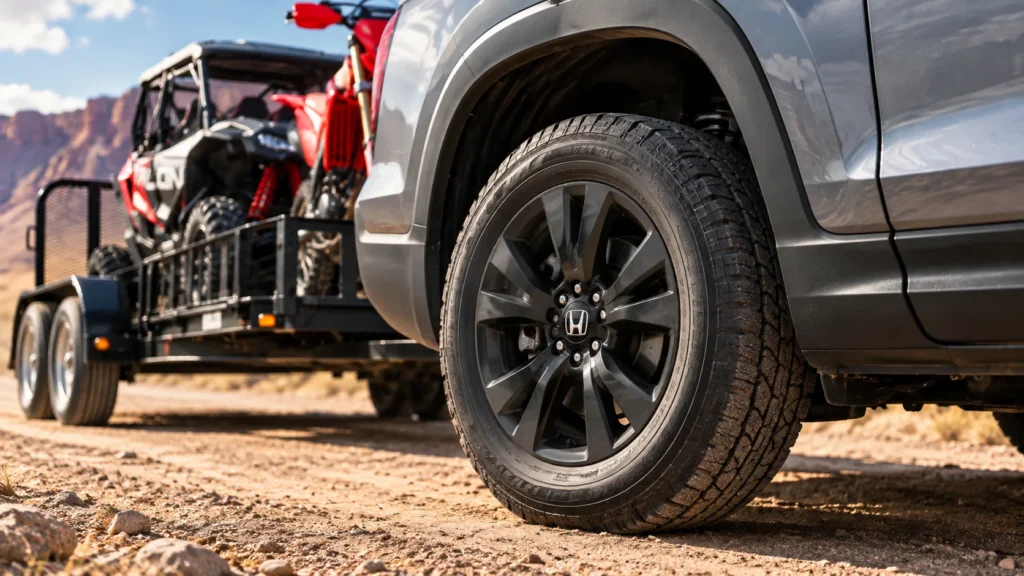
The TrailSport adds all-terrain tires and an off-road-tuned suspension as standard, so it’s the one to get if you’ll spend real time on dirt, gravel, or unpaved trails. Know that the off-road hardware trims the fuel economy slightly and doesn’t turn the Ridgeline into a Wrangler.
Towing and payload
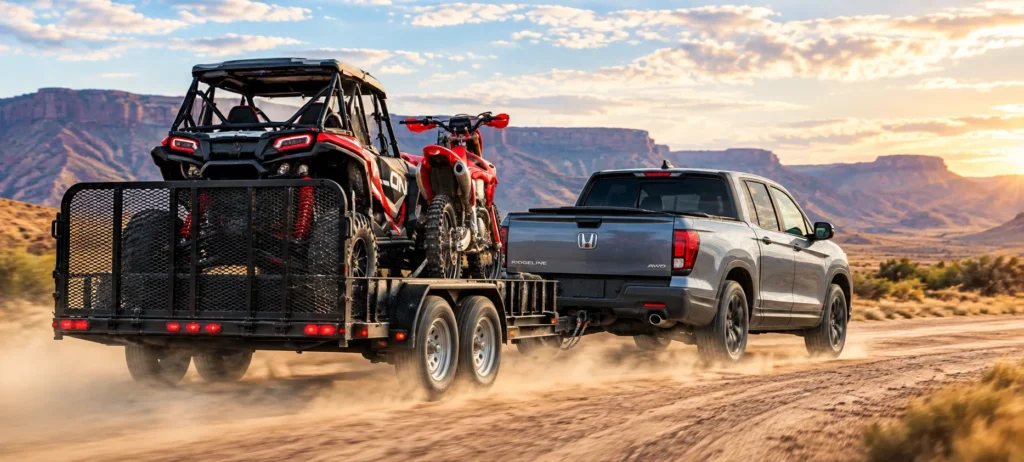
Here’s where you need to be realistic. The 2026 Honda Ridgeline towing capacity tops out at 5,000 pounds with the standard Class III hitch. That’s enough for a small boat, a pair of jet skis, a light utility trailer, or a compact camper.
It is not enough if you’re regularly hauling a big travel trailer or a car hauler. A Toyota Tacoma or Chevrolet Colorado will tow closer to 6,000 to 7,700 pounds depending on setup, so heavy-tow buyers should shop those instead. The Ridgeline’s payload of roughly 1,544 pounds is competitive, though, and for people whose “towing” means a jet ski on weekends, 5,000 pounds is plenty.
One overlooked upside: because the Ridgeline drives like a car, towing within its limit feels far more stable and less nervous than in a tall body-on-frame truck. You notice it most in crosswinds and on long highway pulls.
Fuel economy and range
The 3.5L V6 was never going to sip fuel, and it doesn’t. But the numbers are fair for the segment:
| Trim | City | Highway | Combined |
| Sport, RTL, Black Edition | 18 mpg | 24 mpg | 21 mpg |
| TrailSport | 18 mpg | 23 mpg | 20 mpg |
Real owners report averaging 19 to 21 mpg in mixed driving, which lines up with the EPA figures rather than beating or badly missing them. With the 19.5-gallon tank and a 21 mpg combined average, you’re looking at roughly 400 miles of range between fill-ups. Useful for long Gulf highway runs or American road trips.
If maximum fuel economy is your priority, the Ridgeline isn’t your truck. A Ford Maverick hybrid rates around 37 mpg combined. But the Maverick is smaller, tows less, and can’t match the Ridgeline’s bed features or interior space. Different tools for different jobs.
Technology and safety
Every 2026 Ridgeline comes with Honda Sensing, the brand’s suite of driver-assist features. The standard kit across the range includes:
- Adaptive cruise control
- Lane keeping assist and lane departure warning
- Forward collision warning with automatic emergency braking
- Blind-spot monitoring
- Rear cross-traffic alert
Higher trims add front and rear parking sensors, a wider camera view, and more convenience tech like the wireless charger and upgraded audio.
Two honest notes from owners. First, the adaptive cruise can lag when a slower car pulls in front, taking a beat too long before slowing or resuming speed. Second, some drivers in cold climates report the front-facing driver-assist sensors switching off when there’s snow, ice, or heavy grime on the sensor. Neither is a dealbreaker, and the second one matters far less to Gulf buyers than to someone in a Michigan winter.
The Gulf market reality: read this before you shop
This is the part most articles skip, and it’s the most important section for readers in the UAE, Saudi Arabia, Qatar, Kuwait, Bahrain, and Oman.
Honda does not officially sell the Ridgeline in the Gulf. Look at Honda’s Middle East lineup and you’ll find the City, Civic, Civic Type R, Accord, HR-V, ZR-V, CR-V, and Odyssey. No Ridgeline. Honda has never positioned this truck for the region, the same way it keeps the Passport and the US-market Odyssey out of most Gulf showrooms.
So how do you see Ridgelines listed for sale in Dubai or Riyadh? They’re grey-market US imports, brought in privately or by independent dealers, sold used or as low-mileage American-spec trucks. That has real consequences you should weigh:
- No official AED price and no manufacturer warranty. You’re buying a vehicle; Honda’s regional arm doesn’t back. Any warranty comes from the importing dealer, if at all.
- Parts and service. Honda’s Gulf dealers aren’t set up around the Ridgeline. Common items are shared with other Honda V6 models, but body panels, the in-bed trunk hardware, and trim pieces can mean waiting on US shipments.
- Spec differences. US-spec trucks are tuned for US fuel and conditions. They’ll run fine in the Gulf, but they weren’t validated for sustained 45-plus-degree summers the way region-specific models are, so cooling and battery care matter more.
What it costs in the Gulf (estimates only)
Because there’s no official Gulf price, the fairest reference point is the US MSRP converted at the fixed peg (1 USD is about 3.6725 AED). These are conversion estimates, not official prices, and real landed costs run higher once you add shipping, roughly 5% customs, and registration.
| Trim | US MSRP | AED conversion (estimate) |
| Sport | $40,795 | ~AED 149,800 |
| RTL | $43,595 | ~AED 160,100 |
| TrailSport | $45,995 | ~AED 168,900 |
| Black Edition | $47,395 | ~AED 174,100 |
| Black Edition Two-Tone | $47,895 | ~AED 175,900 |
Treat any specific AED figure you see on a UAE classifieds site as the importer’s asking price, not a Honda price. Always verify the final drive-away cost, the import paperwork, and whatever warranty is on offer before you commit.
Hot-weather ownership tips for the region
If you do import one, a few things pay off in Gulf heat:
- Park in shade or use a windshield sunshade. The Ridgeline’s large glass area heats the cabin fast.
- Check the AC performance on a test drive during the day, not the evening. US-spec cooling handles the Gulf but has less margin.
- Watch the battery. Extreme heat kills car batteries faster here than almost anywhere, and a US import won’t have region-hardened components.
- Confirm the tires. All-terrain rubber on a TrailSport wears differently on hot asphalt than on US roads.
Pros and cons
What the Ridgeline does well:
- Rides and handles like a comfortable SUV, not a stiff truck
- Standard AWD with genuine torque vectoring
- The In-Bed Trunk and dual-action tailgate are class-leading practicality
- Roomy, quiet cabin with a usable rear seat
- Runs on regular fuel and returns fair mileage for a V6
- Strong Honda reliability reputation and good resale in the US
Where it falls short:
- 5,000-lb tow rating trails most body-on-frame midsize rivals
- Only one engine, no hybrid, no fuel-economy champion option
- Infotainment feels dated and can be glitchy
- Adaptive cruise and cold-weather sensor quirks
- Not officially sold or warrantied in the Gulf
How it compares to rivals
If you’re cross-shopping the 2026 Ridgeline, three trucks come up most often.
Toyota Tacoma. The segment’s bestseller. Tougher image, higher tow ratings, more aftermarket support, and a hybrid option. But it rides firmer, and its interior isn’t as family-friendly. Choose the Tacoma if resale, off-road credibility, and towing matter most.
Chevrolet Colorado. Strong turbo engine, competitive towing, and a modern cabin. It’s a more conventional truck than the Ridgeline and tows more, but you give up the unibody ride comfort and the clever bed storage.
Ford Maverick. Smaller, cheaper, and available as a hybrid rated around 37 mpg combined. Great for city buyers and light hauling, but it’s a size down and can’t match the Ridgeline’s space or bed features.
Honda Passport. Worth a look if you don’t need a bed at all. It’s the Ridgeline’s SUV sibling, sharing much of the platform and V6, with more enclosed cargo room instead of an open bed.
The short version: the Ridgeline wins on comfort, daily livability, and bed cleverness. It loses on outright towing and rugged-truck image.
Reliability and ownership costs
The Ridgeline carries Honda’s reputation for reliability, and the mechanical core (the V6 and the 9-speed ZF-sourced automatic) has proven dependable. Owners routinely cross 100,000 miles with basic maintenance. Running on regular fuel keeps costs down, and most repairs owners report fall under $100 in parts.
A few second-generation issues are worth knowing about so you can inspect for them, especially on a used or imported truck:
- Cab water leaks. Some Gen 2 owners have reported water entering the rear cab floor through body-panel seams that weren’t sealed well at the factory. Check the rear carpet for dampness on any used example.
- Wind noise and window seals. A handful of owners flag wind noise around the doors and faulty window gaskets. Listen for it at highway speed on a test drive.
- Rear seat support brace. There’s a known service bulletin about a rear seat brace that doesn’t retract properly. Fold the rear seats up and down to confirm they operate cleanly.
- Common wear items. Across all years, owners most often replace stabilizer-bar links and bushings, CV boots, and radiators as the truck ages. These are normal for a high-mileage vehicle, not signs of a weak design.
For US buyers, factory warranty and a strong dealer network make ownership straightforward. For Gulf buyers, budget for the reality that these fixes may need an independent workshop and imported parts, since the truck isn’t in Honda’s regional service ecosystem.
Who should buy the 2026 Honda Ridgeline?
Buy it if you want a pickup that behaves like a family SUV six days a week and hauls or tows within reason on the seventh. It’s ideal for homeowners tackling projects, outdoor weekend types with a boat or bikes, and anyone who’s tired of body-on-frame truck harshness but still wants a real bed.
Skip it if you tow heavy trailers, want serious off-road hardware, or need maximum fuel economy. And if you’re in the Gulf, go in clear-eyed: this is a US-market truck you’ll import, without official Honda backing, so the value only makes sense if you love what it offers and accept the ownership trade-offs.
Final verdict
The 2026 Honda Ridgeline is the smartest midsize pickup for people who value comfort and everyday usability over towing bragging rights. The single-engine, single-body lineup keeps buying simple; the in-bed trunk and dual-action tailgate are the best practical features in the class, and the SUV-like ride makes it a pleasant daily driver. Its ceiling is the 5,000-pound tow rating and the dated infotainment, so heavy-duty buyers should look elsewhere.
For US buyers, it’s an easy recommendation in the RTL or Black Edition trim. For Gulf buyers, it’s a niche import you choose with your eyes open, weighing the lack of official support against a truck that does daily life better than almost anything with a bed.
Frequently asked questions
Q. Is the 2026 Honda Ridgeline a real truck if it’s built like a car?
A. Yes. It has a proper bed, tows up to 5,000 pounds, and carries around 1,544 pounds of payload. The unibody construction changes how it rides and handles, making it smoother than body-on-frame rivals, but it still does normal truck jobs within its limits.
Q. How much does the 2026 Honda Ridgeline cost?
A. In the US, it starts around $40,795 for the Sport and climbs to roughly $47,895 for the Black Edition Two-Tone. There’s no official Gulf price because Honda doesn’t sell it in the region. Converted to AED at the fixed peg, US prices fall roughly between AED 149,800 and AED 175,900 before import costs.
Q. What is the Honda Ridgeline’s towing capacity?
A. Up to 5,000 pounds with the standard Class III hitch, across all trims. That covers a small boat, jet skis, or a light camper. For heavier towing, look at the Toyota Tacoma or Chevrolet Colorado.
Q. Does the Honda Ridgeline come as a hybrid?
A. No. For 2026 the Ridgeline uses only a 3.5L V6 with a 9-speed automatic. Honda has not confirmed a Honda Ridgeline Hybrid or a redesigned 2027 model, so any hybrid claim is speculation for now.
Q. Can I buy a new Honda Ridgeline in the UAE or Saudi Arabia?
A. Not through official Honda dealers. The Ridgelines you see for sale in the Gulf are grey-market US imports, sold privately or by independent dealers, usually without a manufacturer warranty. Verify the warranty, service plan, and import paperwork before buying.