The Tesla Cybercab has moved from a stage prop to a real vehicle rolling off a real production line. What started as a concept reveal at Tesla’s “We, Robot” event in October 2024 is now a working robotaxi carrying paying passengers around Austin, Texas. For anyone shopping for their next EV, watching Tesla’s robotaxi bet, or simply curious whether a car with no steering wheel can actually work on public roads, here is where the Tesla Cybercab stands as of September 2026, production status, interior, range, and what it might eventually cost in the US and the Gulf.
This guide breaks down the Tesla Cybercab design, interior, powertrain, safety story, and pricing outlook, and compares what’s confirmed against what’s still speculation. If a number or feature below isn’t official yet, we’ve labeled it clearly.
What Is the Tesla Cybercab?
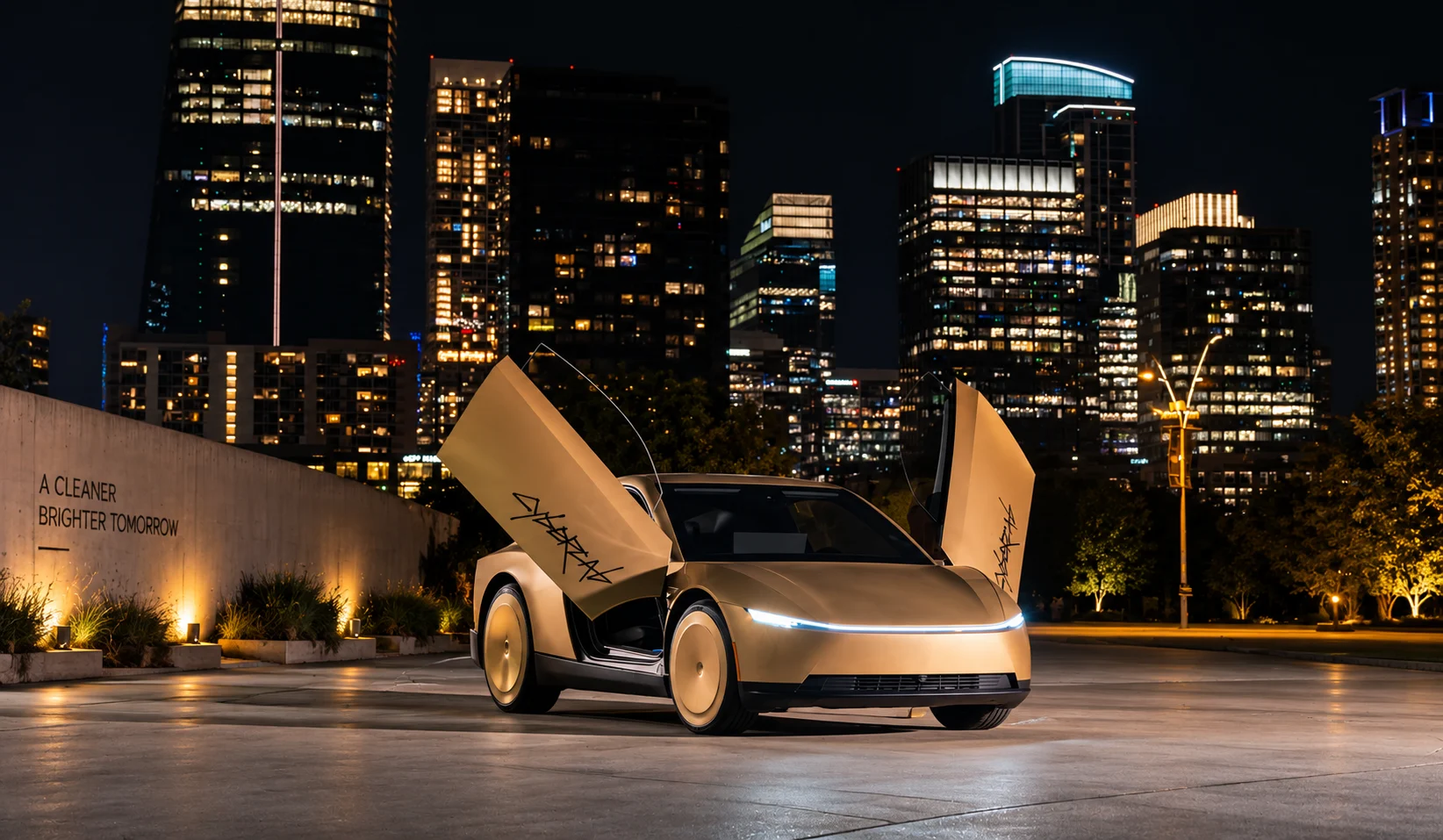
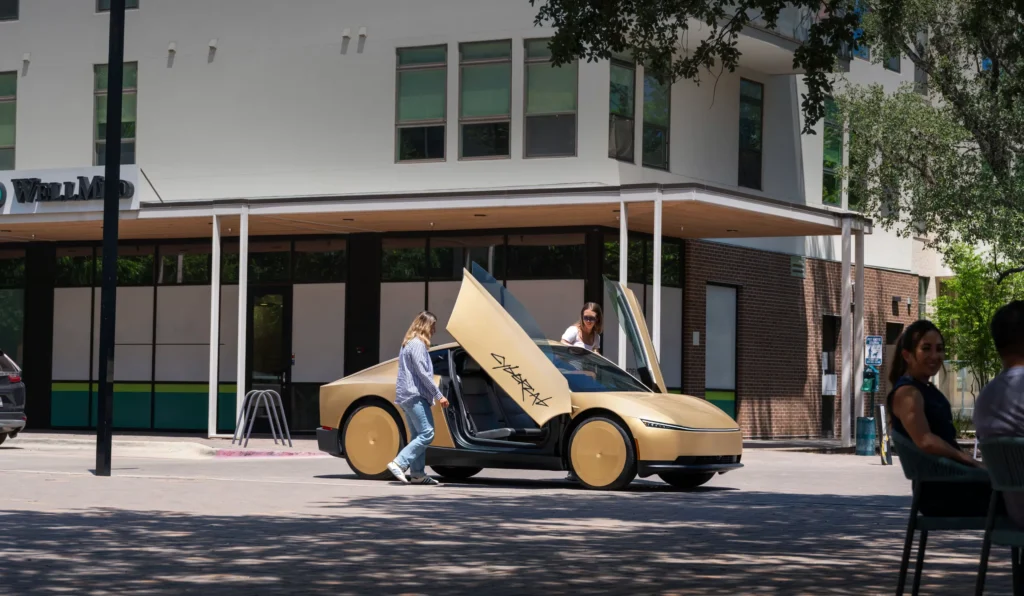
The Tesla Cybercab is a two-passenger, battery-electric robotaxi built specifically for autonomous ride-hailing, not for private ownership in the traditional sense, at least not yet. Designed under Tesla chief designer Franz von Holzhausen, it’s a two-door liftback coupe with scissor-style doors, no side mirrors, and, most notably, no steering wheel or pedals.
Unlike a modified Model Y or Model 3 running Tesla’s current Full Self-Driving (Supervised) system, the Cybercab is purpose-built from the ground up for full autonomy. Tesla’s plan is for it to eventually replace a large share of the Model Y fleet as the company’s highest-volume vehicle, according to the automaker’s own investor commentary.
Quick facts about the new Tesla Cybercab:
- Body style: Two-door, two-seat liftback coupe
- Doors: Scissor-style, lift upward
- Driving controls: None, no steering wheel, no pedals, no rearview mirrors
- Assembly plant: Gigafactory Texas, Austin
- First production unit: Rolled off the line on February 17, 2026
- Current use: Tesla’s own robotaxi fleet in Austin, Dallas, and Houston
- Consumer sales: Not yet open; targeted for 2027
Tesla Cybercab Design and Exterior
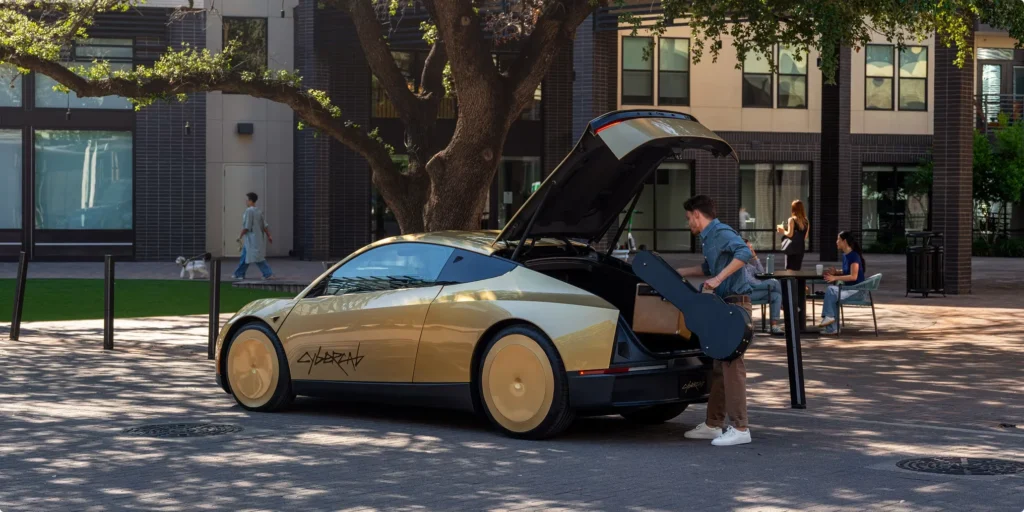
The Tesla Cybercab exterior draws visual DNA from the Cybertruck: flat surfaces, sharp creases, and a low, wedge-like stance, but in a much smaller, friendlier package. Tesla ditched conventional door mirrors entirely, relying on cameras instead, and the car uses a single-piece front fascia with no traditional grille, since there’s no engine to cool the way a gas car would need.
Because the Tesla Cybercab was never meant to be driven by a person, the exterior proportions look different from a normal coupe. The cabin sits closer to the center of the wheelbase, and there’s no long hood housing an engine bay or driver-focused cockpit.
Tesla Cybercab Robotaxi in Different Colors
Early test units spotted around Giga Texas and on public roads in Austin and Silicon Valley have appeared in Tesla’s usual palette, white, black, and silver, but spy shots have also caught a gold Tesla Cybercab test unit, along with matte and satin wrap variations used for durability and camera-visibility testing. Tesla hasn’t published an official color lineup or configurator for retail buyers, so treat any color chart you see online as unconfirmed until Tesla opens ordering.
Tesla Cybercab Interior: No Steering Wheel, No Pedals
The Tesla Cybercab interior is where the design philosophy really shows. With no steering column, pedal box, or driver-focused dashboard to package around, Tesla reclaimed that space entirely for passengers. Reviewers who sat inside the vehicle at its European tour and at the U.S. Department of Transportation’s National Autonomous Vehicle Safety Forum in Washington, D.C., described a cabin that feels closer to a small lounge than a traditional car interior.
Key interior details confirmed on the production version:
- A single large center display, reportedly close to 21 inches, roughly 25% bigger than the screen in a current Model 3/Model Y, that handles trip status, climate, entertainment, and safety information since there’s no driver interface to compete with it.
- Flat, horizontal dashboard design language consistent with other current Teslas.
- Expanded front legroom, since there’s no steering rack or pedal assembly eating into footwell space.
- A trunk-mounted camera, likely there for rear-approach detection during pickups, drop-offs, and reversing.
- Personalized profiles that carry over a rider’s climate and media preferences across trips, similar to how Tesla profiles already work in the Model 3 and Model Y.
- Floor space designed to accommodate service animals, according to observers at the DOT showcase.
If you’re wondering what the Tesla Cybercab interior with no steering wheel actually feels like day to day, the honest answer from early hands-on impressions is: spacious, minimal, and clearly built around the assumption that you’re a passenger, not a driver, from the moment you climb in.
Will the Cybercab Ever Get a Steering Wheel?
Possibly, but only if regulators force the issue. Tesla Chair Robyn Denholm has said publicly that if a jurisdiction requires a steering wheel and pedals, Tesla can add them. Automotive spy photographers have also photographed Cybercab test mules running with conventional steering wheels and pedals on test tracks, which suggests Tesla is keeping an engineering fallback in its back pocket even while marketing the car as fully control-free.
Tesla Cybercab Powertrain, Performance & Range
Tesla and EPA filings from mid-2026 have confirmed several core specifications for the production Cybercab:
| Spec | Detail |
| Motor | Single AC permanent magnet synchronous motor, front-mounted |
| Drive layout | Front-motor, front-wheel drive |
| Power output | Approximately 219 hp (163 kW) |
| Battery | ~48 kWh lithium-ion pack |
| EPA-cited range | ~293 miles (adjusted real-world estimate; up to 418 miles raw laboratory test) |
| Curb weight | 3,113 lb (1,412 kg) |
| Seating | 2 passengers |
| Charging | Inductive wireless charging pads: early prototypes carry an NACS port for Supercharger use during early rollout |
The Tesla Cybercab range figures floating around online vary depending on the source and testing method, so don’t be surprised to see different numbers on different sites. What’s consistent across reporting is that Tesla designed the car around a small, efficient pack rather than chasing maximum range, since robotaxis spend most of their life doing short urban trips with frequent access to charging infrastructure rather than long highway hauls.
The wireless charging setup is notable. Tesla’s long-term plan is for Cybercabs to return to depots or curbside pads and charge without a human plugging in a cable, a detail that matters for hot climates like the Gulf, where automated, hands-free charging removes one more task from outdoor maintenance work.
Tesla Cybercab Production Timeline 2026
Here’s how the Tesla Cybercab production timeline has actually played out, based on Tesla’s own investor filings and independent reporting from outlets like Electrek, Teslarati, and the Wikipedia production log:
| Date | Milestone |
| October 2024 | Cybercab concept unveiled at “We, Robot” event |
| November 2025 | Elon Musk tells shareholders production will begin Q2 2026 |
| February 17, 2026 | First production Cybercab unit built at Gigafactory Texas |
| March 2026 | Test units spotted on public roads in Austin and Silicon Valley; roughly 25 units seen at Giga Texas |
| April 2026 | Continuous, volume-oriented production begins; Musk describes early output as “agonizingly slow” before ramping |
| July 2026 | Over 100 Cybercab units spotted across 40+ testing cities |
| September 3, 2026 | Tesla begins limited commercial deployment of Cybercab robotaxi rides in Austin |
| Targeted for 2027 | Private consumer sales expected to open |
So, is the Tesla Cybercab production status in April 2026 the same as “on sale”? No. April 2026 marked the shift from pilot-scale to continuous production for Tesla’s own fleet, not the start of retail deliveries to private buyers. As of this writing, all Cybercabs built are going into Tesla’s own ride-hailing network, not into customer driveways.
It’s also worth noting that Tesla’s second-quarter 2026 shareholder letter quietly dropped the phrase “volume production” when referring to the Cybercab after citing 4680 battery cell capacity as the main constraint on ramping output. That’s a meaningfully softer tone than the company’s Q1 letter, so expect the ramp to stay gradual through the rest of 2026 rather than accelerating overnight.
Tesla Cybercab Price: US and Gulf Estimates
There is no official retail price yet, Tesla has not opened an order configurator, and there’s no destination charge, tax structure, or trim list published anywhere. What we do have is Elon Musk’s repeated public target, most recently reaffirmed on X after the first production unit rolled off the line in February 2026.
| Market | Status | Price |
| United States | Limited commercial robotaxi deployment active in Austin; private sales targeted for 2027 | Target under $30,000 (fleet purchase target; direct consumer configurator not yet open) |
| UAE / Saudi Arabia / Qatar / Kuwait / Bahrain / Oman | Not yet launched; no official regulatory approval or timeline announced | No configurator or official regional pricing available |
If Tesla hits its stated US target, a rough unofficial AED conversion of $30,000 lands around AED 110,000, but treat that purely as a currency conversion for context, Tesla has never listed a Gulf price for the Cybercab, and regional pricing for Tesla vehicles typically runs higher than a straight currency conversion once import structure, registration, and market positioning are factored in (the Cybertruck, for example, sells for a real premium over its US price once it reaches UAE, Qatar, and Saudi showrooms). Until Tesla publishes an actual Gulf configurator for the Cybercab, any AED number you see quoted online is speculation, not a real price.
For comparison, Tesla’s current cheapest US model, the Model 3 Standard, starts at $38,630 with destination and order fees included. If the Cybercab reaches its $30,000 target, it would undercut Tesla’s current lineup by a meaningful margin, which is the whole point of building it on a simplified, consumer-electronics-style assembly process rather than a conventional car line.
Tesla Cybercab Technology and Safety
The Cybercab runs on the same core hardware as Tesla’s current Full Self-Driving (Supervised) system, the same cameras and the HW4 computer found in the Model 3 and Model Y, but with the ambition of achieving fully unsupervised autonomy rather than the driver-supervised Level 2 system Tesla sells today. That distinction matters: there’s no human behind the wheel to intervene if the software makes a mistake, because there’s no wheel to grab in the first place.
A few technology and safety points worth knowing:
- Camera-only approach. Tesla continues to skip lidar entirely, betting that a vision-based neural network system can match or beat sensor-fusion approaches used by Waymo and other robotaxi operators.
- NHTSA scrutiny. After Tesla’s commercial Cybercab launch in Austin on September 3, 2026, the National Highway Traffic Safety Administration opened an Audit Query into how Tesla self-certified the vehicle’s compliance with Federal Motor Vehicle Safety Standards, given that it lacks permanently attached manual controls like a steering wheel, pedals, or mirrors.
- Bypassing the 2,500-unit exemption cap. Tesla VP of Vehicle Engineering Lars Moravy confirmed the Cybercab doesn’t fall under NHTSA’s usual 2,500-vehicle annual cap for vehicles built without full FMVSS compliance because Tesla self-certifies rather than applying for an exemption, a different regulatory path than the one Waymo and Cruise have historically used.
- Real-world safety record so far. Independent tracking cited by industry outlets found 17 documented incidents involving Tesla’s Austin autonomous fleet between July 2025 and March 2026, with six being minor contact events where Tesla’s system was fully or partially at fault, and zero major crashes reported in that window.
Tesla Cybercab vs. Competitors
| Vehicle | Sensor approach | Human controls | Status (Sept 2026) |
| Tesla Cybercab | Camera-only, no lidar | None | Limited commercial rides in Austin (NHTSA audit ongoing) |
| Waymo (Jaguar I-Pace based) | Lidar + radar + cameras | Retains full manual controls | Operating commercially in 14+ US cities |
| Baidu Apollo RT6 | Lidar + cameras | Removable steering wheel, modular floorplan | Deployed at scale in Chinese cities |
| Zoox | Lidar + radar + cameras, bidirectional design | None, purpose-built, no manual controls | Paid rides active in Las Vegas; testing/expansion in SF, Austin, and Miami |
The Cybercab’s biggest differentiator against Waymo and Baidu is cost. Musk has repeatedly said Tesla is targeting an operating cost of roughly $0.20 per mile, well below the $0.81 per mile Morgan Stanley estimated for Tesla’s current robotaxi operations and dramatically lower than the $1.43 per mile estimated for Waymo or the $1.71 estimated for traditional rideshare services. Whether Tesla actually reaches that number depends entirely on how well unsupervised FSD performs at scale, something that hasn’t been proven yet outside a handful of cities.
Cybercab in the US vs. Gulf Markets
For readers in the UAE, Saudi Arabia, Qatar, Kuwait, Bahrain, and Oman, here’s the honest state of play: the Cybercab is not available, reserved, or configurable in any Gulf country right now. Every unit built so far has gone into Tesla’s own robotaxi fleet in Texas.
That said, there are useful signals from how Tesla handled its last major new-model launch in the region, the Cybertruck:
- Tesla treated the Gulf as a priority international market once US production capacity allowed for exports, opening configurators in the UAE, Saudi Arabia, and Qatar within about a year of ramping US production.
- Gulf pricing on the Cybertruck landed meaningfully above a straight currency conversion of the US price; the AWD Cybertruck runs about AED 404,990 in the UAE versus $79,990 in the US, a gap driven by import costs, market positioning, and regional demand.
- Tesla has already built out Supercharger infrastructure across Riyadh, Dubai, Abu Dhabi, and Doha, which would support a Cybercab-style robotaxi network if Tesla eventually expands the service internationally.
If Tesla follows a similar playbook, a Gulf Cybercab rollout, whether as a robotaxi service or a retail vehicle, would likely arrive well after the US ramp matures, probably not before Tesla clears its 2027 consumer-sales target domestically.
Hot-Weather Considerations for a Future Gulf Launch
A few technical points matter specifically for Gulf conditions if and when the Cybercab does arrive:
- Battery thermal management will need to handle sustained ambient temperatures well above what most of the car’s early testing (Texas and California) has covered, though Tesla’s existing battery thermal systems already perform in similarly hot US climates like Phoenix and Las Vegas.
- Wireless charging pads could be especially useful in Gulf conditions, since they remove the need for anyone to handle a charging cable in direct summer heat.
- Interior materials and glass will need the same UV and heat-resistance treatment Tesla already applies to Model 3, Model Y, and Cybertruck units sold in Saudi Arabia and the UAE.
Tesla Cybercab Pros and Cons
Pros:
- Aggressive $30,000 target price would undercut every current Tesla model
- Spacious two-seat cabin thanks to the removal of driver-focused hardware
- Camera-based system avoids the cost and complexity of lidar arrays
- Wireless charging removes a maintenance step for fleet and future private use
- Potential to earn passive income by adding a personally owned unit to Tesla’s ride-hailing network, similar in concept to short-term rental platforms
Cons:
- No private consumer sales yet, every unit currently belongs to Tesla’s own fleet
- Unsupervised FSD, the software the entire concept depends on, is still under regulatory review
- NHTSA has opened a formal audit into how the vehicle was safety-certified
- No steering wheel or pedals means zero manual override if the system fails
- Two-seat layout limits use cases compared to a four- or five-seat vehicle
- No Gulf pricing, availability, or timeline announced
Can You Buy a Tesla Cybercab? Ownership Outlook
Not yet, and there’s no reservation system or deposit program as of this writing. All Cybercab production in 2026 is going toward Tesla’s own robotaxi fleet in Austin, Dallas, and Houston. Musk has said Tesla plans to open private ownership before 2027, with a twist: owners would reportedly be able to add their personal Cybercab to Tesla’s ride-hailing network when they’re not using it, earning income while Tesla takes a platform cut, a model comparable to renting out a property on a short-term rental app.
Until that program launches, the only way to experience a Cybercab is by booking a ride through Tesla’s Robotaxi app in one of its currently supported US cities.
Final Verdict
The Tesla Cybercab is real; it’s being built at Gigafactory Texas, and it’s already carrying passengers in Austin, but it’s still a fleet vehicle, not a car you can order. For US readers, it’s worth watching closely if you’re interested in a sub-$30,000 EV or curious about how Tesla’s unsupervised autonomy story plays out through 2026 and into 2027. For Gulf readers, there’s nothing to configure or reserve yet, and any AED price you see online right now is an estimate, not an official figure.
The Cybercab makes the most sense for early adopters comfortable riding in an autonomous vehicle with no manual override and for anyone tracking Tesla’s robotaxi economics rather than shopping for a personal daily driver today. If you need a car you can buy, register, and drive yourself this year, the Cybercab isn’t it, but if you’re watching where Tesla’s next major product bet is headed, 2026 is the year to pay attention.
Prices, specifications, and availability are current as of September 2026 and are subject to change as Tesla finalizes retail plans for the Cybercab. AutoCram will update this article as official pricing and Gulf availability details are confirmed.
FAQs
Q. Is the Tesla Cybercab available to buy right now?
A. No. As of September 2026, Cybercab production is dedicated entirely to Tesla’s own robotaxi fleet in Austin, Dallas, and Houston. Private consumer sales are targeted for 2027, and Tesla hasn’t opened reservations or a configurator anywhere, including the US or the Gulf.
Q. much will the Tesla Cybercab cost?
A. Elon Musk has repeatedly confirmed a target price of under $30,000 in the US, most recently after the first production unit rolled off the line in February 2026. That figure is a stated target, not a finalized retail price, Tesla hasn’t published destination fees, taxes, or a trim lineup yet.
Q. Does the Tesla Cybercab have a steering wheel?
A. The production version has no steering wheel or pedals. Tesla has said it can add them if a specific region’s regulations require manual controls, and test mules with steering wheels have been spotted, but the commercial product currently being deployed in Austin is fully control-free.
Q. Will the Tesla Cybercab be sold in the UAE, Saudi Arabia, or other Gulf countries?
A. Tesla hasn’t announced a Gulf launch for the Cybercab. Based on how the Cybertruck rolled out, US production first, followed by a Middle East configurator roughly a year later, a Gulf launch, if it happens, would likely come after the US consumer rollout targeted for 2027.
Q. What is the Tesla Cybercab’s range?
A. Reported figures vary by source and testing method, generally landing somewhere between roughly 290 and 420 miles depending on the filing referenced. Tesla hasn’t published a single official EPA range rating tied to a retail configuration yet, since the car isn’t sold to consumers.