
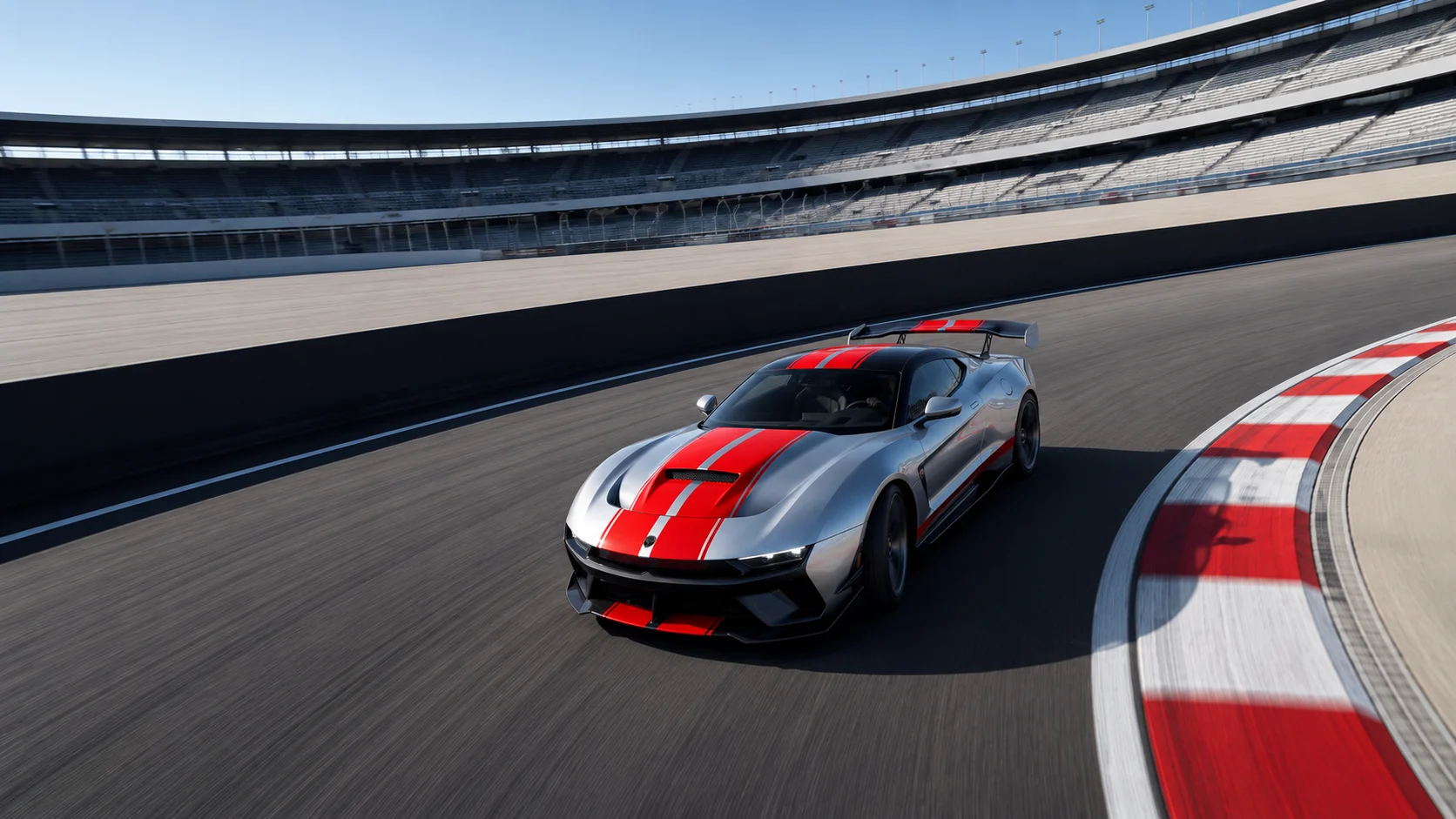
Dodge has a new snake in the grass, and it is not the viper. At Stellantis 2026 Investor Day, the company opened the doors on a full-scale styling model of the Dodge Copperhead, a low-slung two-door coupe that is meant to sit at the very top of the SRT performance ladder. Enthusiasts have been looking for a proper halo car since the Viper went out of production, and this is the closest thing they have seen in years.
Here is the catch: almost nothing about the car is official yet. Dodge provided a clay model behind a no-photos rule, dropped a few teasing lines, and left the rest to speculation. What follows is a collection of everything credible reporters, renders, and SRT boss Tim Kuniskis have shared so far, with a clear line drawn between confirmed detail and educated guess. Pricing is in US dollars and UAE dirhams for readers in both markets.
From 1997 Concept to 2029 Halo Car

The name goes back much further than most people remember. The original Dodge Copperhead concept was presented at the 1997 Detroit Auto Show as a lightweight roadster (Copper Fire Orange paint at that time) with a front-mounted 2.7-liter V6 that produced about 220 horsepower and a five-speed gearbox. Dodge marketed it as an inexpensive baby Viper, a driver’s car for those who desired something in the Mazda Miata and BMW Z3 mold rather than a V10 monster. At the time, it was rumored the price was around $30,000, roughly $45,000 under the Viper. It never came into production, but the Mopar fans kept the name alive.
The 2029 version flips that idea on its head. Rather than the low-priced companion of the Viper, the new Dodge Copperhead sports car is going to be the flagship, the machine that shows off what Dodge can do when performance is the first order of business. The 1997 roadster wanted to be attainable. This one wants to be aspirational.
What the Dodge Copperhead Is (and Is Not)
- It is a top SRT coupe with a high-end range over the current Charger.
- It is built around a low, wide track stance, closer in size to a Ford Mustang than to the big Charger sedan.
- It is not a direct Viper replacement. Kuniskis was blunt about it: the team picked Copperhead as a name of note because this is not a Viper.
- It is not a warmed-over charger. Kuniskis confirmed the coupe does not have the Charger’s hard points.
That last point matters to anyone who sees a two-door Charger with a body kit. This is meant to be its own thing.
Dodge Copperhead SRT Reveal: What Actually Happened
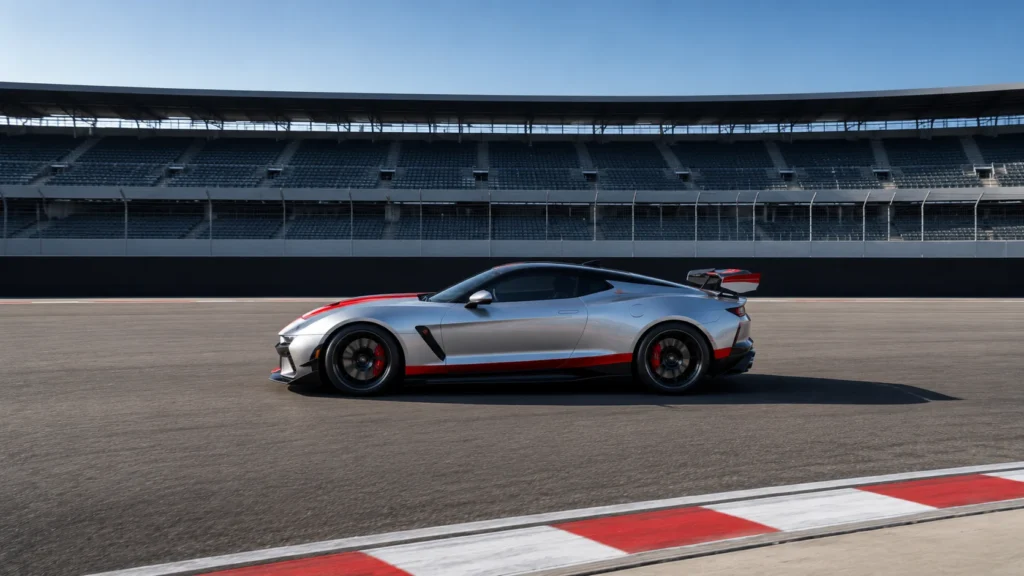
The Dodge Copperhead SRT reveal was not a glitzy auto-show unveiling. It was during Stellantis’s “FaSTLAne 2030” strategy presentation, a five-year plan that commits around €60 billion (roughly $70 billion) to the business and promises over 60 new nameplates across combustion, hybrid, and electric lines.
A few journalists were shown a full-scale model under a no-cameras policy. Their descriptions matched up well with the independent renders that flooded the internet days later, which suggests the styling vision is firmly in place even if the hardware is not. The Copperhead is part of an SRT build-up of eight performance models from American brands, with a GLH-badged hot hatch, new Ram SRT trucks, and a trio of Jeep performance variants.
So the Dodge Copperhead concept, as most people are calling it, is real. What is underneath the sheet metal is where the guessing begins.
Design Details: Shark Nose, Big Wing, Serious Aero
Everyone who saw the model came away describing the same aggressive shape. The Dodge Copperhead SRT design leans hard into function-first aero, with cooling and downforce driving nearly every surface.
Reported design cues include:
- A sharp shark-nose front end with LED headlights and a blacked-out grille area packed with vents.
- A dramatic hood treatment that blends the Charger Daytona’s R-Wing pass-through idea with a traditional muscle-car power dome and an S-duct that channels air up and over.
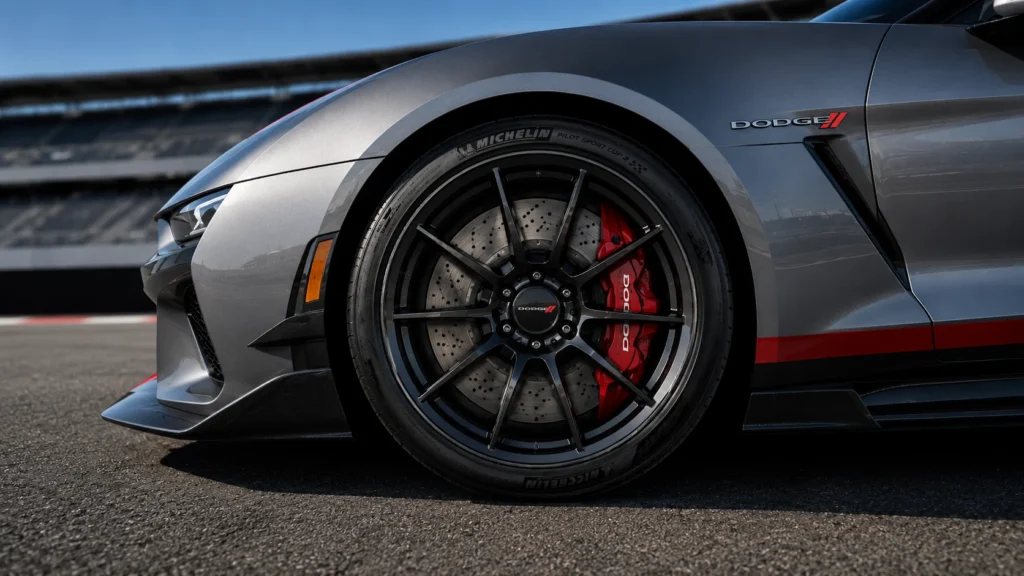
- A deep front splitter and brake cooling ducts behind the front wheels.
- A massive rear wing sitting near roof height, echoing the absurd unit that kept the Viper ACR glued to the track.
- Long, low, wide proportions that read as exotic rather than as a scaled coupe.
The rear has swept-up taillights and a tail shape that reflects the fifth-generation Viper, and the front has a modern Dodge design language. Snake-themed badging connects the whole thing to the brand’s venomous bloodline. These Dodge Copperhead design details are what separate it visually from anything else in the current lineup.
The oversized wing is the tell most reporters keep coming back to. You don’t see wings like that in NASCAR or drag racing. You see them in GT3 endurance racing, which has fed a lot of the speculation about where this car is really headed.
Interior and Cabin Technology
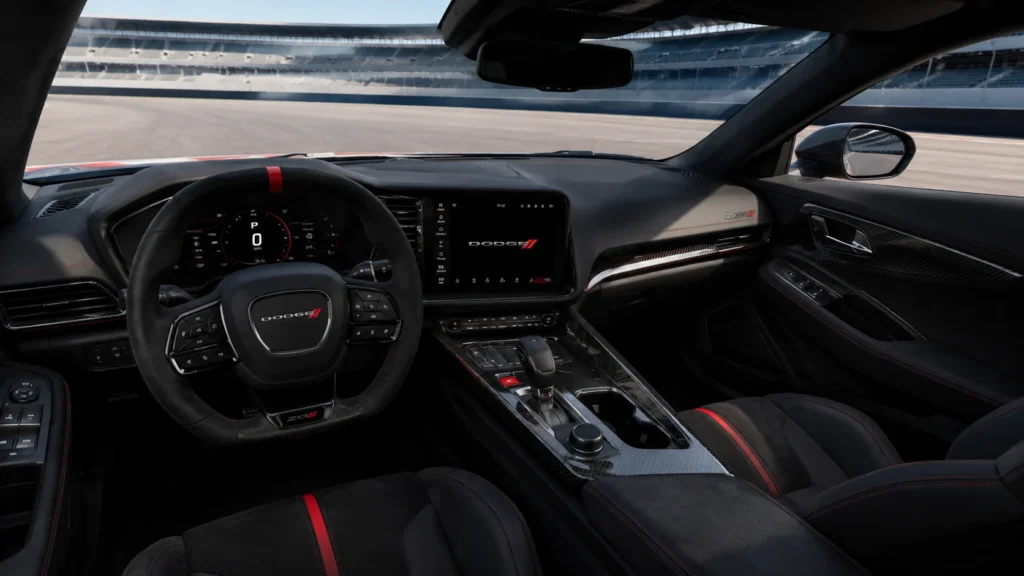
Dodge has shown no traces of the cabin, so this section relies on where recent Stellantis interiors have gone. Expect a driver-first setup with two large digital screens: a reconfigurable instrument cluster ahead of the wheel and a central touchscreen canted toward the driver, the same setup as in the Charger Daytona. SRT models have built in some special performance pages, customized telemetry, launch control, and line lock for the drag strip.
A track-focused ACR-style version would strip weight with lightweight buckets, thinner glass, less sound deadening, and Alcantara surfaces. If that patented multi-position racing seat is made available to the road car, it is a cabin that is built around driver fit rather than luxury. Physical buttons for drive modes still matter on a car built to be thrown at an apex, and Dodge has refused to bury them in menus. Cross-shoppers will want answers on daily usability, trunk space, and rear visibility past that big wing, none of which the brand has addressed. Comfort features, seat cooling, and infotainment detail all remain open questions.
Specs and Engine: What Might Power the Copperhead
There are no official Dodge Copperhead specs. Dodge has not released a single confirmed figure. But the industry consensus points in a clear direction.
The most likely Dodge Copperhead engine is a supercharged 6.2-liter Hemi V8 from the Hellcat family. That unit already provides 777 horsepower in the 2027 Ram 1500 SRT TRX, and Dodge will push it over 800 horsepower for Copperhead with more boost, better internals, and better cooling.
A second path involves the twin-turbo Hurricane inline-six, the engine Stellantis has been developing to replace larger V8s in some applications. In its hottest tuning, it can produce 500 horsepower, making it a base-engine option under a V8-topped range. Kuniskis also didn’t rule out electrification and pointed at the model’s visible tailpipes while hinting at “something you don’t know,” which set off a wave of hybrid speculation.
A rough picture of the possible Dodge Copperhead new model lineup, based on current reporting:
| Variant | Likely Powertrain | Expected Output | Positioning |
| Copperhead (base) | Twin-turbo Hurricane I6 | 500+ hp | Entry into the range |
| Copperhead SRT | Supercharged 6.2L V8 | 800+ hp | The core performance model |
| Copperhead SRT ACR-style | Supercharged V8, max aero | Highest output | Track-focused limited run |
Treat every number in that table as a projection, not a promise.
The Platform Question
Kuniskis confirmed that the car does not ride on the Charger’s STLA Large architecture, as that platform packages a battery in the floor and cannot deliver the low stance the Copperhead needs. He spoke instead about “synergies” and using sunk investment from around the global Stellantis portfolio. That comment has pointed many observers toward the Giorgio platform that underpins the Maserati GranTurismo and the Alfa Romeo Giulia, a rear-drive-friendly base with the right proportions. Nothing is guaranteed, and the platform may end up bespoke, the way the Viper’s aluminum and magnesium spaceframe was.
Speed and Performance: What to Expect
With 800-plus horsepower rumored and a curb weight targeting Mustang territory rather than Charger heft, the Dodge Copperhead performance coupe should be quick in the way the Viper ACR was quick. Think serious straight-line pace with real cornering ability, the second of which the old Vipers only found late in their life.
For context on the company it wants to keep, the Ford Mustang GTD runs an 815-hp supercharged V8 and lapped the Nürburgring in 6:40.835. The last Viper ACR set a 7:01.3 lap as the record for American rear-drive manual cars. If Dodge wants the Copperhead to matter, it has to find its place in that conversation. That is a high bar, and the brand has set it for itself by calling this a halo car.
Dodge Copperhead vs Ford GT3: The Racing Angle
The “Dodge Copperhead vs Ford GT3” question comes up a lot, and it is worth clarifying what people are really comparing.
The Ford Mustang GT3 is a factory-built GT3 endurance racer developed by Ford and Multimatic and runs a naturally aspirated 5.4-liter V8 with 550 horsepower, weighs around 2,842 pounds, and has been racing at Daytona and Le Mans since 2024. GT3 rules limit power and add weight to keep the class close so that a race car’s numbers don’t match a street car’s.
Here is why the comparison sticks: that big rear wing, the brake ducts, and a recently uncovered Stellantis patent for a multi-position “slouch” racing seat all point towards endurance racing, where driver swaps demand adjustable seating. If Dodge builds a Copperhead GT3 car to take on the Mustang and the Corvette, a hopped-up street version almost always follows. The Viper did exactly that.
For the road, the more honest rivals are the street cars:
- Ford Mustang GTD (815 hp, transaxle, inboard rear suspension).
- Chevrolet Corvette Z06 and ZR1X.
- Ford Mustang Dark Horse at the more attainable end.
Dodge calls the Copperhead a “hyper-muscle” car rather than a sports car, and it’s a blend: the drama and noise of American muscle wrapping around modern chassis engineering.
Dodge Copperhead Price: US Dollars and AED
There is no official Dodge Copperhead price announced yet. The starting price is now above $100,000, which also reflects its position as the brand’s premium flagship. Loaded trims and any ACR-style limited edition would climb well past that, as the Viper ACR did.
Rough expectations, converted at the pegged rate of about 3.67 AED to the dollar:
| Trim | Estimated US Price | Estimated UAE Price |
| Copperhead (base) | From ~$100,000 | From ~AED 367,000 |
| Copperhead SRT | ~120,000–150,000 | ~AED 440,000–551,000 |
| Copperhead SRT track edition | $150,000+ | AED 551,000+ |
Gulf buyers should add import duty, VAT, dealer margins, and shipping to those figures. Real on-the-road pricing in the UAE, Saudi Arabia, Qatar, Kuwait, Bahrain, and Oman will land higher than a straight currency conversion suggests. The Dodge Copperhead SRT price is the single most speculative number in this article, so treat it as a placeholder until Dodge publishes an MSRP.
Dodge Copperhead Release Date and Timeline
The target is the 2029 model year, but some sources warn it could slip to 2030. Everything in the FaSTLAne 2030 plan is meant to launch by the end of the decade, which gives the program room to breathe.
A realistic path from the clay model to the showroom looks like this:
- Late 2026 to early 2027: design freeze and first engineering prototypes.
- 2027 to 2028: testing, validation, and certification, with camouflaged mules likely seen at the Nürburgring and other tracks.
- Late 2028: the official production reveal, probably at a major show or a dedicated Dodge event.
- 2029: production starts and first deliveries.
Today anyone looking at “Dodge Copperhead for sale” is early. Order books have not opened, and no dealer can take a deposit on a confirmed car yet.
A quick note on the year-based searches you may have done. The phrases “Dodge Copperhead 2026″ and “Dodge Copperhead 2027” reflect how far ahead of the car the hype has gone. The 2026 date is the concept reveal, not a car anyone can buy. A 2027 or 2028 model does not appear as a product, and those years consist of engineering and testing. The Dodge Copperhead 2029 label is associated with a real planned launch, and even that could change.
What the Copperhead Means for Gulf Buyers
Dodge has a strong following in the GCC, where V8 muscle and torque-happy coupes do well. It’s because the brand’s official distributors sell the Charger, Durango, and other models in the region, so a Halo Copperhead would fit the market. Whether it arrives through official channels or grey-market importers first will shape both price and warranty coverage.
Hot-climate buyers should pay particular attention to the cooling package, the aggressive venting means Dodge is taking it seriously, and the powertrain choice, since a supercharged V8 behaves differently in 45°C Gulf summers than it does in a US spring. If a hybrid becomes available, battery thermal management becomes an issue to talk to your dealer about.
The Bottom Line: Worth the Wait?
Driving away the renders and rumors, and one thing is clear: Dodge wants a true flagship again, and the Copperhead is the vehicle to carry that weight. The brand sold muscle sedans and an electric Charger for years while competitors built sharp, lighter, track-ready coupes. This is the answer that fills that gap.
For US buyers, the appeal is a homegrown 800-plus-horsepower coupe that could clash with the Corvette and Mustang GTD without an exotic badge. For Gulf buyers, it would fit well into a region that has a fetish for loud, torque-rich Dodges, assuming that cooling holds in summer heat. The risks are real. The 2029 date might slip, the price could climb beyond six figures fast, and Stellantis has cancelled ambitious projects before, so patience is the only place to go.
FAQs
Q. When will the Dodge Copperhead go on sale, and will it reach the Gulf?
A. 2029 model year with a slim chance of 2030. US sales would be the first. Gulf availability is not clear, but given Dodge’s presence in the UAE, Saudi Arabia, and the Gulf, an official or grey market arrival is almost certain within a year of the US launch. Closely determine when to confirm timing with your local Dodge distributor closer to reveal.
Q. How much will the Dodge Copperhead cost in the US and UAE?
A. We expect a starting price above $100,000 (around AED 367,000) with SRT and track-focused trims at $150,000 or more (around AED 551,000 and up). Gulf pricing will go higher when duty, VAT, and dealer costs are added to it. No official price is known.
Q. Is the Copperhead a new Dodge Viper?
A. No. Dodge deliberately avoided the Viper name. The Copperhead Dodge Viper link is thematic; both are snake-badged halo cars, but the Copperhead is a contemporary coupe with different underpinnings and a broader “hyper-muscle” mission rather than a stripped V10 supercar.
Q. What engine will the Dodge Copperhead SRT use?
A. The best candidate is a supercharged 6.2-liter Hemi V8 with more than 800 horsepower. A twin-turbo Hurricane inline-six may serve as a base engine, and Dodge has hinted at possible electrification.
Q. Can the Copperhead compete with the Ford Mustang GTD and Corvette Z06?
A. That is the goal. With rumored 800-plus horsepower, aggressive aero, and a lighter, Mustang-sized footprint, the Copperhead is squarely aimed at America’s top performance coupes. A GT3 racing program made possible by the large wing and a racing-seat patent could put it in direct competition with the Ford Mustang GT3 on track.