
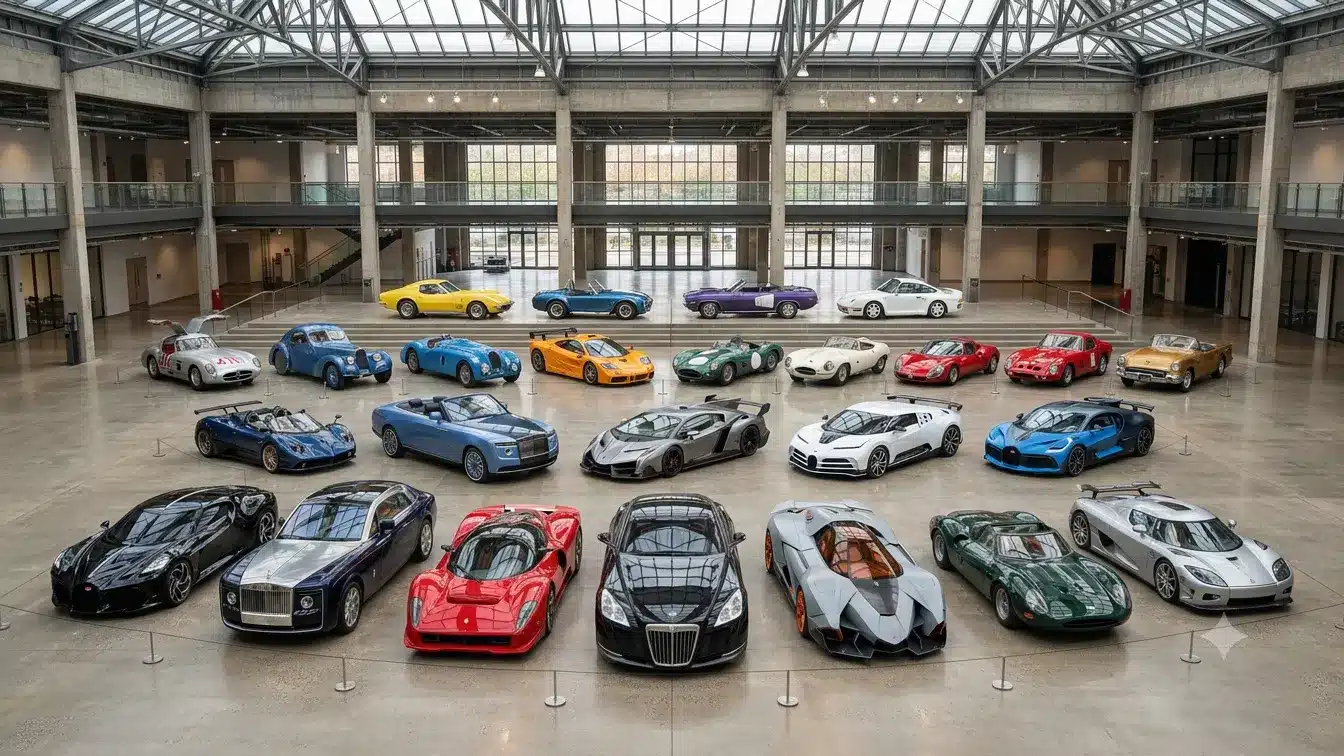
Ask ten car people to name the rarest car in the world and you will get ten answers, because they are all counting something different. The cleanest answer is the Mercedes-Benz 300 SLR Uhlenhaut Coupé. Mercedes built two of them in 1955, kept both for 67 years, then sold one in May 2022 for €135 million, about $143 million, which is still the most anyone has ever paid for a car. Go by raw numbers instead and several cars beat it.
Bugatti’s La Voiture Noire exists in exactly one example. So does the Maybach Exelero, and so does the Jaguar XJ13. This 2026 guide ranks 25 of the world’s rarest cars by how many were actually built, keeps the survivors separate from the ones that burned or crashed, and shows where every number came from.
Quick answer: The answer changes with how you count. By units built it is the Mercedes-Benz 300 SLR Uhlenhaut Coupé at two, with the Bugatti Type 57 SC Atlantic second at four built and three surviving. Among modern hypercars it is the Koenigsegg CCXR Trevita at two, and among American muscle the 1969 Chevrolet Corvette ZL1, also at two. Count survivors instead, and among cars built in more than one example the Shelby Cobra 427 Super Snake and the Bugatti Type 57G Tank take it, with a single survivor each.
What Is the Rarest Car in the World Right Now?
The title belongs to the Mercedes-Benz 300 SLR Uhlenhaut Coupé, with two cars built and one of those still owned by Mercedes-Benz. That leaves a single example in private hands anywhere on earth. The one time it changed hands, on 5 May 2022, RM Sotheby’s sold it at the Mercedes-Benz Museum in Stuttgart for €135 million. Guinness World Records logs the figure as $142,769,250 including buyer’s premium.
Age is only part of why the car is so hard to replace. Underneath is the W196 R Grand Prix machine that Juan Manuel Fangio drove to world championships, wrapped in a closed body and made road-legal. Mercedes engineering chief Rudolf Uhlenhaut used one as his company car, which is how the model got its name. The second car has never left Mercedes-Benz and is on display at the museum in Stuttgart, so anyone hoping to buy an Uhlenhaut Coupé is waiting for one person to sell.
What Is the Second Rarest Car in the World?
The Bugatti Type 57 SC Atlantic, with four built between 1936 and 1938 and three of those still around. Collectors tend to put it second because it combines a tiny run with a genuine missing car. One Atlantic has not been seen since the Second World War, and it was Jean Bugatti’s own car, the original “La Voiture Noire”.
The survivor count carries an asterisk. Bugatti names only the Mullin Automotive Museum car and the Ralph Lauren car as surviving originals of the Type 57 SC Atlantic. The third survivor was wrecked in a 1955 collision and rebuilt afterwards, which is why some sources count three and some count two.
How Rarity Is Counted: One-Offs vs Limited Runs vs Survivors
Three different measurements get called “rarest”, and mixing them is what produces three different answers to the same question.
- Units built: How many cars left the factory. Clean, checkable, and the measure used throughout this guide.
- Survivors: How many of those still exist. A Shelby Cobra 427 Super Snake is 2 of 2 built but 1 of 1 surviving, because the other car went off a cliff.
- Configuration: One car with a particular engine, transmission and color. Owners in r/regularcarreviews point out that only about 15% of Porsche 928s came with a manual transmission, which makes a 1989 928 S4 five-speed roughly a 1-in-2,000 car without the factory ever planning it that way.
Enthusiasts in r/cars make a further point that the price lists never capture: rarity is supply measured against demand, not a low number by itself. A Saab 9-4X has fewer than 800 examples in the world and nobody looks twice at one in traffic. A Lexus LFA had a 500-car run and gets photographed every time it stops for fuel. Go the other way and the DeLorean, with roughly 9,000 built, is one of the most recognizable cars alive.
Every build number below comes from the maker’s own pages, an auction house’s records or a marque registry, with the date of each sale given beside the figure.
The 25 Rarest Cars in the World at a Glance
Sorted by how many were built, fewest first. Where a car has no documented public sale, saying so beats inventing an estimate, so that is what the last column does. Figures checked November 2026.
| Car | Years | Built | Surviving | Group | Latest Known Sale or Value |
| Bugatti La Voiture Noire | 2019-2021 | 1 | 1 | One-off | €11m before tax at launch (2019) |
| Rolls-Royce Sweptail | 2017 | 1 | 1 | One-off | About $13m, reported, never confirmed (2017) |
| Ferrari P4/5 by Pininfarina | 2006 | 1 | 1 | One-off | About $4m to commission (2006) |
| Maybach Exelero | 2005 | 1 | 1 | One-off | About $8m, reported private sale (2011) |
| Lamborghini Egoista | 2013 | 1 | 1 | One-off | Museum car, never offered |
| Jaguar XJ13 | 1966 | 1 | 1 | One-off | Museum car, never offered |
| Mercedes-Benz 300 SLR Uhlenhaut Coupé | 1955 | 2 | 2 | Classic | €135m / about $143m (May 2022) |
| Koenigsegg CCXR Trevita | 2009-2010 | 2 | 2 | Hypercar | No public auction sale on record |
| Shelby Cobra 427 Super Snake | 1966-1967 | 2 | 1 | Muscle | $5,115,000 (2015) |
| Chevrolet Corvette ZL1 | 1969 | 2 | 2 | Muscle | No public sale of a documented car |
| Bugatti Type 57G Tank | 1936-1937 | 3 | 1 | Classic | Museum car, never offered |
| Pagani Zonda HP Barchetta | 2017-2018 | 3 | 3 | Hypercar | About €15m when new, reported (2018) |
| Rolls-Royce Boat Tail | 2021-2023 | 3 | 3 | Hypercar | About £20m / $28m, reported (2021) |
| Bugatti Type 57 SC Atlantic | 1936-1938 | 4 | 3 | Classic | Bugatti cites expert estimates above €100m |
| Oldsmobile F-88 | 1954 | 4 | 1 | Classic | $3,240,000 (January 2005) |
| McLaren F1 LM | 1995 | 5 customer cars, plus 1 prototype | 6 | Classic | No public auction sale on record |
| Aston Martin DBR1 | 1956-1958 | 5 | 5 | Classic | $22,550,000 (August 2017) |
| Bugatti Centodieci | 2022 | 10 | 10 | Hypercar | €8m list price (2019) |
| Plymouth Hemi ’Cuda Convertible | 1971 | 11 or 12 | About 11 | Muscle | $3.5m (Mecum, June 2014) |
| Lamborghini Veneno | 2013-2014 | 4 coupés, 9 roadsters | 13 | Hypercar | No public auction sale on record |
| Jaguar XKSS | 1957 | 16, plus 9 continuation cars | 16 | Classic | No recent public auction sale |
| Alfa Romeo 33 Stradale | 1967-1969 | 18 | 18 | Classic | No recent public auction sale |
| Porsche 959 Sport | 1987-1989 | 29 | 29 | Classic | No confirmed recent public sale |
| Ferrari 250 GTO | 1962-1964 | 36 | 36 | Classic | $51,705,000 (November 2023) |
| Bugatti Divo | 2020-2021 | 40 | 40 | Hypercar | €5m net list price (2018) |
Read the Built and Surviving columns together and the picture changes. Four Oldsmobile F-88s were made and one is left. Of the three Bugatti Type 57G Tanks built for Le Mans in the 1930s, one survives, which is how it ties the Shelby Super Snake for the smallest surviving population here. The Porsche 959 Sport, the stripped-out lightweight version of the 959, is the biggest run in the table at 29 cars and still almost impossible to find. On survivors alone, a car with four builds can be rarer today than a car with one.
One-of-One Cars: Only a Single Example Exists
Yes, 1-of-1 cars are real, and there are more of them than most people expect. Every major maker now runs a department that will build a single car for a single buyer, and museums and tire companies have commissioned their own. Here are six that nobody else owns a copy of.
Bugatti La Voiture Noire
Bugatti built one La Voiture Noire for the company’s 110th anniversary, a Chiron underneath and a tribute to the Type 57 SC Atlantic on top. The price was €11 million before tax. Bugatti President Stephan Winkelmann later put the figure at about €16.5 million with tax, roughly $18.7 million, which is where the widely quoted number comes from. Shown at Geneva in 2019, finished in 2021.
Rolls-Royce Sweptail
One car, delivered in 2017 to a client who spent four years on it with Rolls-Royce’s designers. The rear deck tapers to a point like a racing yacht and the roof is a single panel of glass. Rolls-Royce has never confirmed a price. Reporting at the time put it near £10 million, about $13 million, and the company’s own chief executive said only that he believed it to be the most expensive new car ever sold.
Ferrari P4/5 by Pininfarina
James Glickenhaus bought a 2003 Enzo, handed it to Pininfarina in 2005 and asked for a body in the spirit of Ferrari’s 1960s P-series racers. The finished car cost him roughly $4 million all in. Ferrari Chairman Luca di Montezemolo liked it enough to let it wear the Ferrari badge and the official name, which is how a privately commissioned rebody became a catalogued Ferrari.
Maybach Exelero
Tire maker Fulda, part of Goodyear, needed a heavy, fast test bed for its Carat Exelero tires and commissioned a single car in 2005. The result weighs well over 5,000 pounds, runs a 5.9-liter twin-turbo V12 on a Maybach 57 platform, and wears 315/25 ZR23 rubber at all four corners. Rapper Birdman reportedly bought it for about $8 million in 2011.
Lamborghini Egoista
Walter de Silva designed the Egoista for Lamborghini’s 50th anniversary and it was unveiled on 11 May 2013 at the anniversary gala dinner. One seat, a fighter-jet canopy that lifts away, and a steering wheel you have to remove to get in or out. The running gear is Gallardo, a 5.2-liter V10 making 600 hp. Lamborghini kept it, and since 2014 it has been on permanent display at the museum in Sant’Agata Bolognese.
Jaguar XJ13
Jaguar built a single mid-engined V12 prototype in 1966 to go Le Mans racing, then never raced it. In 1971 test driver Norman Dewis was lapping the MIRA bowl for a publicity film when a tire let go. Dewis walked away, the car did not. Jaguar rebuilt it and says plainly that what you see today is not an exact reproduction of the original. It now resides at the British Motor Museum in Gaydon.
The Rarest Classic and Race Cars
The rarest classic cars are mostly race cars that outlived their purpose, which is why their numbers are so strange. Teams built what the rules demanded, crashed a few, and the leftovers became the cars collectors now chase. These eight have the smallest confirmed runs in the classic cars category.
Mercedes-Benz 300 SLR Uhlenhaut Coupé (2)
Two cars, built in 1955, and the pair stayed inside Mercedes-Benz for 67 years. The 3.0-liter straight-eight came from the W196 R Grand Prix car and the coupé would do about 180 mph, which made it the fastest road car on the planet in the mid-1950s. Simon Kidston, the British specialist who represented the buyer at that record sale, is one of very few people who have driven one.
Bugatti Type 57 SC Atlantic (4 Built, 3 Survive)
Four were bodied between 1936 and 1938, with riveted spines running the length of the car because the original Aérolithe show car used a magnesium alloy that could not safely be welded. Three survive, two of them unmodified. Bugatti has pointed to expert estimates above €100 million if one ever came up, which is an estimate rather than a hammer price, because none has been publicly offered in decades.
McLaren F1 LM (5, Plus a Prototype)
McLaren built five road-going LMs to mark the five F1 GTRs that finished the 1995 Le Mans 24 Hours, then kept a sixth car, the XP1 LM prototype, for development work. Each one uses the GTR’s 680 hp race engine with no restrictors, weighs about 130 pounds less than a standard F1, and was painted Papaya Orange in tribute to Bruce McLaren.
Aston Martin DBR1 (5)
Five DBR1s were built between 1956 and 1958, and they gave Aston Martin the one thing the company had chased for decades: an outright Le Mans win, in 1959, with Carroll Shelby and Roy Salvadori driving. Chassis DBR1/1 sold at RM Sotheby’s Monterey auction in August 2017 for $22,550,000, a record for a British car at the time. Aston’s modern track-and-road halo, the Aston Martin Valkyrie, traces its ambition back to this car.
Jaguar XKSS (16)
Jaguar had unsold D-Types after pulling out of racing, so it converted them for the road with a windscreen, a passenger door and a bit of trim. Sixteen were finished of a planned 25 before a fire tore through the Browns Lane plant on 12 February 1957 and destroyed the remaining nine on the line. Steve McQueen bought one for $5,000 in 1958. In 2016 the Jaguar XKSS came back, with Jaguar Classic hand-building the nine lost cars to the original drawings.
Alfa Romeo 33 Stradale (18 Originals)
Eighteen chassis were bodied by Marazzi between 1967 and 1969, each one a detuned Tipo 33 sports racer with butterfly doors and a 2.0-liter V8 that revved to 10,000 rpm. Several more chassis went to Bertone and Pininfarina for concept cars and are counted separately. The 2023 Alfa Romeo 33 Stradale revival borrowed the name and the door design for a 33-car run.
Ferrari 250 GTO (36)
Ferrari puts the production run at 36 cars between 1962 and 1964, built to homologate the 250 for FIA Group 3 racing. Count the three 4.0-liter cars that are sometimes labeled 330 GTO and the number reaches 39, which is why both figures are in circulation. In November 2023 chassis 3765, the only GTO ever raced by Scuderia Ferrari itself, sold at Sotheby’s in New York for $51,705,000, $47 million of that at the hammer.
Oldsmobile F-88 (1 Survivor)
The 1954 F-88 was General Motors’ fiberglass Motorama show car, a Rocket V8 answer to the Corvette that Oldsmobile never got to sell. Barrett-Jackson’s own lot record states it plainly: four cars came out of the project and only styling order #2265 survived. That car sold on 29 January 2005 for $3,240,000 to John and Maureen Hendricks and now anchors the Gateway Colorado Automobile Museum.
The Rarest Modern Hypercars
Modern rarity is manufactured on purpose. A maker decides on three cars, or ten, sells every one before the covers come off, and the scarcity is a product decision rather than an accident of history. A 499-car run like the LaFerrari feels exclusive until you line it up against these six.
Koenigsegg CCXR Trevita (2)
The name is a contraction of “tre vita”, Swedish for three whites, because Koenigsegg planned three. The diamond-coated carbon weave that gives the car its silver shimmer took so long to produce that the run ended at two. Koenigsegg’s own model list counts two, and a chassis-by-chassis registry analysis reaches the same number. The current flagship, the Koenigsegg Jesko, is positively mass-market at 125 cars.
Pagani Zonda HP Barchetta (3)
Horacio Pagani designed the Barchetta as a 60th birthday present to himself and planned a single car. Three were built in the end, and one of those stays in Pagani’s own collection. It uses the 7.3-liter AMG V12 at 789 hp, with a fully enclosed left rear wheel. Pagani has never published an official production figure, so three comes from press coverage and owner records rather than the factory.
Rolls-Royce Boat Tail (3)
Three Boat Tails have been delivered since 2021, each one different, each built by the Coachbuild division that Rolls-Royce created for exactly this kind of commission. The rear deck opens into a parasol and a hosting suite with its own refrigerator. Rolls-Royce has never disclosed the price. The figure that circulates is about £20 million, roughly $28 million, and it remains unconfirmed.
Lamborghini Veneno (4 Coupés + 9 Roadsters)
Veneno counts are quoted anywhere between three and five coupés, so here is what Lamborghini itself accounts for: three customer coupés plus one production prototype, now kept at the MUDETEC museum in Sant’Agata. That makes four coupés, three of them privately owned, alongside nine roadsters, for 13 Venenos in all. All of them use a 6.5-liter V12 making 750 hp on an Aventador platform.
Bugatti Centodieci (10)
Ten cars, built as a tribute to the EB110 and sold out before the reveal at Monterey in 2019 at €8 million apiece. Bugatti delivered the first in June 2022 and confirmed the tenth and final delivery that December. The Bugatti Centodieci makes 1,578 hp from the W16, and its wedge profile and five-hole side intakes are a straight lift from the 1991 original. Bugatti’s track-only Bugatti Bolide followed the same few-off playbook with 40 cars.
Bugatti Divo (40)
Forty cars at €5 million net each, every one spoken for before the public announcement in 2018. Named after Albert Divo, who won the Targa Florio twice for Bugatti, the Bugatti Divo trades 22 mph of top speed for 198 lb of downforce and a corner-carving setup the Chiron never had. The roadster that closed out the W16 era, the Bugatti W16 Mistral, was limited to 99.
The Rarest American Muscle Cars
American muscle rarity works differently again. The cars were built on ordinary production lines, so the rare ones are the option boxes almost nobody ticked. Collectors in r/classiccars make the point well: a car gets called rare when it is scarce against the model it came from, which is why a 1984 Hurst/Olds at roughly 3,300 units beats far scarcer oddballs in those arguments.
1969 Chevrolet Corvette ZL1 (2)
The ZL1 option put an all-aluminum 427 in a Corvette and added about $4,700 to a car that cost $4,800. Chevrolet’s production records show two sold, and of those only the yellow car is fully documented. The confusion comes from the engine plant: Tonawanda built 94 ZL1 engines with Corvette prefixes in 1969, which has kept the forums arguing for 50 years about where the rest went.
Shelby Cobra 427 Super Snake (2)
Two were built from competition Cobras with twin Paxton superchargers, making somewhere near 800 hp with no roof and no roll bar. Carroll Shelby kept CSX3015. CSX3303 went to Bill Cosby, who returned it after one drive, and a later owner was killed when it went off a cliff into the Pacific, destroying the car. CSX3015 is the only survivor and sold for $5,115,000 at Barrett-Jackson in 2015. The replica question dogs the model: enthusiasts in r/auto regularly argue over how many roadside Cobras are original cars at all.
1971 Plymouth Hemi ’Cuda Convertible (11)
The rarest Dodge-family Hemi muscle car is not a Dodge at all. Plymouth fitted the 426 Hemi to a ’Cuda convertible for one model year, and the count is either 11 or 12 depending on the source, with the higher figure counting seven US cars and five for export. Stellantis itself has said it cannot be certain. Three had the four-speed manual. One sold at Mecum in Seattle for $3.5 million in June 2014, a record for an American muscle car at the time, and another drew a $4.8 million high bid at Mecum in 2021 without meeting reserve.
The Most Expensive Rare Cars Ever Sold
Public auction records give the clearest picture, since private sales rarely confirm a number.
| Car | Price | Auction | Date |
| Mercedes-Benz 300 SLR Uhlenhaut Coupé | €135,000,000 (about $143m) | RM Sotheby’s, Stuttgart | May 2022 |
| Ferrari 250 GTO, chassis 3765 | $51,705,000 | Sotheby’s, New York | November 2023 |
| Aston Martin DBR1/1 | $22,550,000 | RM Sotheby’s, Monterey | August 2017 |
| Shelby Cobra 427 Super Snake, CSX3015 | $5,115,000 | Barrett-Jackson, Scottsdale | January 2015 |
| Plymouth Hemi ’Cuda Convertible | $3,500,000 | Mecum, Seattle | June 2014 |
| Oldsmobile F-88 | $3,240,000 | Barrett-Jackson, Scottsdale | January 2005 |
Scarcity by itself does not set the price, and there is data behind that. “If lower production consistently meant higher values, the data points would show a nice diagonal slope from the top left to the bottom right. Instead, it looks like an L shape,” wrote John Wiley, senior data analyst at Hagerty’s Automotive Intelligence team, after mapping production numbers against Hagerty Price Guide values for about 200 vehicles. A handful of cars are both scarce and wanted. Plenty more are scarce and cheap. Collectors in r/classiccars put the same complaint more bluntly, griping about dealers leaning hard on production numbers alone.
Can You Buy One of the World’s Rarest Cars?
In theory yes, in practice almost never, and the route depends on the car’s age. Historic cars change hands at the big collector sales, mainly RM Sotheby’s, Gooding & Company and Mecum, or privately through specialists who never publish a figure. A car like the Uhlenhaut Coupé surfaces once in a lifetime.
New few-offs work on allocation instead. Buyers on r/Bugatti describe a preferred-customer list, several previous cars from the brand, and invitation-only events where the specification is agreed. Cars sell out before any public announcement. A secondary trade in unbuilt build slots exists too, and owners on the marque forums treat it warily, since paying for a place in a queue leaves you with paperwork rather than a car.
FAQs
Q. Is there a car worth $1 billion?
A. No. The highest price ever paid for a car is the €135 million, roughly $143 million, that the Mercedes-Benz 300 SLR Uhlenhaut Coupé fetched in May 2022. Billion-dollar claims online describe an entire collection valued together, or the total revenue a model earned across every unit sold.
Q. What is the rarest Ferrari?
A. The Ferrari P4/5 by Pininfarina, with one built in 2006. Among Ferrari’s own production models the 250 GTO is the rarest significant car at 36 units, or 39 if you count the three 4.0-liter 330 GTOs. Special Projects commissions also exist in single examples.
Q. What is the rarest muscle car?
A. The 1969 Chevrolet Corvette ZL1, with two cars sold under that option code and only one of them fully documented. For Mopar fans the answer is the 1971 Plymouth Hemi ’Cuda Convertible at 11 or 12 cars, which draws seven-figure bids whenever an example appears.
Q. What is the rarest car color?
A. Gold and purple, both at effectively 0.0% of 2025-model-year vehicles, followed by yellow at 0.1%. The iSeeCars study published in June 2026 found that 80.4% of new cars are now white, black, gray or silver, up from 47.3% in 1996.
Q. How many one-of-one cars exist?
A. Nobody keeps a central tally, and the number grows every year. Bugatti, Rolls-Royce, Ferrari, Aston Martin and Pagani all run bespoke departments that build single commissions, and prototypes and museum pieces add more. The six here are the ones with documented build numbers and public histories.