
Quick Answer
The Chevrolet silverado electric truck is a full-size pickup truck built for work, towing, and daily driving, sold in trims that range from a basic work truck to a luxury-leaning High Country. For 2026, it starts in the high-$30,000s to low-$40,000s and stretches past $70,000 fully loaded, with engine choices that include a turbocharged four-cylinder, two V8s, and a diesel six-cylinder. It’s a strong pick if you tow regularly, need real payload capacity, or want a truck that can flex between job site and family duty. If your needs are lighter — mostly commuting, occasional cargo — a midsize truck or a lower trim will save you money without much sacrifice.
Introduction
The Chevrolet silverado electric truck has been Chevy’s full-size pickup since 1998, and it currently sits in a three-way fight with the Ford F-150 and Ram 1500 for the best-selling truck in America. The 2026 model continues on the truck’s current generation, refining the interior, technology, and engine lineup rather than reinventing the platform.
Who should buy it? Contractors and tradespeople who need towing and payload numbers they can trust, families who want a comfortable crew cab with real cargo space, and anyone who tows a boat, camper, or trailer on a regular basis.
Why is it popular? Four distinct engines (including a diesel), a wide trim spread that covers budget buyers through luxury buyers, and towing figures that hold up against anything Ford or Ram offers.
What’s new in 2026? Expect continued rollout of Google built-in infotainment across more trims, expanded availability of the turbocharged TurboMax engine, and small trim and equipment shuffles rather than a ground-up redesign.
What this guide covers: pricing by trim, every engine option with real numbers, interior space and comfort, safety and driver-assist tech, towing and payload figures, fuel economy, how it stacks up against the F-150, Ram 1500, Sierra 1500, and Tundra, and which trim actually makes sense for your situation.
Chevrolet Silverado Quick Specs at a Glance
| Specification | Details |
| Starting Price | ~$38,600 (WT trim, before destination fee) |
| Body Style | Full-size pickup truck |
| Engine Options | 2.7L Turbo (TurboMax), 5.3L V8, 6.2L V8, 3.0L Duramax Turbo-Diesel |
| Horsepower | 310–420 hp depending on engine |
| Torque | 348–495 lb-ft depending on engine |
| Transmission | 8-speed automatic (turbo/diesel), 10-speed automatic (V8) |
| Drivetrain | RWD standard, 4WD available |
| Seating Capacity | 5–6 passengers, depending on cab configuration |
| Fuel Economy | 16–23 mpg combined, depending on engine and drivetrain |
| Towing Capacity | Up to 13,300 lbs (properly equipped) |
| Payload Capacity | Up to roughly 2,460 lbs |
| Bed Sizes | 5’8″, 6’6″, 8’0″ |
Figures vary by trim, cab, and configuration — always confirm exact numbers for your build against the window sticker.
Chevrolet Silverado Overview
What is the Chevrolet Silverado?
The Chevrolet silverado electric truck is a full-size, half-ton pickup truck (with heavier-duty 2500 and 3500 HD versions sold separately). It shares its underlying platform with the GMC Sierra 1500, though Chevrolet tunes the styling, trim structure, and some features differently.
Key highlights
- Four engine choices, including a diesel — more variety than most rivals offer
- Towing capacity that competes at the top of the segment
- A trim lineup that spans work-truck basics to leather-lined luxury
- Three cab styles and three bed lengths, so buyers can match the truck to the job
Who is it designed for?
The Chevrolet silverado electric truck is built for people who need a truck to actually work — hauling materials, towing trailers, driving on job sites — as much as for people who just want a big, comfortable, capable vehicle for daily life. It’s less suited to someone who wants tight city parking and light cargo needs; a compact SUV or midsize truck fits that better.
Table: Quick Highlights
| Category | Detail |
| Segment | Full-size pickup |
| Main rivals | Ford F-150, Ram 1500, GMC Sierra 1500, Toyota Tundra |
| Cab styles | Regular Cab, Double Cab, Crew Cab |
| Standout feature | Diesel engine option with strong towing and mileage |
| Best for | Towing, hauling, work use, family duty |
What’s New in the Chevrolet Silverado 2026?
New updates
The 2026 Chevrolet silverado electric truck is an incremental update rather than a redesign. Chevrolet has been rolling out changes gradually since the current generation’s mid-cycle refresh, and 2026 continues that pattern.
Design changes
Expect minor trim-level tweaks to grille treatments, wheel designs, and available exterior colors. The core body structure and cab layout carry over unchanged.
Technology improvements
Google built-in infotainment (with Google Maps, Assistant, and the Play Store baked into the truck rather than requiring a phone connection) continues to expand to more trims across the lineup, alongside the larger available touchscreen options introduced in recent model years.
Performance updates
The 2.7L TurboMax engine, which replaced the older base turbo four-cylinder, remains available across a wider trim spread, giving budget-conscious buyers V8-adjacent towing numbers without the V8 fuel bill.
New trim availability
Trim names and packages shift slightly year to year — some special editions come and go. Check current Chevrolet.com configurator listings or your local dealer’s inventory for the exact 2026 trim list, since these details are finalized close to launch.
Chevrolet Silverado Price 2026
Starting price
The 2026 Chevrolet silverado electric truck 1500 starts at roughly $38,600 for the base WT (Work Truck) trim with 4×2 drivetrain, before destination charges, taxes, and any dealer add-ons. Fully loaded High Country trims with 4WD and the 6.2L V8 can push past $75,000.
Trim-wise pricing
Chevrolet organizes the Chevrolet silverado electric truck lineup from basic to premium. Below is a representative breakdown — treat these as approximate starting points, since regional pricing and incentives shift throughout the year.
| Trim | Starting Price | Best For | Key Features |
| WT (Work Truck) | ~$38,600 | Fleet & work use | Vinyl floors, basic infotainment, steel wheels |
| Custom | ~$41,000 | Budget buyers wanting more style | Upgraded cloth interior, larger touchscreen |
| Custom Trail Boss | ~$44,500 | Light off-roading on a budget | Lifted suspension, off-road tires |
| LT | ~$45,500 | Daily drivers & families | Alloy wheels, dual-zone climate, better infotainment |
| RST | ~$48,500 | Buyers who want a sportier look | Blacked-out trim, sport suspension tuning |
| LT Trail Boss | ~$49,000 | Off-road capability with comfort | Z71 suspension, skid plates, all-terrain tires |
| Z71 | ~$52,000 | Serious off-road use | Off-road suspension, locking rear differential |
| LTZ | ~$54,000 | Comfort-focused buyers | Leather seating, heated/ventilated seats |
| High Country | ~$60,000 | Luxury truck buyers | Premium leather, wood trim, top-tier tech |
| ZR2 | ~$68,000 | Off-road enthusiasts | Multimatic dampers, front locker, wide-track stance |
Best value trim
The LT trim tends to be the sweet spot for most buyers — it adds meaningful comfort and tech over the Custom without jumping into luxury-trim pricing.
Which trim is right for you?
- Want a truck purely to work? WT or Custom.
- Want comfort without overspending? LT.
- Want off-road capability? Trail Boss or Z71.
- Want luxury? High Country.
- Want a dedicated off-road machine? ZR2.
Exterior Design
Front styling
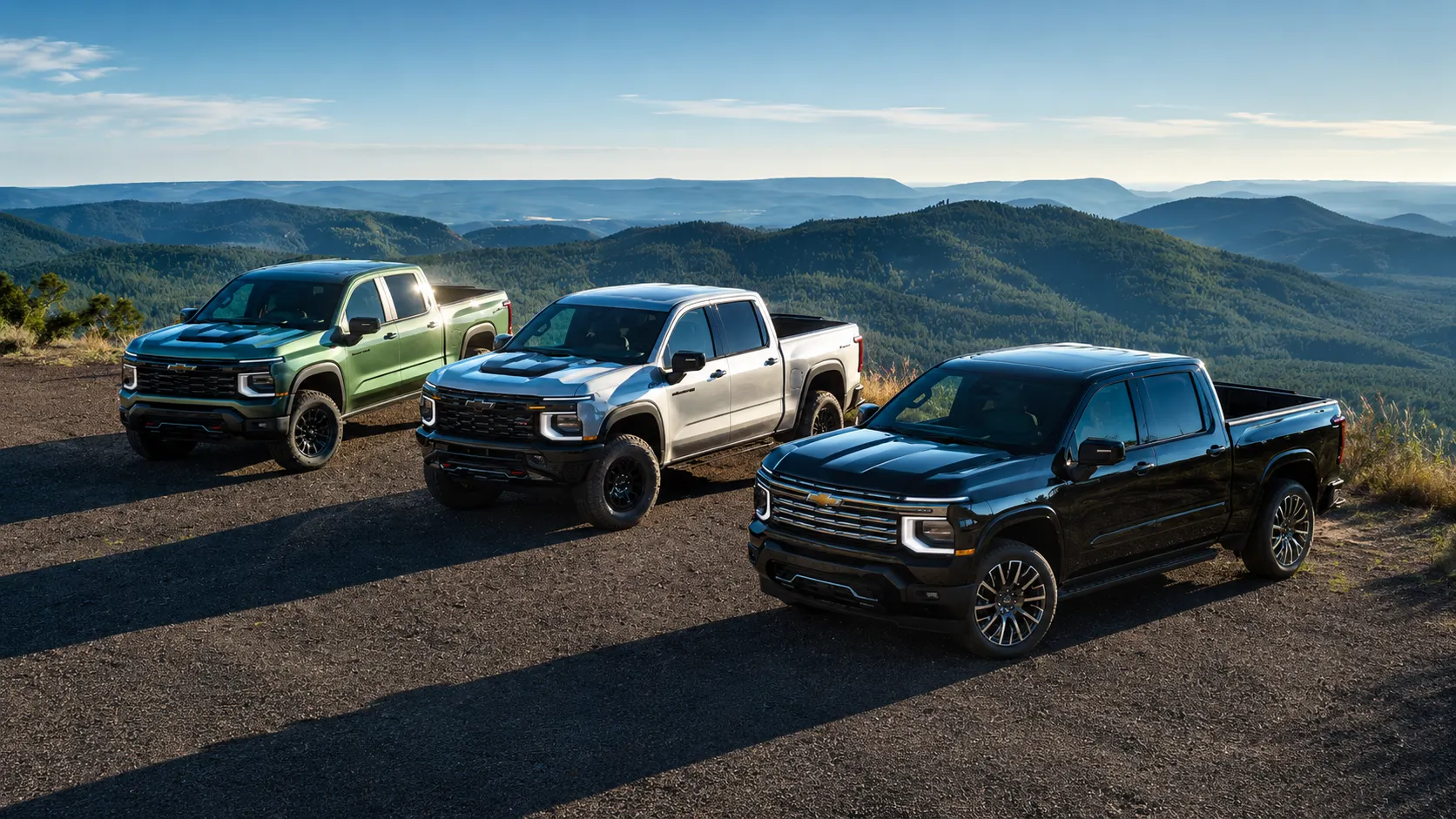
The current Chevrolet silverado electric truck wears a bold, upright grille that scales in size and chrome trim depending on the trim level — WT trims keep it simple, while High Country and ZR2 trims get more aggressive, blacked-out or chrome-heavy treatments.
LED lighting
LED headlights and taillights are standard or available across most trims, improving nighttime visibility over older halogen setups still found on base fleet trucks in some markets.
Color options
Chevrolet typically offers a dozen or so exterior colors across the lineup, including a mix of neutrals (white, black, gray) and a few standout shades that rotate year to year.
Bed styles
The bed comes finished in either a spray-in or drop-in liner depending on trim and options, with a durable composite inner bed structure (Chevrolet calls it the “Durabed”) standard across the range.
Build quality
Panel gaps and fit-and-finish on recent Chevrolet Silverado model years have been solid, though some owners note interior plastics on lower trims feel utilitarian rather than premium — which tracks with the price point.
Chevrolet Silverado Interior 2026
Cabin quality
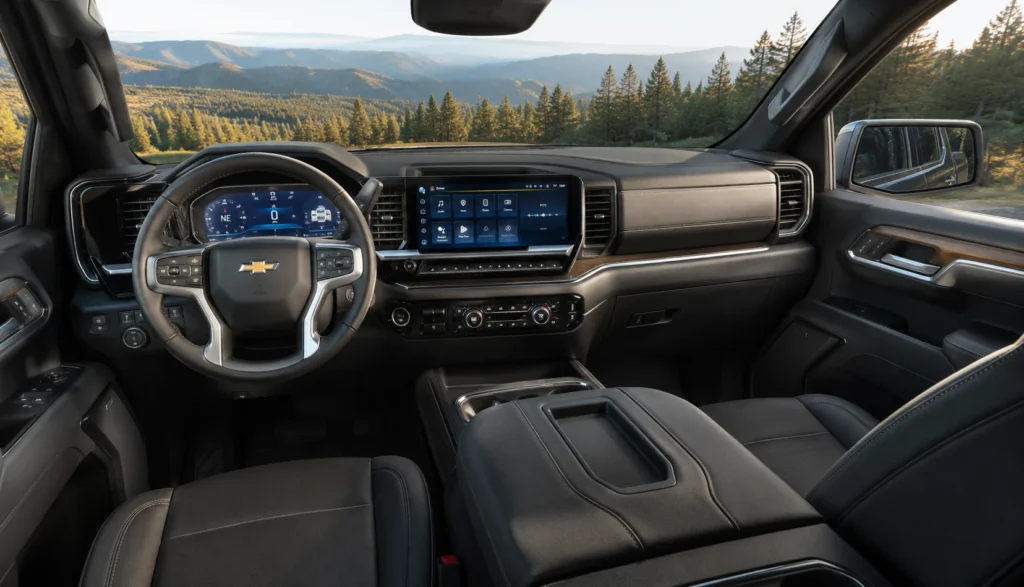
Interior quality scales noticeably with trim. WT and Custom trims use harder plastics and simpler materials built for durability and easy cleaning. LTZ and High Country move into leather, soft-touch surfaces, and more refined stitching.
Seating comfort
Front seats are wide and supportive, with heated and ventilated options available from LTZ upward. Bench seating is available on lower trims for six-passenger capacity.
Passenger space
Crew Cab models offer some of the most generous rear legroom in the segment, making them genuinely comfortable for adult passengers on long drives — not just an occasional-use back seat.
Dashboard
The dashboard layout keeps physical climate controls alongside the touchscreen, which owners generally prefer over fully touch-based systems for quick adjustments while driving.
Infotainment
Higher trims get an 11- or 13.4-inch touchscreen (depending on configuration) paired with a digital driver display, wireless Apple CarPlay and Android Auto, and — on trims equipped with it — Google built-in for native navigation and apps.
Storage
The Chevrolet Silverado includes a large center console bin, door pockets sized for bottles and folders, and available underseat storage on Crew Cab models.
Rear-seat comfort
Rear seats on Crew Cab trims recline slightly and offer enough space for car seats, adult passengers, or flat cargo when folded.
Table: Interior Dimensions (Crew Cab, approximate)
| Measurement | Front | Rear |
| Headroom | ~43.0 in | ~40.4 in |
| Legroom | ~45.1 in | ~43.4 in |
| Shoulder room | ~66.6 in | ~65.6 in |
| Hip room | ~64.6 in | ~63.6 in |
Dimensions vary slightly by cab style (Regular, Double, Crew) and should be confirmed for the specific configuration you’re considering.
Chevrolet Silverado Engine 2026
TurboMax (2.7L Turbo, high-output)
The 2.7L TurboMax four-cylinder produces around 310 hp and 430 lb-ft of torque, making it a genuinely strong base-adjacent engine rather than an afterthought. It’s paired with an 8-speed automatic.
5.3L V8
The naturally aspirated 5.3L V8 makes roughly 355 hp and 383 lb-ft of torque. It’s the traditional middle-ground choice — proven, simple, and widely serviced.
6.2L V8
The 6.2L V8 tops the gas lineup at approximately 420 hp and 460 lb-ft of torque, and it’s the engine to pick if maximum towing and payload matter most.
Duramax Diesel (3.0L Turbo-Diesel)
The 3.0L Duramax inline-six diesel makes around 305 hp and 495 lb-ft of torque — less horsepower than the gas V8s, but the strongest torque figure in the lineup, plus noticeably better fuel economy for long-distance or heavy-towing use.
Transmission options
The TurboMax and Duramax pair with an 8-speed automatic; both V8s pair with a 10-speed automatic.
Which engine should you choose?
- Budget-conscious buyer who still wants solid capability: TurboMax
- Traditional, low-maintenance choice: 5.3L V8
- Maximum towing and payload: 6.2L V8
- Best fuel economy and torque for long hauls: Duramax Diesel
| Engine | HP | Torque | MPG (combined, approx.) | Best For |
| 2.7L TurboMax | 310 | 430 lb-ft | 20 | Value + capability |
| 5.3L V8 | 355 | 383 lb-ft | 18 | All-around use |
| 6.2L V8 | 420 | 460 lb-ft | 16 | Max towing/payload |
| 3.0L Duramax Diesel | 305 | 495 lb-ft | 23 | Long-distance towing, efficiency |
MPG figures are combined-cycle approximations and vary by drivetrain (2WD vs 4WD) and cab/bed configuration.
Performance & Driving Experience
City driving
The Chevrolet Silverado feels large in tight city spaces — expect wider turning circles and more careful parking than a car or crossover — but the turbo four-cylinder and V8s both provide confident power off the line for merging and city traffic.
Highway comfort
At highway speeds, the cabin stays quiet, and the ride settles into a smooth, composed cruise, especially on Crew Cab models with the longer wheelbase.
Ride quality
Ride quality varies by trim. Standard suspension trims lean toward comfort, while Trail Boss, Z71, and ZR2 trims trade a bit of on-road softness for off-road capability.
Off-road capability
Trail Boss trims offer a lifted, capable setup for moderate trails. Z71 goes further with a locking rear differential and off-road-tuned suspension. The ZR2 is the dedicated off-road flagship, with Multimatic spool-valve dampers and a wider stance built for serious terrain.
Steering
Steering is light and easy to manage at low speeds, with reasonable weight and feedback building at highway speeds — tuned more for comfort than sharp feedback.
Braking
Braking performance is confident for a truck this size, though — as with any full-size pickup — stopping distances lengthen noticeably when towing near the truck’s max capacity.
Towing & Payload Capacity
Maximum towing
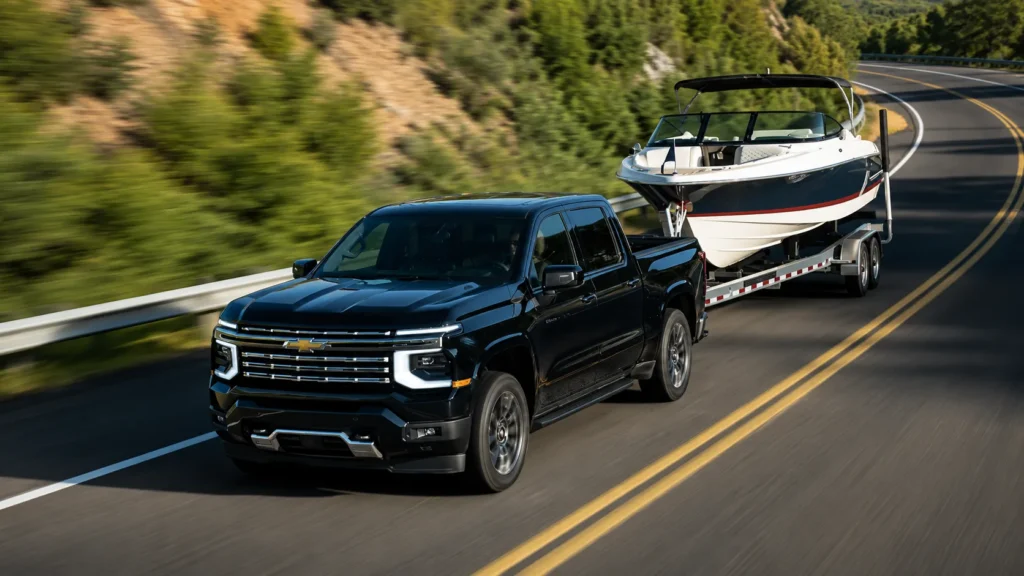
Properly equipped, the Chevrolet Silverado can tow up to approximately 13,300 lbs, typically achieved with the 6.2L V8, 2WD, and the Max Trailering Package. Towing capacity drops with 4WD, smaller engines, and lighter-duty axle ratios, so the number on a specific truck can vary by several thousand pounds from the max advertised figure.
Payload
Maximum payload sits around 2,460 lbs on certain configurations, though most trims fall somewhere in the 1,700–2,300 lb range depending on cab, bed, and engine.
Trailer technology
Available trailering tech includes a trailer camera system with multiple views (including a transparent trailer view that effectively lets you “see through” the trailer on the display), integrated trailer brake controller, and trailering-specific apps that track tire pressure and trailer light function.
Trailering tips
- Always check the specific truck’s door-jamb sticker for exact towing and payload figures — advertised max numbers assume a specific, often stripped-down configuration.
- Distribute cargo weight evenly and keep tongue weight within the hitch’s rated capacity.
- Use the Max Trailering Package if towing is a regular, heavy-duty task — it upgrades cooling, suspension, and brake components.
| Engine | Maximum Towing | Maximum Payload |
| 2.7L TurboMax | ~9,500 lbs | ~2,280 lbs |
| 5.3L V8 | ~11,300 lbs | ~2,260 lbs |
| 6.2L V8 | ~13,300 lbs | ~2,130 lbs |
| 3.0L Duramax Diesel | ~13,000 lbs | ~1,940 lbs |
Exact figures depend heavily on cab style, bed length, drivetrain, and optional packages — treat this table as directional, not a substitute for the specific build’s rating.
Fuel Economy
City MPG
City fuel economy ranges from roughly 15–20 mpg depending on engine, with the diesel and TurboMax leading and the 6.2L V8 trailing.
Highway MPG
Highway figures run higher across the board, generally 18–26 mpg, with the Duramax diesel typically posting the best highway numbers in the lineup.
Best fuel-efficient engine
The 3.0L Duramax diesel is the clear efficiency leader, particularly for highway and towing use, though the TurboMax is the better choice if you want efficiency without diesel fuel pricing and maintenance considerations.
| Engine | City MPG | Highway MPG | Combined MPG |
| 2.7L TurboMax | 18 | 22 | 20 |
| 5.3L V8 | 16 | 21 | 18 |
| 6.2L V8 | 14 | 19 | 16 |
| 3.0L Duramax Diesel | 20 | 26 | 23 |
Figures are approximate and vary by drivetrain and cab/bed configuration; check EPA ratings for your exact build.
Chevrolet Silverado Features 2026
Technology
- Wireless Apple CarPlay — standard or available across most trims
- Android Auto — wireless connectivity mirrors the CarPlay setup
- Google Built-In — native Google Maps, Assistant, and app store on equipped trims
- Digital Driver Display — configurable instrument cluster on mid-to-upper trims
- Wireless Charging — available from LT and up on most model years
Comfort
- Heated seats — available from LT/RST upward
- Ventilated seats — available on LTZ and High Country
- Dual-zone climate control — standard from LT upward
Convenience
- Remote Start — widely available across trims
- Multi-Flex Tailgate — a six-position tailgate that can act as a step, load stop, or wide-opening gate for easier cargo access
- Camera System — up to an 8-camera system with trailer views on higher trims
Driver Assistance
- Adaptive Cruise Control — available, standard on some upper trims
- Lane Keep Assist — part of the Chevrolet Safety Assist suite
- Blind Spot Monitoring — widely available, standard on several trims
- Automatic Emergency Braking — standard across most or all trims as part of Chevrolet Safety Assist
Checklist: Standard vs Optional Features
| Feature | WT | LT | LTZ/High Country |
| Wireless Apple CarPlay/Android Auto | Available | Standard | Standard |
| Heated seats | No | Available | Standard |
| Ventilated seats | No | No | Available/Standard |
| Multi-Flex Tailgate | Available | Available | Standard |
| Adaptive Cruise Control | No | Available | Available/Standard |
| Automatic Emergency Braking | Standard | Standard | Standard |
Safety Features
Chevrolet Safety Assist
Chevrolet Safety Assist bundles several driver-assist systems as a standard package on most trims, including automatic emergency braking, forward collision alert, lane keep assist with lane departure warning, and automatic high beams.
Crash prevention features
Forward collision alert and automatic emergency braking work together to reduce or prevent front-end collisions at city and highway speeds.
Parking assistance
Rear park assist and, on higher trims, front park assist help with tighter parking situations — genuinely useful given the Chevrolet Silverado’s size.
Driver assistance technologies
Adaptive cruise control, lane change alert with side blind zone alert, and rear cross-traffic alert are available depending on trim and package.
Table: Safety Feature Availability by Trim
| Feature | WT/Custom | LT/RST | Z71/LTZ | High Country/ZR2 |
| Automatic Emergency Braking | Standard | Standard | Standard | Standard |
| Lane Keep Assist | Standard | Standard | Standard | Standard |
| Blind Spot Monitoring | Available | Available/Standard | Standard | Standard |
| Adaptive Cruise Control | No | Available | Available | Available/Standard |
| Rear Cross-Traffic Alert | Available | Available | Standard | Standard |
Chevrolet Silverado Wheels 2026
Available wheel sizes
Wheel sizes range from 17-inch steel wheels on base WT trims up to 22-inch alloy wheels on High Country and select appearance packages.
Tire options
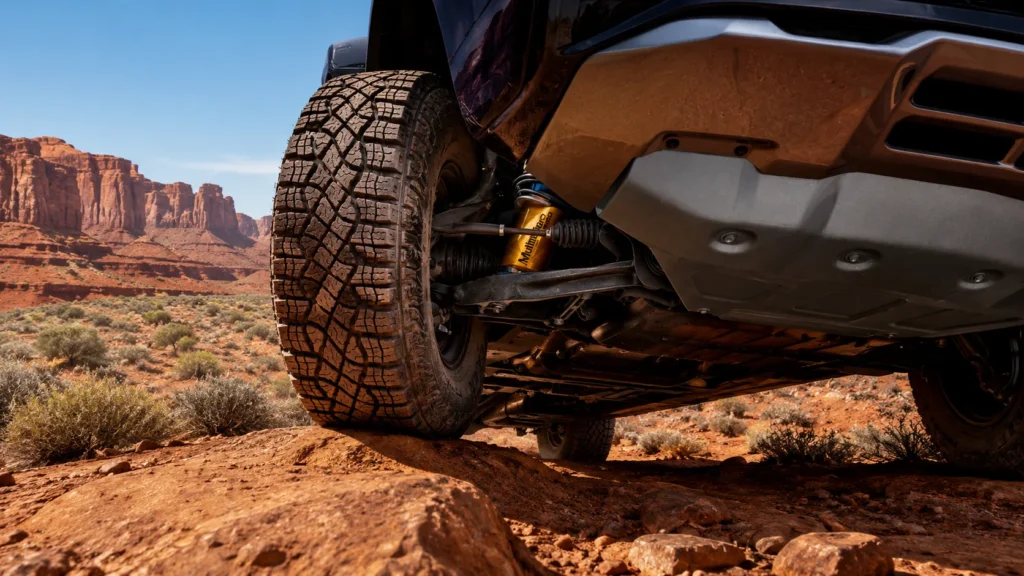
Tires range from standard all-season rubber on street-focused trims to all-terrain tires on Trail Boss and Z71 models, built to handle gravel, mud, and light trail use.
Off-road wheel packages
Z71 and ZR2 trims come with wheel and tire packages specifically matched to their suspension setups — wider, more aggressive tread patterns designed for traction over pure highway comfort.
Best wheel choice by trim
- Daily driving/highway comfort: factory 18–20-inch alloy wheels with all-season tires
- Light off-roading: Trail Boss all-terrain package
- Serious off-roading: Z71 or ZR2 factory off-road tire package
Bed Sizes & Cargo Space
Short Bed
Roughly 5’8″ long, paired typically with the Crew Cab for a more maneuverable overall truck length.
Standard Bed
Roughly 6’6″ long, offered across most cab configurations as the middle-ground option.
Long Bed
Roughly 8’0″ long, generally offered on Regular Cab and some Double Cab configurations for buyers who need maximum cargo length.
Cargo management
The Durabed structure includes available fixed and movable tie-downs, plus an available 120V power outlet in the bed for job-site tools.
Bed accessories
Spray-in liners, tonneau covers, and bed extenders are common dealer- or aftermarket-installed additions, along with the factory Multi-Flex Tailgate for easier loading.
Table: Bed Dimensions & Cargo Volume
| Bed Length | Approx. Length | Approx. Cargo Volume |
| Short Bed | 69.0 in | ~62.9 cu ft |
| Standard Bed | 78.2 in | ~71.7 cu ft |
| Long Bed | 97.4 in | ~89.1 cu ft |
Reliability, Warranty & Maintenance
Expected reliability
The current Chevrolet Silverado generation has generally posted average-to-slightly-below-average reliability scores in independent studies compared to the segment, with the diesel and turbo engines being newer designs worth watching for long-term durability data as more high-mileage examples accumulate.
Warranty coverage
Chevrolet’s standard new-vehicle warranty covers 3 years/36,000 miles bumper-to-bumper and 5 years/60,000 miles powertrain, in line with GM’s broader lineup.
Maintenance schedule
Oil changes are typically recommended every 7,500–10,000 miles under normal use for gas engines (the truck’s oil life monitor adjusts this based on driving conditions), with diesel models generally requiring more frequent service intervals.
Estimated ownership costs
Expect moderate-to-higher-than-average maintenance costs typical of a full-size truck, with the V8 and diesel engines generally costing more to service than the TurboMax four-cylinder.
Common maintenance considerations
- Diesel models require diesel exhaust fluid (DEF) top-offs
- V8 engines with cylinder deactivation should follow recommended oil specs closely
- Regular towing increases wear on transmission fluid, brakes, and tires — adjust service intervals accordingly
Chevrolet Silverado Reviews 2026
Expert impressions
Automotive reviewers generally praise the Chevrolet Silverado’s engine variety, towing capability, and Multi-Flex Tailgate, while noting that interior refinement on base trims lags behind the Ram 1500’s more upscale cabin.
Owner feedback trends
Owners commonly highlight strong towing confidence and a comfortable ride on Crew Cab models, alongside occasional complaints about infotainment glitches and interior material quality on lower trims.
Strengths
- Wide engine lineup, including a genuinely capable diesel
- Strong towing and payload figures at the top end
- Multi-Flex Tailgate and trailering camera tech
- Spacious Crew Cab rear seating
Areas for improvement
- Base-trim interior materials feel budget-oriented
- Reliability data on newer turbo and diesel engines is still developing
- Ride can feel stiff on off-road-suspension trims when unloaded on pavement
Chevrolet Silverado Pros & Cons
| Pros | Cons |
| Four distinct engine choices, including a diesel | Base trim interior feels utilitarian |
| Strong towing and payload at the top of the segment | Fuel economy trails some rivals with smaller engines |
| Multi-Flex Tailgate is genuinely useful | Turning radius is large in tight spaces |
| Comfortable Crew Cab rear seating | Newer engines lack long-term reliability history |
| Wide trim spread from budget to luxury | High Country pricing approaches luxury-truck territory |
Chevrolet Silverado vs Competitors
The full-size truck segment is crowded, and each competitor plays a slightly different angle.
- Ford F-150 — offers a hybrid powertrain option the Chevrolet Silverado doesn’t match, plus the well-regarded PowerBoost setup for buyers who want electrified efficiency.
- Ram 1500 — generally wins on interior refinement and ride comfort thanks to its coil-spring rear suspension, though it trails slightly in max towing versus the Chevrolet Silverado’s top configurations.
- GMC Sierra 1500 — shares its platform and engines with the Chevrolet Silverado but leans further upmarket, especially at the Denali and AT4 trim levels.
- Toyota Tundra — offers a hybrid (i-FORCE MAX) option and a reputation for long-term reliability, though its interior packaging and ride are more divisive among reviewers.
| Feature | Chevrolet Silverado | F-150 | Ram 1500 | Sierra 1500 | Tundra |
| Max Towing | ~13,300 lbs | ~14,000 lbs | ~12,750 lbs | ~13,300 lbs | ~12,000 lbs |
| Diesel Available | Yes | No (discontinued) | Yes | Yes | No |
| Hybrid Available | No | Yes (PowerBoost) | No | No | Yes (i-FORCE MAX) |
| Rear Suspension | Leaf spring | Leaf spring | Coil spring | Leaf spring | Leaf spring/coil (trim-dependent) |
| Starting Price (approx.) | $38,600 | $38,000 | $41,000 | $40,000 | $41,000 |
Competitor figures are approximate and change with each model year — verify current numbers before comparing configurations directly.
Which Chevrolet Silverado Trim Should You Buy?
| Buyer Type | Recommended Trim |
| Budget | WT or Custom |
| Daily Driving | LT |
| Family | LT or LTZ (Crew Cab) |
| Luxury | High Country |
| Off-Road | Z71 or ZR2 |
| Heavy Towing | LTZ or High Country with 6.2L V8 or Duramax Diesel |
Is the Chevrolet Silverado Worth Buying in 2026?
Best reasons to buy
- You need real towing and payload capability backed by a wide engine lineup
- You want the flexibility of choosing between gas, high-output turbo, or diesel power
- You need a spacious, comfortable Crew Cab for family or crew use alongside work duty
Potential drawbacks
- Base-trim interior quality doesn’t match some rivals at similar price points
- Long-term reliability data on the newer engines is still accumulating
- Full-size trucks are expensive to own — fuel, insurance, and parts costs all run higher than a midsize truck or SUV
Who should consider alternatives
Buyers who rarely tow or haul heavy loads, or who mainly need a vehicle for commuting and light errands, will likely find a midsize truck (like a Chevrolet Colorado) or a crossover more efficient and easier to live with day to day.
Overall verdict
For buyers who genuinely need towing capacity, payload, and engine variety, the Chevrolet Silverado remains one of the strongest choices in the full-size truck segment. It’s not the most refined cabin in its class, but its capability and trim flexibility make it a sound choice for work, family, and everything in between.
The 2026 Chevrolet Silverado sticks to what’s made it a perennial top seller: a wide engine lineup, strong towing and payload numbers, and a trim spread that covers everyone from fleet buyers to luxury-truck shoppers. The LT trim is the practical sweet spot for most daily drivers, Z71 or ZR2 make sense if off-road capability matters, and High Country suits buyers who want a full-size truck that also feels like a luxury vehicle inside.
It’s best suited to buyers who tow, haul, or need genuine work capability — less so for someone who just wants an efficient daily commuter. If towing capacity, payload, and engine choice matter to you, the Chevrolet Silverado earns its place on the shortlist. Before buying, confirm current pricing, incentives, and exact trim specs with Chevrolet’s official configurator or a local dealer, since figures shift throughout the model year.
FAQs
Q. What is the starting price of the Chevrolet Silverado?
A. The 2026 Silverado starts at approximately $38,600 for the base WT trim, before destination charges and taxes. Fully loaded trims can exceed $75,000.
Q. What engine options are available in the Chevrolet Silverado?
A. Four engines: a 2.7L TurboMax turbocharged four-cylinder, a 5.3L V8, a 6.2L V8, and a 3.0L Duramax turbo-diesel six-cylinder.
Q. How much can the Chevrolet Silverado tow?
A. Up to approximately 13,300 lbs when properly equipped, typically with the 6.2L V8, 2WD, and the Max Trailering Package. Exact capacity varies by configuration.
Q. Is the Chevrolet Silverado fuel efficient?
A. The 3.0L Duramax diesel is the most fuel-efficient option, with combined ratings around 23 mpg. The TurboMax four-cylinder is the most efficient gas engine.
Q. Which Chevrolet Silverado trim offers the best value?
A. The LT trim generally offers the best balance of price and features for most buyers.
Q. Is the Chevrolet Silverado good for off-road driving?
A. Yes, particularly in Trail Boss, Z71, and ZR2 trims, which add off-road suspension tuning, all-terrain tires, and (on Z71/ZR2) a locking rear differential.
Q. What are the available bed sizes?
A. Short Bed (5’8″), Standard Bed (6’6″), and Long Bed (8’0″), depending on cab configuration.
Q. How reliable is the Chevrolet Silverado?
A. Reliability has generally scored average to slightly below average in independent studies compared to the segment, with newer engine options still building a long-term track record.
Q. What are the key interior features of the Chevrolet Silverado?
A. A configurable digital driver display, up to a 13.4-inch touchscreen, available Google built-in, wireless Apple CarPlay/Android Auto, and available heated/ventilated seats on upper trims.
Q. Is the Chevrolet Silverado worth buying in 2026?
A. For buyers who need towing capability, payload capacity, and engine variety, yes. Buyers with lighter-duty needs may find better value in a midsize truck or SUV.