
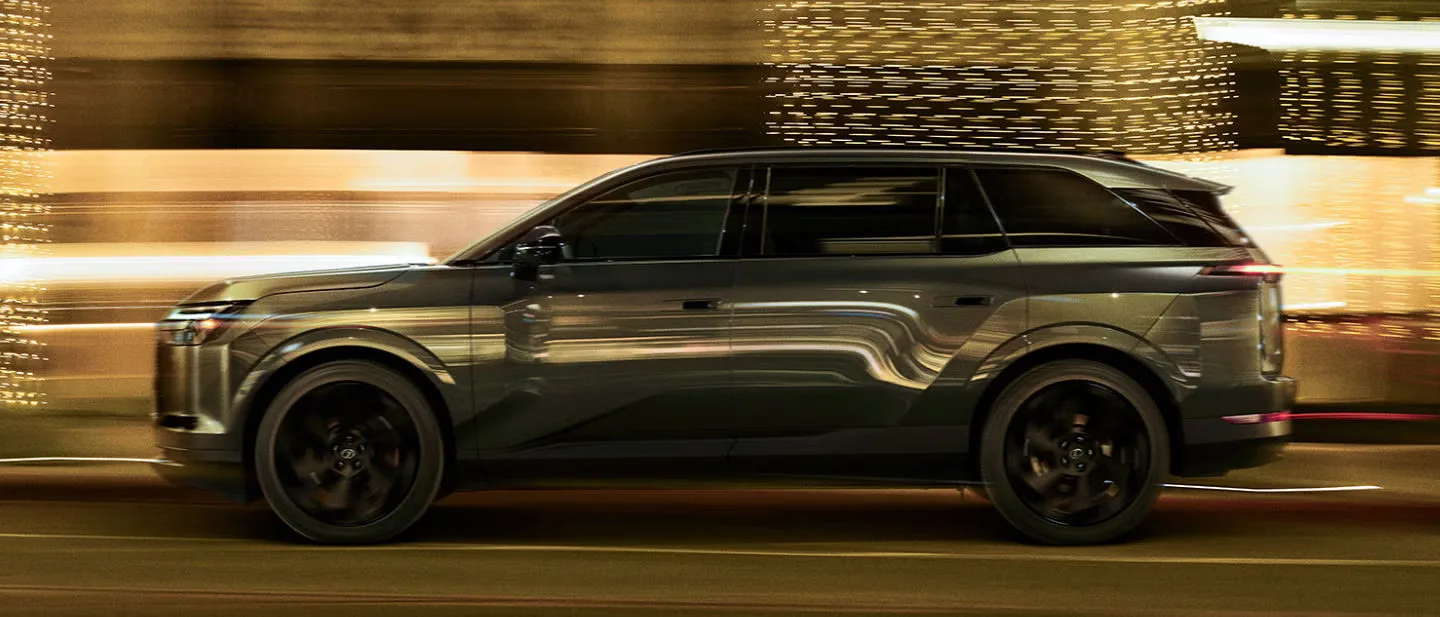
The Lexus TZ is the brand’s first three-row, all-electric SUV and it has a clear job to do: give luxury families a quiet, spacious EV without asking them to leave the Lexus badge behind. It was released in May 2026, and the Lexus TZ will be above the two-row RZ as Lexus’ biggest battery-electric SUV yet, built around what the company calls a “Driving Lounge”. For US buyers it goes on sale at the end of 2026 and Gulf families are already asking when it arrives at showrooms in Dubai, Abu Dhabi, and Riyadh.
This guide covers Lexus TZ price in US dollars and AED, full specs, range, interior details, and how it compares with the Volvo EX90 and Toyota Highlander EV.
Lexus TZ at a glance Type: three-row, six-seat all-electric luxury SUV Drivetrain: dual-motor DIRECT4 all-wheel drive (standard) Batteries: 76.96 kWh or 95.82 kWh Range: up to 300 miles (about 480 km), manufacturer-estimated On sale: late 2026 in the US, 2027 expected in the Gulf Estimated price: around $65,000 to $75,000 (roughly AED 239,000 to AED 275,000)
What is the Lexus TZ?
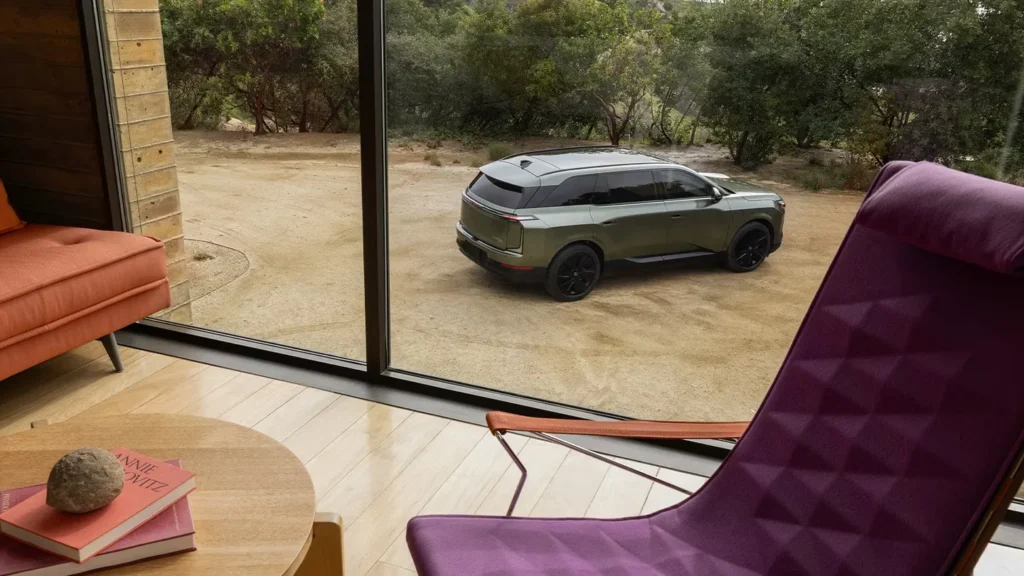
The Lexus TZ is a large electric SUV with three rows and six seats and it is the third EV in the Lexus range after the RZ SUV and the electric ES sedan. Lexus revealed it on May 6, 2026 in Plano, Texas, and confirmed a 2027 model year.
The TZ shares its engineering with the Toyota Highlander EV and Subaru “Getaway” so think of it as the luxury sibling of a mainstream trio. What separates the Lexus is the pampering: forged bamboo cabin trim from Japan’s Shikoku Island, second-row captain’s chairs with power ottomans, a 21-speaker Mark Levinson sound system and the quietest cabin Lexus says it has ever put in an SUV.
Lexus built the TZ on its TNGA platform with a dual-motor, all-wheel-drive setup across every grade. There’s no front-wheel-drive base version like the one Toyota plans for the Highlander EV. That decision keeps the TZ firmly in premium territory and gives Gulf buyers the traction and composure they expect from a flagship family car.
How much does the Lexus TZ cost?
Lexus has not yet given official pricing. The company said grade and pricing details for the 2027 Lexus TZ will be released later in 2026, closer to the on-sale date. Everything below is an informed estimate based on where the TZ falls in the range and what independent US outlets expect.
Industry estimates put the Lexus TZ price around $65,000 to $75,000 in the United States and a mid-range price around $70,000. That puts it above the RZ and squarely against three-row electric rivals. For Gulf buyers, the calculation of those figures in terms of the fixed dirham rate is an indicative range, but the GCC will be set separately once the car is confirmed for the region.
| Lexus TZ (Estimated) | US Price (USD) | Gulf Estimate (AED) |
| Expected entry grade | ~$65,000 | ~AED 239,000 |
| Expected mid grade | ~$70,000 | ~AED 257,000 |
| Expected top grade | ~$75,000 | ~AED 275,000 |
Treat the AED figures as a straight currency conversion, not a confirmed GCC MSRP. Gulf pricing seldom aligns with the US sticker, as local duties, warranty terms, standard equipment, and dealer structures all change the final number. Al-Futtaim Motors provides Lexus in the UAE, and previous launches have shown regional pricing can be higher or lower than a simple conversion once local specs are fixed. Check with an official Lexus dealer for the confirmed Lexus TZ price before you make a purchase.
Lexus TZ specs, battery, and range
The TZ has two lithium-ion battery packs: a 76.96 kWh unit and a larger 95.82 kWh unit. Lexus has suggested a manufacturer-estimated range of up to 300 miles (around 480 km on a certain grade). Regional test cycles in Europe and the Gulf can produce a higher number, and some outlets list up to 530 km on the WLTP-style rating.
Lexus has not released official power figures. Independent estimates of the dual motor output are around 402 horsepower (408 PS), which would be consistent with Subaru’s version of the same platform. Make that number a guess until Lexus confirms it.
| Specification | Details |
| Body Style | Three-row, six-seat electric SUV |
| Drivetrain | Dual-motor DIRECT4 AWD (standard) |
| Battery Options | 76.96 kWh / 95.82 kWh |
| Estimated Range | Up to 300 miles / ~480 km (manufacturer estimate) |
| Estimated Power | ~402 hp / 408 PS (unconfirmed) |
| Length | 200.8 in (5,100 mm) |
| Width | 78.3 in (1,990 mm) |
| Height | 67.1 in (1,704 mm) |
| Wheelbase | 120.1 in (3,050 mm) |
| Cargo Capacity (3rd Row Up) | 13.8 cu ft |
| Wheels | 20 in or 22 in |
| Drag Coefficient | 0.27 Cd |
| Towing Capacity | Up to 3,500 lb |
| Charging Port (US) | NACS |
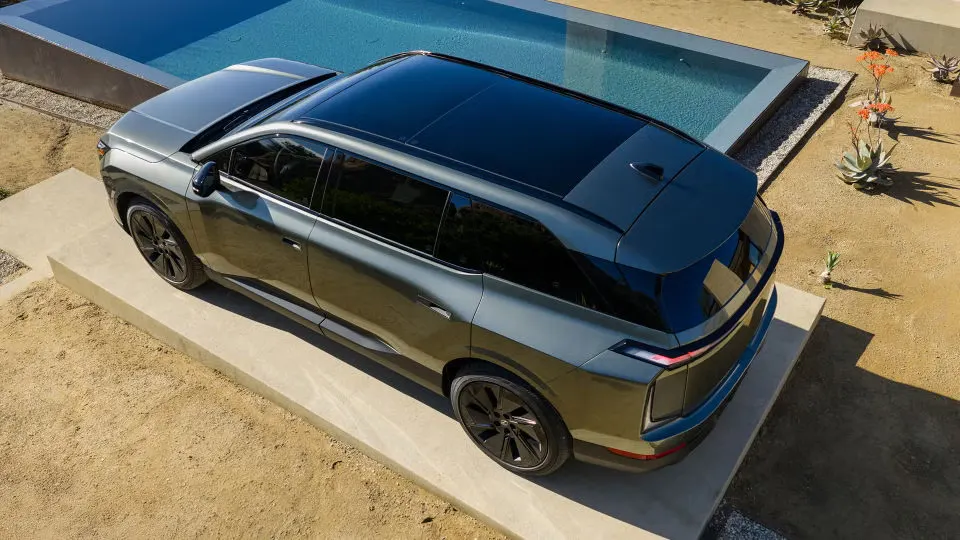
The chassis pairs MacPherson struts up front with a multi-link rear, and an available Dynamic Rear Steering system turns the rear wheels up to four degrees. At low speed that tightens the turning circle for parking; at highway speed it steadies the big SUV through lane changes. A 0.27 drag coefficient is strong for a vehicle this size and helps the TZ stay in its range at Gulf highway cruising speeds.
Lexus TZ Exterior Design
Lexus provided the TZ with a look that stands apart from the rest of its SUV portfolio. The spindle body treatment trades the old grille for a solid, sculpted front mass, with Twin-L signature lamps that split the daytime running lights and turn signals into an L-shaped motif. The front emblem lights up in body color so it reads clean by day and glows at night. Flush door handles, aerodynamic mirrors, underbody fins, and resin aero wheel covers all work toward that low 0.27 drag figure.
The profile is long and low for a three-row SUV, with pronounced fenders that keep the presence you expect from a big Lexus. The roofline slopes at the rear for airflow without stealing third-row headroom, and aluminum roof rails made of recycled material add a practical mounting point for a roof box or bikes. Wheels come in 20-inch and 22-inch sizes, the larger set using sculpted aluminum spokes.
Lexus has six exterior colors at launch, with a new color called Shaded Ivy introduced in a muted green to tie the car to its natural surroundings. Inside, there are three palettes: Birch in light grey, Acorn in mid-tone, and a monochrome Black with Dapple Grey. For Gulf buyers who want lighter cabins that are cool in the sun, the Birch option is a good choice.
Inside the Lexus TZ: the Driving Lounge
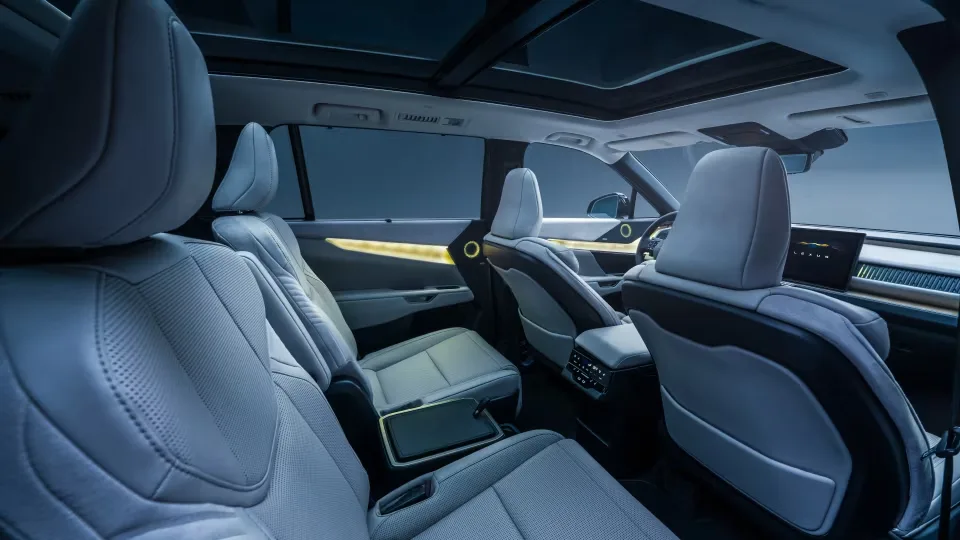
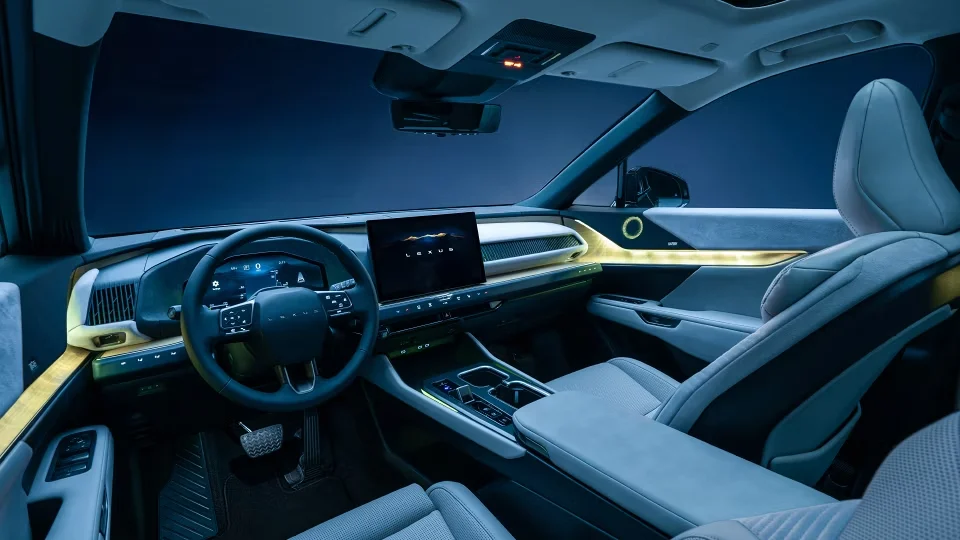
Lexus designed the TZ interior around comfort for everyone on board, not just the driver. The cabin is low floor and long wheelbase to open up space, with a slim instrument panel and an expansive panoramic roof that extends all the way to the third row. Ambient lighting incorporates six Japanese themes.
The materials are where the Lexus TZ interior earns its price. Forged bamboo surfaces, plant-based UltraSuede, and recycled aluminum roof rails make the cabin a very eco-minded one. Front passenger and second-row seats have ventilation and power ottomans, a first for a Lexus SUV, and every seat is heated. The third row has sofa-like cushioning, and a walk-in button on the second-row chairs makes climbing back easier even with a child seat fitted.
Lexus calls the TZ the quietest SUV it has ever built, using sound-absorbing materials, a vibration-offsetting design, and aerodynamic mirrors so passengers can talk across all three rows without raising their voices. For a family that spends long stretches on the road, whether that be a US interstate or the Sheikh Zayed Road, the REAR COMFORT drive mode is a useful touch. It coordinates rear steering, braking, and torque delivery to reduce pitching and swaying that make back-seat passengers queasy.
Lexus TZ features and technology
The TZ runs the latest Lexus Interface multimedia system with sharper graphics, an improved “Hey Lexus” voice assistant, and AT&T 5G connectivity. Wireless Apple CarPlay and Android Auto are included, along with a Mark Levinson 21-speaker audio system and available streaming through Spotify and SiriusXM with 360L.
Charging hardware is important. The US model has a North American Charging Standard (NACS) port and Lexus has a first-of-its-kind 2-in-1 charging port that puts the AC and DC connectors side by side under a motorised sliding cover. Reports from the reveal put a 10 to 80 percent DC charge at around 35 minutes on a 150 kW charger. Pre-conditioning the battery warms the pack before you get to a fast charger so that it is ready to accept power quickly, which is even more important in cold US winters than in Gulf heat.
On driver assistance, the TZ comes with Lexus Safety System+ 4.0. It also includes Risk Avoidance Emergency Steering Assist, Intersection Turn Assist, Proactive Driving Assist, and full-speed radar cruise with Eco-Run mode. Traffic Jam Assist allows hands-free steering in slow highway traffic on select grades.
Lexus also provided the TZ with an Active Sound Control. Some sites reported that it can pipe in an on-demand soundtrack inspired by the LFA supercar’s V10, so the silent EV can put on a show when the driver wants one. Lexus has presented this as a feature that is not a specification, and we expect details to come in at launch.
When is the Lexus TZ release date?
Lexus expects the 2027 TZ to go on sale in the United States by the end of 2026, and details around pricing and grades will be released closer to that date. That timing is in line with the RZ and ES electric models that are already in showrooms.
For the Gulf, there is no official launch date yet. The usual trend for luxury EVs is to arrive in the Gulf a few months after the US launch, and therefore it would be possible that the GCC launch will be made by official Lexus dealers in the UAE, Saudi Arabia, and the wider region in 2027. The first battery-electric SUV (RZ500e) was launched in the Middle East in mid-2026, so there is already a base for the launch of TZ. There is nothing to confirm though until Lexus provides GCC specs, warranty, and pricing.
Lexus TZ vs Volvo EX90
The Volvo EX90 is the TZ’s most direct luxury rival, and it arrived a year earlier, so it sets a useful benchmark. The 2026 EX90 switched to an 800-volt system for faster charging and more power.
| Spec | Lexus TZ (2027) | Volvo EX90 (2026) |
| Starting price (US) | ~$65,000 (est.) | $78,090 |
| Power | ~402 hp (est.) | 329 to 670 hp |
| Range | Up to ~300 mi (est.) | Up to ~305 mi |
| Seats | $6 | 6 or 7 |
| Drivetrain | AWD standard | RWD or AWD |
| Electrical architecture | 400-volt | 800-volt |
The EX90 has an 800-volt platform, quicker charging, and a wider power spread at 670 hp. The Lexus answer is probably a lower entry price, standard all-wheel drive, and a cabin tuned harder for passenger comfort. Buyers who value serenity and value may prefer Lexus; those who want charging speed and outright power may opt for Volvo.
Lexus TZ vs Highlander EV
The comparison depends on badge, tuning, and price rather than bones, as the Lexus TZ and Toyota Highlander EV share a platform. The Highlander EV is the mainstream option; the TZ is the luxury version of the same idea.
| Spec | Lexus TZ (2027) | Toyota Highlander EV (2027) |
| Positioning | Luxury flagship EV | Mainstream family EV |
| Drivetrain | AWD only | FWD or AWD |
| Power | ~402 hp (est.) | 221 hp (FWD) / 338 hp (AWD) |
| Cabin Materials | Forged bamboo, UltraSuede | Standard trim |
| Second Row | Captain’s chairs, ottomans | Bench or captain’s chairs |
| Expected Price | Higher | Lower |
If you want the space and the electric drivetrain without the premium investment, then the Highlander EV covers the basics. The TZ is for buyers who want the quieter cabin, richer materials, power ottomans, and the Lexus ownership experience, and who pay a premium for them.
There is also a drivetrain gap worth calling out. Toyota is planning to sell the Highlander EV with front-wheel drive in the US as an entry point, and its dual-motor version has 338 hp. The Lexus does not offer front-drive at all and, by the numbers, adds quite a bit of power on top. It is for Gulf roads, where long high-speed cruising and the occasional loose desert shoulder come into play, that the standard all-wheel drive setup gives the TZ a competitive advantage that the Toyota cousin’s base model doesn’t match.
What the Lexus TZ means for Gulf and GCC buyers
The three rows, dual-motor grip, and a cabin for passengers to remain calm on long drives are all factors that make the TZ a natural fit for Gulf families. A few local realities are worth weighing before you get excited.
The first is heat. Range and cabin cooling work differently in a Dubai or Riyadh summer than in a US test lab. The manufacturer’s 300-mile estimate will drop with the air conditioning working hard across all three rows, so we expect that to be in the range of 350 to 400 km on the larger battery during peak summer. Lexus fitting ventilation to the front passenger and second-row seats helps here.
The second is charging. The US car has a NACS port, and whether that plugs cleanly into GCC networks such as DEWA and ADPower will depend on local adapters and software support at launch. Most Gulf owners will charge at home on a wallbox, where an 11 kW unit can refill the larger pack in about six to eight hours overnight. Confirm with your dealer the regional charging standard rather than assuming the US setup carries over.
The third thing we don’t know anything about is availability. No GCC launch is officially confirmed; all local specs, warranties, and pricing are still pending. Lexus has a strong SUV presence in the region that is based on the LX, RX, and GX, so the TZ is likely to have a clear audience once it hits the market. A three-row electric option allows loyal Lexus families to switch to an EV without changing brands, which is one reason regional interest has been strong ahead of any official announcement. Until then, treat Gulf timing and pricing as expected rather than fixed.
The Verdict
The Lexus TZ provides the brand with a credible three-row electric SUV at a time when luxury EV families have real choice. The case rests on a quiet, richly finished cabin, standard all-wheel drive, and a likely price advantage over the Volvo EX90. The open questions are power, which Lexus has not confirmed, and Gulf availability, which is expected but not dated.
If you are shopping in the US now, then the TZ may be worth waiting for before you decide to buy an EX90 or Rivian R1S, especially if cabin comfort is more important than charging speed. If you are in the Gulf, keep the TZ on your shortlist and ask your local dealer for confirmed GCC specs, warranty, and pricing once Lexus announces them. On paper, it is one of the more compelling luxury electric SUVs going into 2027.
Pricing, power output, and Gulf launch details are estimates or are still under official confirmation as of publication. Verify final figures with Lexus before purchase.
FAQs
Q. What is the expected price of a Lexus TZ in the US and Gulf?
A. Lexus has not confirmed pricing. Independent estimates put the US price between $65,000 and $75,000. Converted at the fixed dirham rate, that is roughly AED 239,000 to AED 275,000, but the official GCC price will be set separately and may differ once local specs are confirmed.
Q. What is the Lexus TZ range on a full charge?
A. Lexus quotes a manufacturer-estimated range of up to 300 miles, about 480 km, on a certain grade with the larger 95.82 kWh battery. Gulf test cycles may have a higher number, and hot-weather driving with the air conditioning running will lower the real-world number.
Q. When will the Lexus TZ be released?
A. The 2027 Lexus TZ goes on sale in the United States at the end of 2026. No Gulf launch date has been set for that time, but regional launch through official Lexus dealers is expected in 2027.
Q. Is the Lexus TZ all-wheel drive?
A. Yes. Every grade of the Lexus TZ has all-wheel drive, and all grades are equipped with a dual-motor DIRECT4 all-wheel-drive system. Unlike the Toyota Highlander EV, there is no front-wheel-drive version.
Q. How many seats does the Lexus TZ have?
A. The Lexus TZ is a six-seat, three-row SUV with second-row captain’s chairs. The front-passenger and second-row seats have ventilation and power ottomans, and the third row has sofa-style cushioning.