
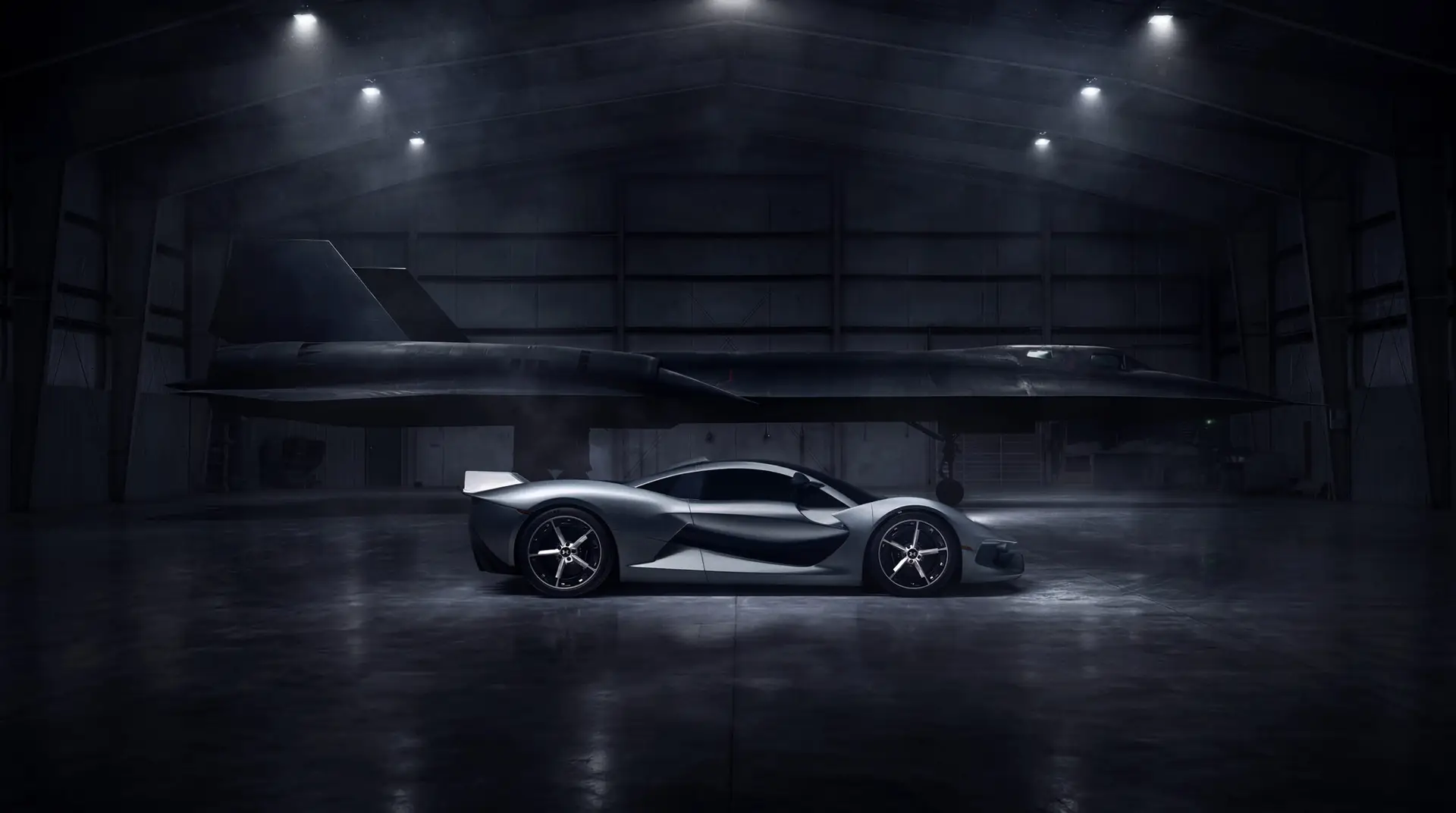
There’s a particular kind of shock that runs through the hypercar world when a manufacturer does the opposite of what everyone expects, and that’s exactly what happened when Hennessey pulled the covers off its newest creation. At a moment when nearly every hypercar maker is racing toward hybrid systems, dual-clutch gearboxes, and screen-filled cockpits, this new arrival came with none of that. No turbos. No hybrid assistance. No digital displays. Just a screaming, naturally aspirated V8, a gated six-speed manual gearbox, and a design language borrowed straight from a Cold War spy plane.
This is Hennessey Blackbird third bespoke hypercar, following the record-setting Venom GT and the 300-mph Venom F5, and the new Hennessey Blackbird takes the company in a genuinely different direction. Rather than chasing another top-speed record, it’s built around driver engagement, long-distance comfort, and a kind of analog purity that’s becoming rare at this end of the market. It’s a statement car in every sense, and for anyone following the hypercar space in the US, GCC, and UAE markets, it’s quickly become one of the most talked-about reveals of 2026.

Hennessey Blackbird Specifications at a Glance
For anyone who wants the full picture in one place, here’s every key spec that matters most, straight from the car’s official reveal.
| Specification | Detail |
| Engine | 6.2-liter naturally aspirated V8 (Ilmor-developed) |
| Horsepower | 800-850 hp (597-634 kW) |
| Redline | Over 9,000 rpm |
| Transmission | 6-speed gated manual |
| Drivetrain | Rear-wheel drive |
| 0-60 mph | 2.5 seconds |
| Top speed | 220 mph (354 km/h) |
| Dry weight | Under 3,000 lbs (approx. 1,360 kg) |
| Chassis | Full carbon-fiber tub and body |
| Production run | 71 units worldwide |
| Starting price | $2.5 million (before taxes) |
| Assembly location | Sealy, Texas, USA |
| Public debut | August 14, 2026, The Quail |
| Customer deliveries | 2029-2030 |
This guide covers everything currently known about the car: its price, full specifications, engine, performance figures, design philosophy, interior, and how it stacks up against its closest rivals.
Hennessey Blackbird First Look: What Happened at The Quail
It made its public debut on August 14, 2026, at The Quail during Monterey Car Week, one of the most closely watched stages in the entire automotive calendar. What made this particular reveal notable wasn’t just the car itself, but how much of it had already sold before anyone outside Hennessey had seen it in person. More than two-thirds of the planned production run was reserved ahead of the public unveiling, which tells you a lot about how strongly this concept resonated with serious collectors before a single review had been published.
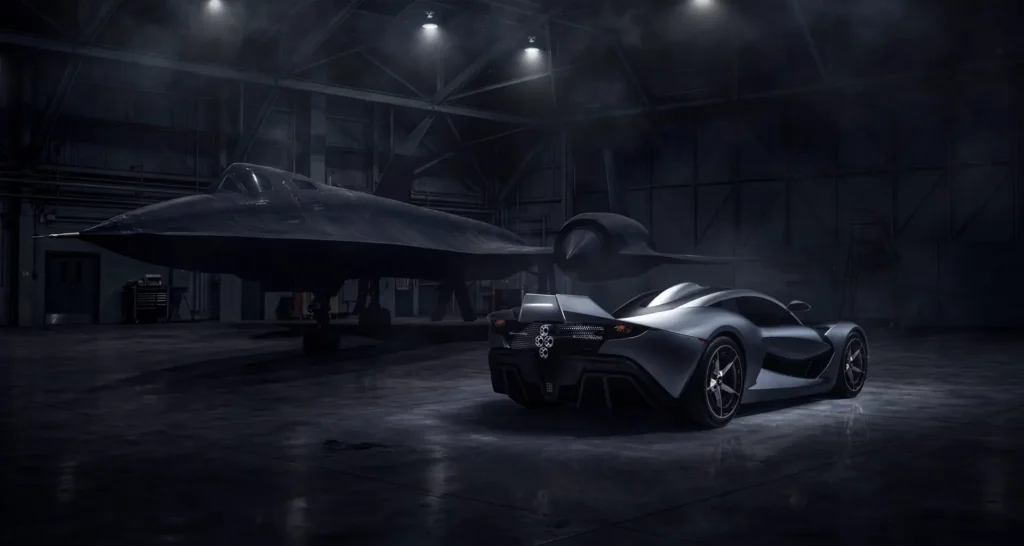
Named after the Lockheed SR-71, a Cold War-era reconnaissance aircraft so fast it reportedly outran every missile ever fired at it, the Blackbird leans on that aerospace heritage in both name and execution. Company founder John Hennessey has described the launch as “the beginning of a new book” for the brand, a description that fits given how sharply this car departs from the twin-turbo, top-speed-focused Venom F5 that came before it.
Hennessey Blackbird Release Date and Delivery Timeline
Anyone hoping to see a Hennessey Blackbird on the road soon will need patience. While the car was formally revealed in August 2026, customer deliveries aren’t expected to begin until 2029, running through 2030. That timeline is deliberate: Hennessey wants the Venom F5 production cycle, which is expected to wind down around 2028, to clear the way before Blackbird production ramps up in earnest at the company’s Sealy, Texas facility.
Every unit will be homologated for key global markets, which matters significantly for buyers in the GCC and UAE, where regulatory approval for low-volume hypercars isn’t always guaranteed. Hennessey has confirmed this car is being engineered from the outset with international compliance in mind, rather than treating overseas homologation as an afterthought.
Hennessey Blackbird Price: What $2.5 Million Actually Buys
Pricing starts at $2.5 million before local taxes, placing it firmly in the same rarefied territory as cars like the Gordon Murray Automotive T50, one of the few other modern hypercars built around a naturally aspirated engine and a manual gearbox rather than outright top-speed numbers.
Production is capped at just 71 units worldwide, and that number isn’t arbitrary. Hennessey Blackbird has built a clever bit of engineering symbolism into the car itself: when the Blackbird reaches 71 mph, active vertical stabilizers at the rear rise and lock at a 71-degree angle, a detail that pays tribute both to the SR-71 namesake and to the exact size of the production run. At this price point and rarity, the Blackbird isn’t really competing on value; it’s competing on exclusivity, engineering purity, and the kind of ownership experience that comes from being one of only 71 people on the planet with one.
Hennessey Blackbird Pricing Comparison
Here’s how the Blackbird’s $2.5 million starting price stacks up against the closest hypercars in its class, along with Hennessey’s own Venom F5 for internal context.
| Hypercar | Starting Price | Price Position |
| Hennessey Blackbird | $2.5 million | Baseline |
| Hennessey Venom F5 | ~$2.1 million | ~16% less than Blackbird |
| Pagani Utopia | ~$2.5-3.0 million | Roughly on par |
| Gordon Murray T50 | ~$3.0 million | ~20% more than Blackbird |
| Bugatti Tourbillon | ~$4.6 million | ~84% more than Blackbird |
| Koenigsegg Jesko | ~$3.0-3.4 million | ~20-36% more than Blackbird |
Competitor pricing figures are approximate, publicly reported estimates and may vary by configuration, region, and taxes.
Positioned this way, the Blackbird actually sits toward the more accessible end of the ultra-low-volume, driver-focused hypercar segment, undercutting both the Gordon Murray T50 and Bugatti’s latest flagship while asking roughly the same money as Pagani’s current halo car.
Hennessey Blackbird Engine: The Return of Naturally Aspirated Power
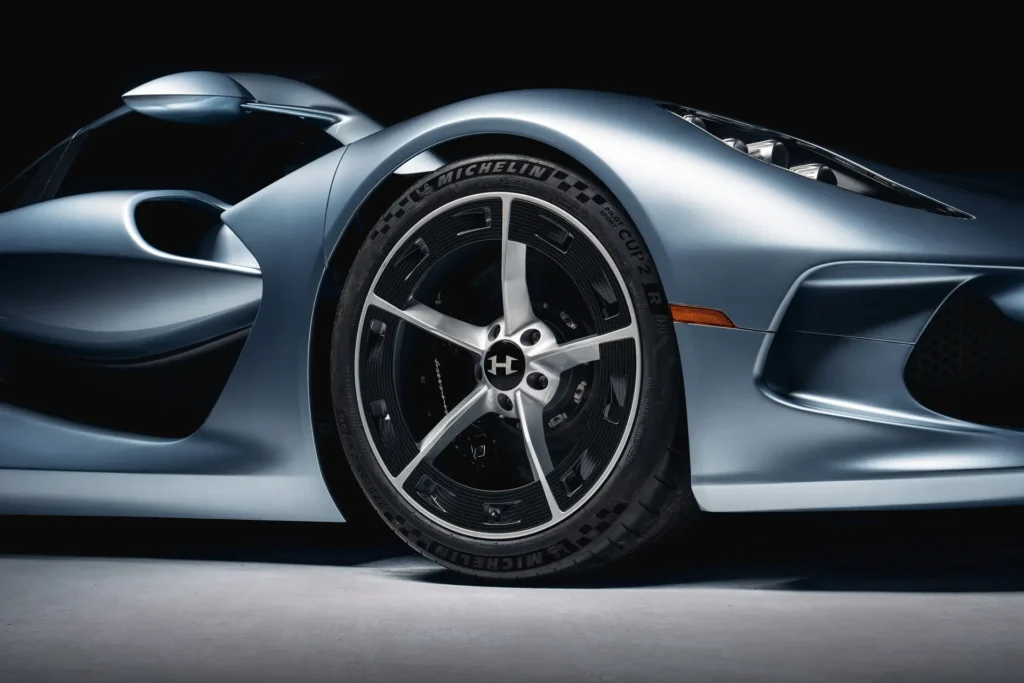
At the heart of this hypercar is a genuinely rare thing in 2026: a big, naturally aspirated V8 with no turbochargers and no electric motors helping it along. Developed in partnership with Ilmor, the storied racing engine specialist, the 6.2-liter unit is engineered to produce between 800 and 850 horsepower while revving past 9,000 rpm, numbers that would have sounded fantastical for a non-turbocharged engine even a decade ago.
This decision runs directly against where the rest of the industry has been heading. Hybrid assistance and forced induction have become the default path to big horsepower numbers because they’re simply easier to engineer around modern emissions and efficiency targets. Going purely naturally aspirated at this power level required Hennessey and Ilmor to solve genuinely difficult problems around combustion efficiency, valvetrain durability at high RPM, and heat management, all without the safety net of turbo boost to make up any shortfall.
Hennessey Blackbird Horsepower and Real-World Performance
The horsepower figure alone only tells part of the story. What matters just as much is how that power reaches the road. All 800-plus horsepower routes exclusively to the rear wheels through a six-speed gated manual transmission, a deliberately old-school choice that puts the driver in complete control of every gear change, throttle blip, and clutch engagement.
Performance here has been engineered around driver involvement first and headline numbers second, but the numbers are still genuinely serious for a car built this way:
- 800-850 horsepower from a naturally aspirated 6.2-liter V8
- 9,000-plus rpm redline, among the highest of any production V8
- Sub-3,000-lb dry weight, giving it a formidable power-to-weight ratio
- Full carbon-fiber tub construction for maximum rigidity with minimal mass
- Adaptive suspension tuned for both spirited driving and long-distance comfort
Hennessey Blackbird 0-60 Time and Top Speed
On paper, the 0-60 time comes in at 2.5 seconds, a genuinely quick figure for a rear-wheel-drive car sending power through a manual gearbox rather than a launch-control-optimized dual-clutch system. Top speed is rated at 220 mph, which is intentionally short of the Venom F5’s 300-mph territory, because outright top speed was never the point of this car.
That’s the core philosophy behind the Blackbird’s entire performance envelope: Hennessey deliberately dialed back the top speed ambition in exchange for a car that feels alive and communicative at every speed, not just flat-out on a runway. For a company built on record-setting speed runs, that’s a meaningful shift in priorities, and it says a lot that Hennessey was willing to give up bragging rights on top speed in exchange for a more emotionally engaging driving experience.
Hennessey Blackbird Exterior Design: Built Like an Aircraft
The exterior design draws directly from its aerospace namesake. Long, disciplined proportions echo the SR-71’s fuselage, complete with a crisp body-side chine line that mirrors the aircraft’s distinctive profile. The rear-mounted active vertical stabilizers aren’t just functional aerodynamic elements; they’re a direct visual callback to the SR-71’s own vertical stabilizers, deployed here in dramatic fashion once the car crosses 71 mph.
Every exterior surface is shaped by a full carbon-fiber body over the carbon tub chassis, keeping weight down while allowing for the kind of sculpted, aircraft-inspired forms that separate the Blackbird visually from the more conventionally aggressive styling seen on most modern hypercars. Gullwing doors complete the aerospace theme while also making entry and exit genuinely easier than the low, narrow door openings typical of this segment.
Hennessey Blackbird Interior: A Screen-Free Cockpit
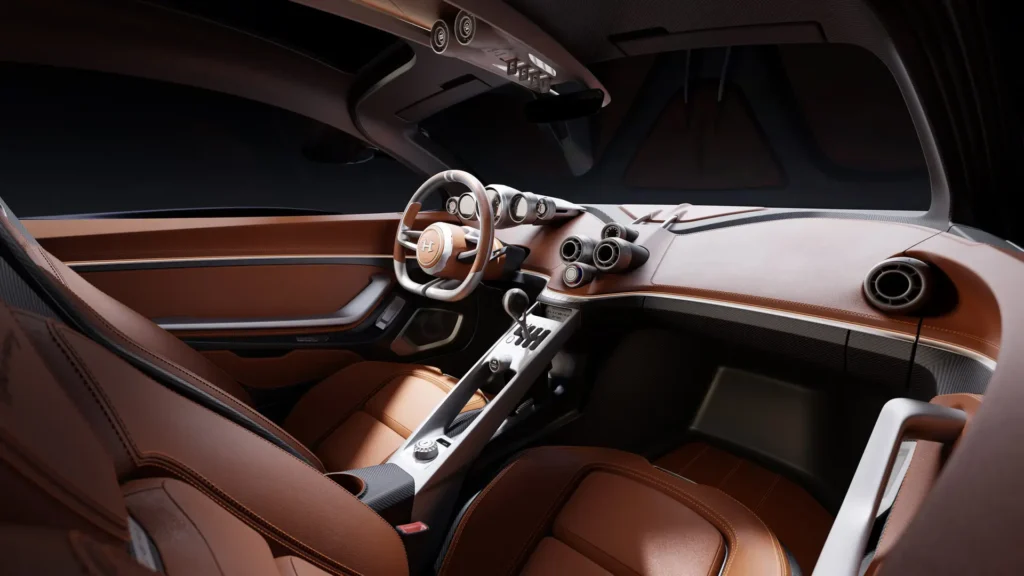
Step inside and the most striking thing isn’t what’s there, it’s what’s missing. There are no digital screens anywhere in the cabin. Instead, the interior uses round analog gauges directly inspired by the SR-71’s actual cockpit instrumentation, physical switchgear, and even a traditional metal key rather than a keyless start button.
Interior details that stand out include:
- Round, aircraft-inspired analog instrument dials in place of any digital display
- Physical switches and controls throughout the cabin
- A traditional metal ignition key
- A standard whiskey compass mounted on the dash
- An optional dedicated timepiece integrated into the interior
- Front trunk space for two full-size carry-on bags, plus additional storage in the rear quarters and cabin
That last point matters more than it might seem. Hennessey engineered the Blackbird with a specific brief: the ability to comfortably cover more than 800 miles in a single day. That required a larger cabin than the Venom F5, genuine luggage capacity, and adaptive suspension tuned with real noise, vibration, and harshness targets, not just outright cornering grip.
Hennessey Blackbird Features That Set It Apart
Beyond the headline specs, a handful of standout features reflect just how differently this car was conceived compared to its hybrid, screen-heavy competitors:
- Zero digital screens anywhere in the cockpit
- Traditional gated manual shifter with a mechanical, visible shift gate
- Active rear stabilizers that physically deploy at 71 mph
- Adaptive suspension tuned for both performance and 800-mile-plus comfort
- Full global homologation from launch, including GCC and UAE markets
- Gullwing doors for easier cabin access
Hennessey Blackbird Design Story: From Spy Plane to Road Car
This design didn’t start with a clay model or a wind tunnel session in the traditional sense; it started with a Cold War aircraft that hasn’t flown since 1998. Designers studied the SR-71’s fuselage proportions, its chine lines, and the way its shape was dictated almost entirely by function rather than styling trends, then translated that same discipline into a road car. The result is a hypercar that looks distinctly different from the sharp-edged, wing-heavy aesthetic that dominates most of its rivals.
Every element of it serves a purpose rooted in that aerospace thinking. The long hood and cabin proportions echo the SR-71’s fuselage-to-cockpit ratio. The active rear stabilizers aren’t styling flourishes bolted on for effect; they’re functional aerodynamic elements that happen to double as a visual tribute to the aircraft that inspired the entire project. Even the choice of a full carbon-fiber tub and body reflects an aerospace-style obsession with strength-to-weight ratio rather than a purely automotive one.
Why This Hypercar Matters for GCC and UAE Buyers
Hypercar collectors in the Gulf region have historically had to wait, sometimes years, for low-volume manufacturers to formally homologate ultra-limited models for local roads. Hennessey has addressed that concern directly with the Blackbird, confirming global homologation, including GCC and UAE markets, as part of the car’s original engineering brief rather than a later addition.
That matters for a few practical reasons specific to this market:
- Extreme heat tolerance is a genuine engineering concern for naturally aspirated engines revving past 9,000 rpm, and Hennessey’s adaptive suspension and cooling systems were developed with international climates in mind
- The car’s 800-mile daily-usability target aligns well with the long-distance highway driving common across GCC road networks
- Formal homologation from launch reduces the registration and import friction that has historically slowed hypercar ownership in the region
- Dubai and Abu Dhabi’s established hypercar dealer networks are expected to be among the first international channels handling Blackbird allocations
Hennessey Blackbird Tuning Philosophy: Engineering for Emotion
Hennessey has built its reputation over more than three decades of tuning and horsepower records, so it’s worth understanding how the Blackbird fits into that broader identity. The company started in 1991 modifying production vehicles for more power, and that tuning heritage eventually evolved into building fully bespoke supercars from the ground up, starting with the Venom GT.
Unlike a tuned or modified vehicle built on someone else’s platform, the Blackbird is a fully bespoke, ground-up hypercar, developed the same way the Venom F5 was. The tuning philosophy here isn’t about extracting the highest possible number from an existing engine; it’s about engineering an entirely new naturally aspirated V8 specifically to deliver a certain feeling behind the wheel. That distinction matters for anyone evaluating Hennessey as a manufacturer rather than just a tuning house, and it’s a meaningful part of how this specific supercar is being positioned to collectors.
The Blackbird represents Hennessey’s most significant engineering and development commitment to date, built entirely in-house in Texas rather than developed as an aftermarket upgrade to another company’s chassis. It’s a distinction that separates this supercar from the vast majority of Hennessey’s earlier catalog, which largely consisted of modified versions of existing production vehicles.
Hennessey Blackbird vs Rival Supercars
As a naturally aspirated, manual-transmission hypercar built around driver feel rather than pure top speed, this supercar sits in a genuinely small category. Here’s how it compares to its closest rivals.
| Model | Engine | Horsepower | 0-60 mph | Top Speed | Price (approx.) |
| Hennessey Blackbird | 6.2L N/A V8 | 800-850 hp | 2.5 sec | 220 mph | $2.5 million |
| Gordon Murray T50 | 4.0L N/A V12 | ~654 hp | ~2.8 sec | ~224 mph | ~$3 million |
| Pagani Utopia | 6.0L twin-turbo V12 | ~852 hp | ~2.8 sec | ~223 mph | ~$2.5-3 million |
| Hennessey Venom F5 | Twin-turbo V8 | 1,817 hp | ~2.6 sec | ~300 mph | ~$2.1 million |
Competitor figures are approximate publicly reported estimates and may vary by configuration.
The comparison makes Hennessey’s positioning clear. Against the Venom F5, its own sibling, the Blackbird trades raw top-end speed for a dramatically lighter, more mechanically engaging package. Against the T50 and Utopia, it holds its own on horsepower while offering a genuinely unique naturally aspirated character in a field where even “analog-focused” rivals like the Utopia still rely on turbocharging.
Hennessey Blackbird for Sale: How to Actually Get One
For anyone hoping to buy one for sale, the reality is straightforward: with more than two-thirds of the 71-unit production run already allocated before the public debut, remaining availability is extremely limited. Prospective buyers will need to work directly through Hennessey Special Vehicles or an authorized dealer network, and given the car’s homologation for global markets, that includes established channels serving GCC and UAE buyers specifically.
Given the multi-year wait for deliveries (targeted for 2029 through 2030), anyone seriously interested should expect a lengthy order process similar to other ultra-limited hypercars, where reservation deposits and buyer vetting typically happen well before a chassis is ever built.
Hennessey Blackbird Review: Early Reactions From the Industry
Early review coverage from major outlets has focused heavily on the contrarian nature of the car’s engineering choices. Automotive journalists have broadly praised the decision to skip hybrid assistance and digital interfaces entirely, framing it as a deliberate rejection of where the rest of the hypercar segment has been heading. Several reviewers have specifically highlighted the naturally aspirated V8’s rev range and the tactile experience of the gated manual as standout elements that differentiate it from nearly everything else currently in development at this price point.
The most consistent theme across early coverage: this is being read less as a spec-sheet flex and more as a genuine philosophical statement from Hennessey about what a hypercar can still be in an era dominated by electrification.
Hennessey Blackbird 2026: Why This Launch Matters Right Now
The timing of this 2026 reveal is significant. It arrives at a moment when nearly every major hypercar manufacturer, from Bugatti to Koenigsegg, has moved toward hybridization to hit both performance and efficiency targets simultaneously. By launching a car that deliberately avoids that entire trend, Hennessey is making a bet that a meaningful segment of ultra-wealthy collectors still wants something purely mechanical, and the fact that two-thirds of the run sold before the public even saw it suggests that bet is paying off.
Hennessey Blackbird: Pros and Cons
| Pros | Cons |
| Naturally aspirated V8 with no turbo lag | Lower top speed than Hennessey’s own Venom F5 |
| Genuine manual transmission, rare at this power level | Multi-year wait for deliveries (2029-2030) |
| Screen-free, analog interior with real character | Extremely limited availability (71 units) |
| Designed for genuine 800-mile daily usability | High entry price at $2.5 million |
| Global homologation from launch, including GCC/UAE | Majority of production already reserved |
Final Verdict
The Hennessey Blackbird is a genuinely unusual hypercar in 2026, not because of what it adds, but because of what it deliberately leaves out. No turbos, no hybrid system, no screens, just an 800-plus-horsepower naturally aspirated V8, a proper manual gearbox, and a design language pulled straight from a legendary reconnaissance aircraft. Looking across the full spec sheet, what stands out most is how consistent the philosophy is from the engine bay to the cabin to the exterior sheet metal — everything here serves the goal of driver engagement over spec-sheet dominance.
At $2.5 million and limited to 71 examples, the Hennessey Blackbird isn’t a car most people will ever own, but as a statement about what a hypercar can still be in an increasingly hybridized, digitized market, it’s one of the most interesting reveals of the year. For collectors across the US, GCC, and UAE who value mechanical purity over spec-sheet dominance, the Blackbird may be exactly the kind of hypercar the segment has been missing.
FAQs
Q. How much does it cost Hennessey Blackbird?
A. The Hennessey Blackbird starts at $2.5 million before local taxes, with production limited to 71 units worldwide.
Q. What engine does it use Hennessey Blackbird ?
A. It uses an Ilmor-developed 6.2-liter naturally aspirated V8 producing between 800 and 850 horsepower, with no turbocharging or hybrid assistance.
Q. How fast is it Hennessey Blackbird?
A. The Blackbird accelerates from 0-60 mph in 2.5 seconds and has a top speed of 220 mph.
Q. Hennessey Blackbird When will it be delivered to customers?
A. Customer deliveries are targeted for 2029 through 2030, after Hennessey’s Venom F5 production cycle winds down.
Q. Hennessey Blackbird Is it sold out?
A. More than two-thirds of the 71-unit production run was reserved before the car’s public debut, so remaining availability is extremely limited.
Q. Does it have a manual transmission in Hennessey Blackbird?
A. Yes, it uses a six-speed gated manual transmission sending power exclusively to the rear wheels.
Q. Hennessey Blackbird Will it be available in the UAE and GCC region?
A. Yes, Hennessey has confirmed the Blackbird is homologated for key global markets, including regions like the GCC and UAE, from the start of production.
Q. How is the Hennessey Blackbird different from the Venom F5?
A. The Venom F5 is a twin-turbo, top-speed-focused hypercar capable of around 300 mph, while the Blackbird prioritizes naturally aspirated power, manual engagement, and long-distance comfort over outright top speed.
Q. Why is it called the Hennessey Blackbird?
A. The name honors the Lockheed SR-71 Blackbird, a Cold War-era Mach 3 reconnaissance aircraft famous for being fast enough to outrun every missile ever fired at it. Hennessey’s design team drew directly on the aircraft’s proportions and details throughout the car’s development.
Q. Hennessey Blackbird Does it have any digital technology at all?
A. The cabin itself is deliberately screen-free, relying on analog gauges and physical switches. The car does, however, include modern engineering underneath, including adaptive suspension, even though none of that technology is presented to the driver through a digital interface.