
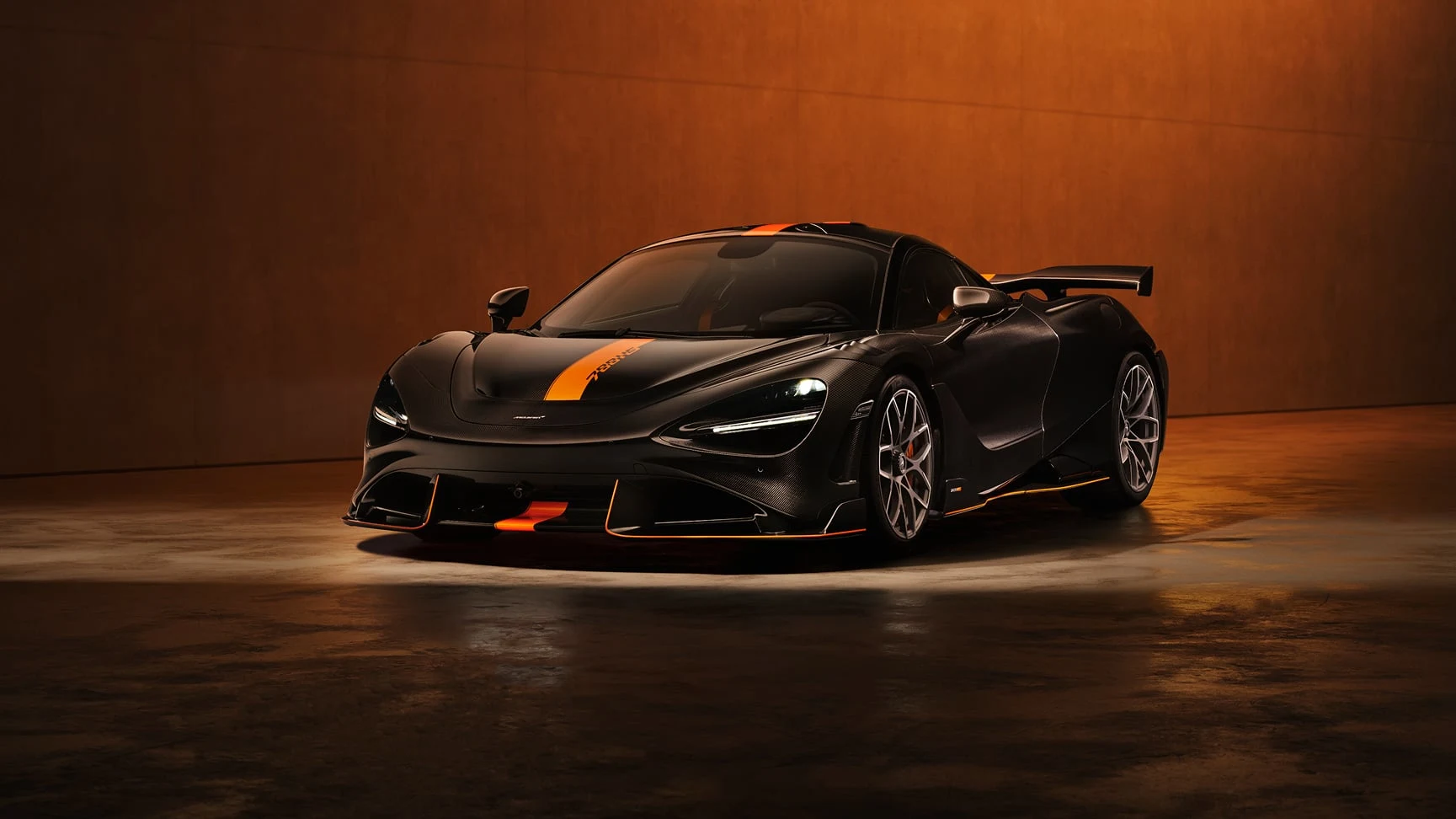
Every long-running supercar line gets its send-off, and the McLaren 788HS is exactly that. This is the car McLaren developed in order to close the book on a chapter that started on the 720S in 2017, went through the savage 765LT and ended with the polished 750S. The McLaren 788HS 2026 takes all Woking learned in 765LT,decade and puts it into a run of just 200 cars. If you want the last, most extreme version of one of the great modern supercars, this is where the road ends.
It arrived at the Goodwood Festival of Speed in 2026 as the first truly new McLaren for nearly two years, and it wears a badge that the brand rarely gives out. HS stands for High School, and only two other McLarens had earned it before the 788HS. That alone tells you where this car belongs in the pecking order.
Below, we walk through the engine, the performance numbers, the aero, the cabin, and what it might cost in the US and the Gulf. We also answer the five questions buyers in America and the GCC ask most.
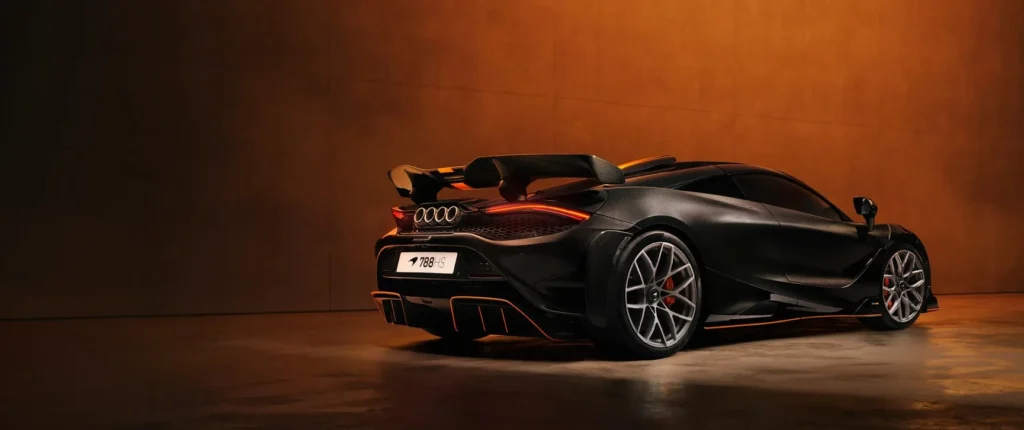
McLaren 788HS 2026 at a Glance
Before going into details, here is the shape of the car in one place.
| Specification | Detail |
| Engine | 4.0-litre twin-turbocharged V8 (M840T evolution) |
| Power | 788 PS (777 hp / 777 bhp) |
| Torque | 800 Nm (590 lb-ft) |
| 0–100 km/h (0–62 mph) | 2.8 seconds (claimed) |
| 0–200 km/h (0–124 mph) | 7.0 seconds (claimed) |
| Top Speed | 330 km/h (205 mph) |
| Dry Weight | 1,265 kg (2,789 lb) |
| Power-to-Weight Ratio | 623 PS per tonne (614 hp per tonne) |
| Body Styles | Coupe and Spider |
| Production | 200 units total (100 Coupe, 100 Spider) |
| Built By | McLaren Special Operations (MSO), Woking, UK |
| Debut | Goodwood Festival of Speed, July 2026 |
Note on pricing: McLaren has not released official US or Gulf list prices at the time of writing. The figures we use later are estimates based on comparable models and early market reporting, and Autocram will update them once McLaren confirms regional pricing.
What Is the McLaren 788HS?
The McLaren 788HS is a limited-run, track-focused supercar that is the final evolution of McLaren’s second-generation Super Series. Think of it as the 720S family taken to its logical extreme; only now it’s made rarer than all its predecessors. McLaren built 765 examples of the 765LT. It will make only 100 788HS Coupes and 100 Spiders, and every single one will go through McLaren Special Operations for a customized commission.
The number in the name is from the engine. In metric terms the V8 produces 788 PS, which is 777 hp in the figures most US buyers will hear quoted. The entire reason for the car is to give owners of the outgoing Super Series a proper farewell before McLaren moves on to a new generation of hybrid cars in the next decade.
There is a bit of history built into that HS badge. It appeared on the MP4-12C HS, of which McLaren made a handful and then on the MSO HS derived from the 675LT, built in tiny numbers. The 788HS is the third car to wear it and the most powerful of the three by a wide margin.
McLaren 788HS Engine and Performance
At the heart of the McLaren 788HS 2026 is the M840T, the 4.0-liter twin-turbocharged V8 that has powered the Super Series since the 720S. This isn’t the new 4.0-litre V8 from the W1 hypercar. It’s a heavily reworked version of the familiar unit, and McLaren has extracted more from it than ever before.
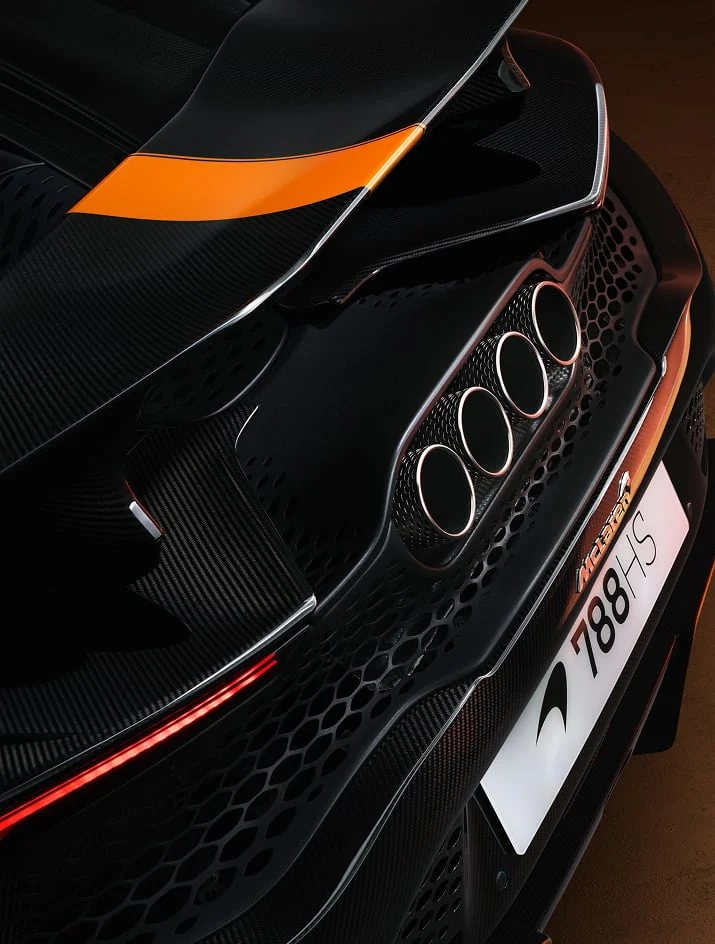
The headline of the McLaren 788HS engine: 788 PS and 777 hp. That is better than the 765LT at the same 7,500 rpm peak. The torque is 800 Nm (590 lb-ft), the same as the 765LT, so the extra is at the top end, not in the mid-range. The flat-plane crank gives the engine that metallic wail that McLaren V8s are known for, and a quad-exhaust setup with perforated finishers sends it out the back.
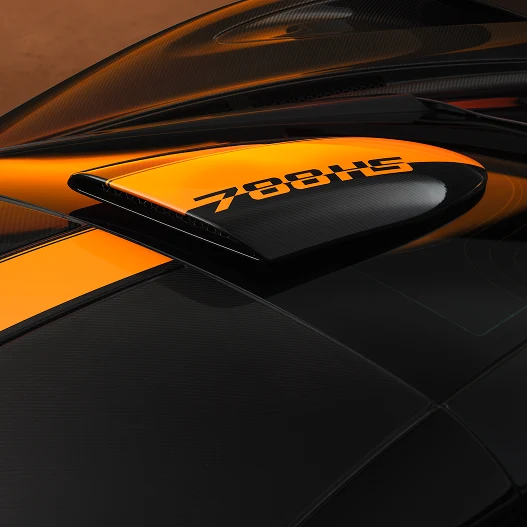
Lightweight forged pistons, low-inertia twin-scroll turbochargers, and twin fuel pumps all contribute to the effort. McLaren also installed a functional roof scoop that releases cooler air into the engine bay which matters more than it sounds when you are running hard laps in a hot climate. Gulf buyers who expect to keep the car on course during the warmer months will appreciate that part of it.
For McLaren 788HS performance, the weight is what does most of the talking. At 1,265 kg dry, the car is 36 kg heavier than the lightest 765LT, but power more than makes up for it. The result is a power-to-weight ratio of 623 PS per tonne (614 hp per tonne), which is the best of any Super Series McLaren. When the turbos wake up on the road, it means a car that is virtually weightless.
How Fast Is the McLaren 788HS?
The McLaren 788HS can hit 100 km/h (62 mph) in 2.8 seconds and has a top speed of 330 km/h (205 mph). It takes just 7.0 seconds to get 200 km/h (124 mph) from rest.
Those are staggering numbers, but it is worth being honest about them. The 788HS is not a lot faster in a straight line than the 765LT it is replacing. The top speed of 330 km/h is in the same category as the rest of the family. Where this car gets its keep is not the drag strip but the corners.
McLaren tuned the 788HS to reformulate the lap-time order within its own range. It has more downforce, sharper aero, and a re-tuned chassis that allows it to speed through bends the older cars had to brake for. So the McLaren 788-8H top speed headline undersells the story. This is a car that is alive at seven tenths, not just to post a big number on a runway.
As for anyone who is looking at McLaren 788HS specifications with a Ferrari or a Lamborghini, the takeaway is pretty simple. It looks like a slight bump on paper. On a circuit it is a much more serious machine.
Design and Aerodynamics
The McLaren 788HS wears the most aggressive aero package ever bolted to a 720S-generation car, and it shows. McLaren claims a 10 percent increase in downforce over 765LT, which was already a hardcore thing, and it is.
In front, a multi-zone carbon-fiber splitter manages airflow, and a redesigned bonnet with an S-duct pulls turbulent air off the nose and cleans up the flow over the body. The front axle is 5 mm lower than it was before, which lowers the car’s stance and improves turn-in. Look closely enough and you will be able to see drag-reducing spats over the wheels, and it comes from motorsport thinking.
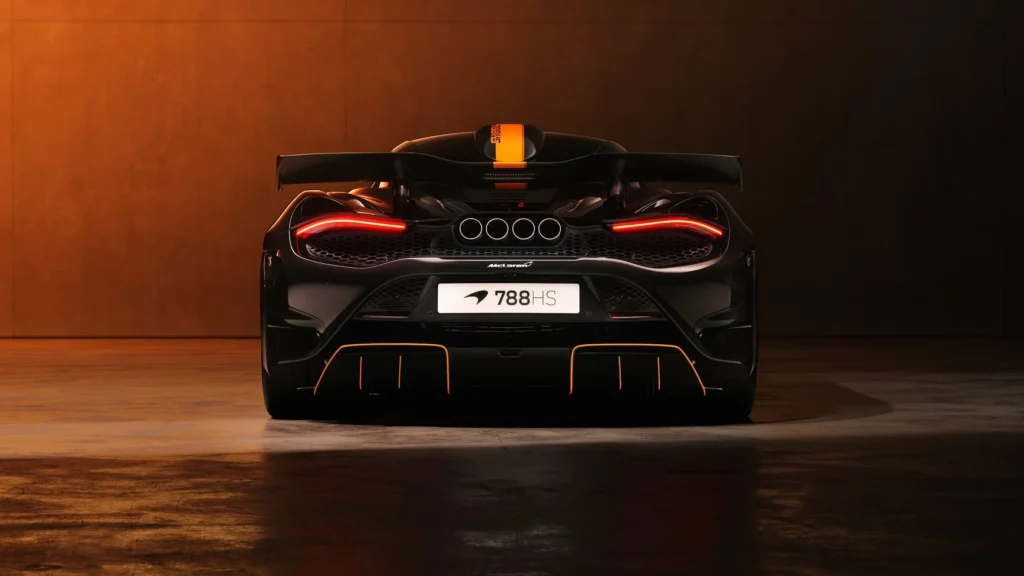
The rear is where the McLaren 788HS really commits. The once-flush airbrake is now a raised, snowboard-quality active spoiler. Below it is the biggest diffuser McLaren has ever fitted into a 720S-family car, complete with F1-style slots cut into its vanes. Every cooling vent has been opened up. The whole back end seems like it’s just meant to keep you pinned to the tarmac at any speed, and that’s exactly the point.
Buyers can also go a step further and order a full carbon-fiber body that will reduce weight and give your car the bare-weave look that collectors love. Because every 788HS runs through MSO, the exterior is a blank canvas. You can apply your own livery, tint the clear coat over exposed carbon, or add a family crest under the lacquer. No two cars leave Woking looking the same.
McLaren 788HS Wheels and Brake
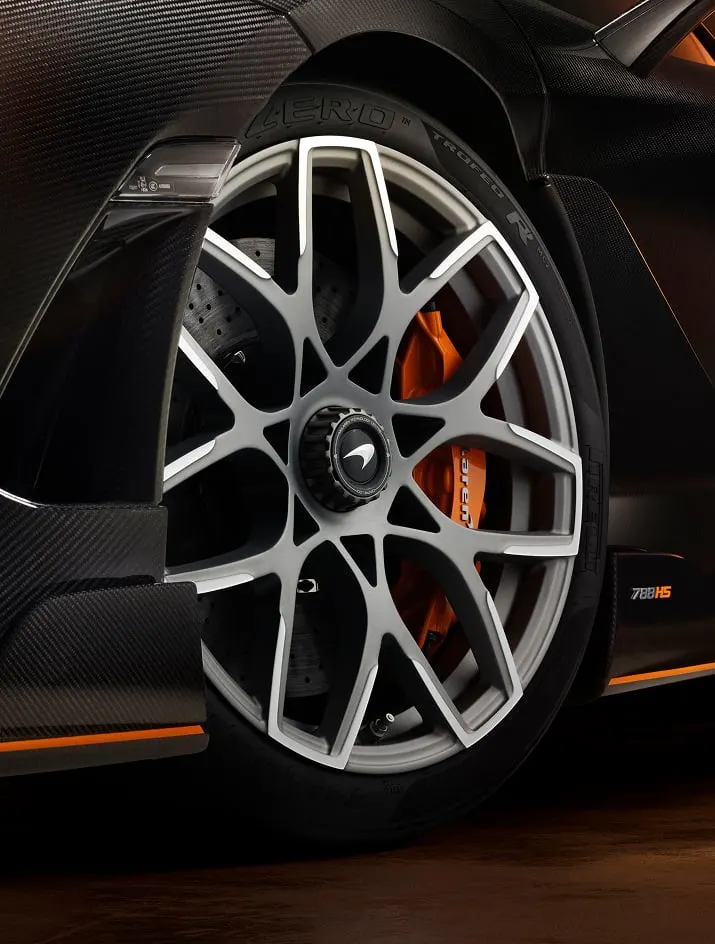
The McLaren 788HS wheels are all forged center-lock units, a first for this generation of Super Series. Center-locks are lighter and stiffer than a standard five-bolt setup, and they reduce unsprung mass at each corner, making the suspension respond faster. They also indicate the car’s racing intent.
And behind those wheels is the braking system of the McLaren Senna, one of the most aggressive road-car brake systems ever built. You got carbon-ceramic discs clamped with six-piston monoblock calipers and Formula 1-inspired integrated brake cooling to keep everything stable lap after lap. In a car that fast, brakes like this are not a luxury. They are the reason you can lean on the performance without cooking the pedal.
Suspension is supplied by McLaren’s Proactive Chassis Control III, a hydraulically linked system with custom tuning for the 788HS. It reads the road, adjusts on the fly, and gives the driver clean, honest feedback on the wheel. That combination of center-lock wheels, Senna brakes, and a re-tuned chassis is a big part of why this car flatters a driver rather than intimidating them.
McLaren 788HS Interior
Inside the McLaren 788HS, the interior seems familiar to anyone who has sat in a 750S and then stripped it back and sharpened. McLaren fits the Senna’s lightweight carbon-shell seats, wraps the cabin in exposed carbon fiber and Alcantara-style suede, and keeps the clutter to a minimum. This is a driver’s space first and a comfort zone second.
The roof scoop that feeds the engine does eat into rear visibility, but that is a small price to pay for cooler intake air and a good race car silhouette. Most owners will consider that a fair trade.
As with the bodywork, MSO opens up the cabin to obsessive personalization. Choose your leather and suede combinations, contrast stitching, machined metal details, or a full bespoke theme based on a color, a flag, or a piece of family history. For Gulf buyers in particular, who often push MSO commissions into truly one-off territory; this is where a 788HS becomes a personal statement rather than just a fast car.
Spider buyers get something the Coupe cannot offer. Drop the roof and the engine and exhaust note flood in, and the sense of speed climbs even though the performance figures barely move. McLaren tuned the Spider so the open air adds drama without costing rigidity, thanks to the carbon-fiber monocoque underneath.
Coupe or Spider: Which McLaren 788HS to Choose?
The choice comes down to what you value. The Coupe is the lighter, purer option, and it has the full 1,265 kg dry weight figure and best power-to-weight number in the range. Serious track drivers and weight purists will lean this way.
The Spider offers a little of that focus for sensation. With the roof down, you feel the full force of the V8 and quad exhaust, and the speed just goes up dramatically as the numbers on paper don’t change much. McLaren built the Spider on the same strong carbon-fiber monocoque, so there’s almost nothing lost in rigidity. In the Gulf, where evening drives and open-air cruising are part of the appeal, the Spider makes a strong case. Both body styles are capped at 100 units, so whichever one you choose, you are on a very short list.
McLaren 788HS Price in the US and Gulf (Estimated)
Here is the honest position. McLaren has not confirmed official US or Gulf list prices for the 788HS, and early estimates vary widely. So treat the numbers below as a guide, not a quote.
The 750S Coupe launched in the US around $365,100, and the closer 765LT started around $358,000. With the extra power, the aero, the MSO-only build process, and the small production run, the McLaren 788HS price is expected to be well above those cars. Early reports range from around $400,000 to $600,000 up to options based on source and body style. The final price for any 788HS will go up from there once you are choosing carbon, paint, and trim, since every car is a customized MSO commission.
If we translate rough Gulf terms in the standard USD-to-AED peg of about 3.6725 to translate that number to roughly AED 1.47 million to AED 2.2 million in rough Gulf terms (the dollar to AED is about AED 3.6725), which is roughly AED 1.47 million to AED 2.2 million before options and before local duties, VAT, and dealer costs. UAE and wider GCC buyers should expect the on-the-road figure to be even higher once those are added.
| Market | Estimated Starting Price (Before Options) |
| United States | $400,000–$600,000+ (estimated) |
| UAE / Gulf | AED 1.47 million–AED 2.2 million+ (estimated) |
Autocram will replace these estimates with confirmed numbers as soon as McLaren releases official regional pricing. If you are planning a purchase, speak to your local McLaren retailer, because all 200 cars are being sold directly to invited clients through MSO rather than through open showroom stock.
Who Should Buy the McLaren 788HS?
This is a car for a specific kind of buyer. If you already own a 720S, a 765LT, or a 750S and you want the final word on the line, the 788HS is built for you. If you like limited McLarens, the 200-unit run and the rare HS badge tell a story that this one is in your pocket and will be worth it over the long run.
It is less obvious the car for someone who just wants the fastest thing in a straight line, because rivals will trade blows with it on raw acceleration. The 788HS rewards the owner who cares about how a car feels through a corner, how it sounds at full noise, and how personal they can make it. In the Gulf, where MSO commissions run wild and track days at circuits like Yas Marina and Dubai Autodrome are part of the ownership culture, that pitch lands especially well.
McLaren 788HS Reviews: What the Verdict Looks Like
Early McLaren 788HS reviews from launch coverage are consistent. The straight-line gains are modest, the aero and chassis gains are not, and exclusivity is real. Reviewers keep coming back to the idea that this is a fitting finale rather than a revolution, and for a farewell model, that is exactly the right brief.
The 788HS ends an era for McLaren. The company is getting into a new era with a new amount of investment and a turn toward hybrid power, so this is probably the last purely combustion-driven, track-honed Super Series the brand ever makes. And that context is the main reason the McLaren 788HS is so important as well as why the 200 people who get one are not likely to let go easily.
FAQs
Q. How much does the McLaren 788HS cost in the U.S.?
A. McLaren has not confirmed an official US price for the 788HS. Based on the 750S and 765LT it replaces, plus the extra performance and the MSO-only build, estimates are somewhere between about $400,000 and $600,000 with options. Every car is an individual commission, so the price for each 788HS will rise once the owner picks carbon, paint, and interior. Check with your local McLaren retailer now.
Q. What is the McLaren 788HS price in the UAE and Gulf?
A. Official Gulf pricing has not been released yet. With the standard USD-AED peg of about 3.6725, the US range is roughly AED 1.47 million to AED 2.2 million-plus before options. GCC buyers should budget higher once local duties, VAT, and dealer costs are added. Because all 200 cars are sold directly to invited clients through McLaren Special Operations, interested Gulf buyers should contact their nearest McLaren showroom in the UAE, Saudi Arabia, Qatar, or Kuwait.
Q. How fast is the McLaren 788HS, and what is its top speed?
A. The McLaren 788HS reaches a top speed of 330 km/h (205 mph). It moves from 0 to 100 km/h (62 mph) in 2.8 seconds and from 0 to 200 km/h (124 mph) in 7.0 seconds. Those numbers are in line with the 765LT, but the 788HS is faster for the corners because of a 10 percent increase in downforce and a redesigned chassis.
Q. What engine runs the McLaren 788HS?
A. The McLaren 788HS uses a reworked 4.0-litre twin-turbocharged V8, the M840T, that has powered the Super Series since the 720S. It has 788 PS (777 hp) and 800 Nm (590 lb-ft) of torque and has a flat-plane crank and quad-exhausts. A dry weight of 1,265 kg gives it a power-to-weight ratio of 623 PS per tonne.
Q. How rare is the McLaren 788HS?
A. Very rare. McLaren is building only 200 examples worldwide, split evenly between 100 Coupes and 100 Spiders. That makes it rarer than the 765LT, of which 765 were produced. Each 788HS is produced as a one-off commission through McLaren Special Operations and sold directly to invited McLaren clients rather than through general showroom stock, which is likely to enhance long-term collectability.