
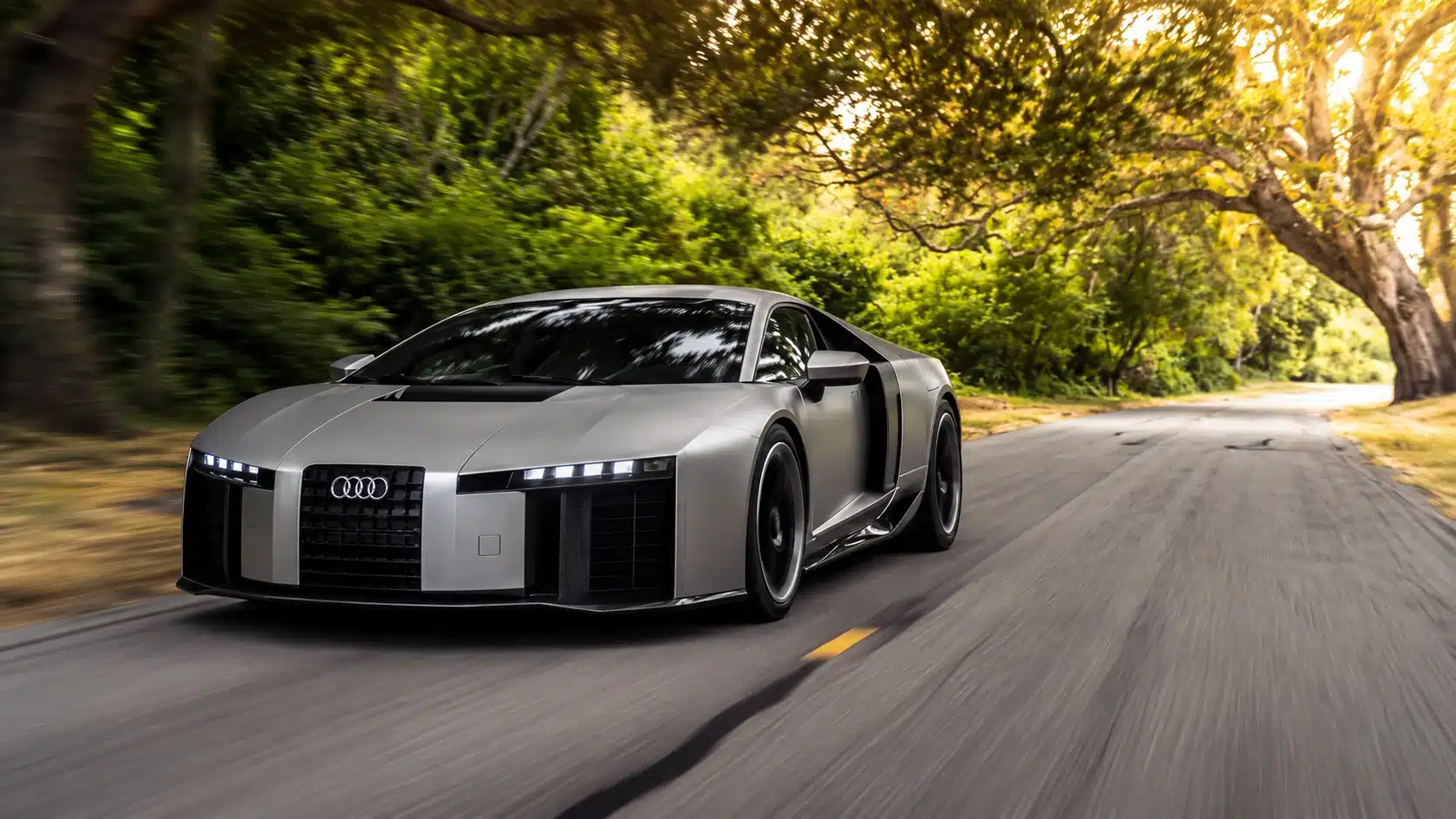
Audi built a 1,001-hp hybrid supercar in 405 days and then dropped it on the world with almost no warning. That car is the Audi Nuvolari, and it is the fastest, most powerful, and rarest road car the four rings have ever made. Only 499 will be built. The price starts at 590,000 euros, which works out to a reported 701,000 US dollars, making it more than double the most expensive R8 that came before it.
If you searched this car after seeing it on your feed, you probably ran into two very different-looking machines. That confusion is a big part of the story, and we will get to it. First, the facts that matter, then the parts nobody else is telling you.
Audi Nuvolari at a glance
| Detail | Figure |
| Body style | Two-door, mid-engine coupe |
| Powertrain | 4.0L twin-turbo V8 plug-in hybrid |
| System output | 1,001 PS (987 hp) |
| Drive | All-wheel drive (quattro) |
| 0–100 km/h (0–62 mph) | 2.6 seconds |
| 0–200 km/h (0–124 mph) | 6.8 seconds |
| Top speed | Over 350 km/h (217 mph) |
| Production | Limited to 499 units worldwide |
| First deliveries | First half of 2027 |
| Starting price (Europe) | 590,000 euros |
| Starting price (US, reported) | About $701,000 |
Dimensions, curb weight, and official Gulf pricing had not been published by Audi at the time of writing. We have flagged every estimate below.
Why is the Audi Nuvolari trending?
Three things happened at once.
The first is the reveal itself. Audi showed the Nuvolari on June 4, 2026, at the Hotel du Cap-Eden-Roc on the French Riviera, with no long teaser campaign and no drip of spy shots. In an industry where every new model leaks for a year, a genuine surprise is rare. Audi dropped this one cold.
The second is the name. “Nuvolari” honors Tazio Nuvolari, the Italian driver Ferdinand Porsche once called the greatest of the past, present, and future. Audi had used the name once before, on a 2003 concept, so longtime fans recognized it right away. Pair a legendary name with a 1,000-hp car and the internet does the rest.
The third reason is the one search engines keep missing: fake AI renders. In the weeks before launch, AI-generated images of a supposed “new Audi supercar” spread across social media. Some looked like a low-slung Lamborghini clone. Others looked nothing like anything Audi would build. When the real Nuvolari appeared, it looked like the Audi Concept C, not those renders, and enthusiasts on the R8 owner forums said so within minutes. So if you are comparing two cars in your head and only one is real, that is why. The renders were never Audi’s work.
There is a fourth, quieter reason. In 2023 Audi said it would stop launching new combustion engines after 2026 and kill the combustion engine entirely by 2033. In June 2025 the company reversed that plan. The Nuvolari, with its very loud V8, is the proof that the reversal was real.
Design: form built around airflow
Massimo Frascella, Audi’s chief creative officer, calls the design language “radical simplicity.” The Nuvolari is the first production Audi to wear it, and the shapes are less about decoration than about moving air.
Look at the nose. A hidden S-duct pulls air through a “vertical frame” made of 64 individual segments, feeding downforce to the front axle. Look at the flanks. The carbon panels behind each door hide three separate vents, one each for the engine, the cooling system, and the brakes, with the door handle tucked into the same panel. Look at the tail. There is no rear window at all. Audi swapped it for side-mounted air intakes, then integrated solid-metal Audi rings flush into the active rear wing so they would not disturb the airflow.
The signature paint is a shade called Titanium, the same color Audi uses on the Concept C and its 2026 Formula 1 car. You can also order the body in exposed carbon. Four horizontal light bars sit at each end, front and rear, a signature you will start seeing across future Audis.
One honest note from studying the launch images: this is a wide, aggressive, low car whose proportions read closer to a Lamborghini than to the friendly old R8. People who loved the R8 for its everyday approachability should know the Nuvolari is a harder, more single-minded object.
Interior: everything points at the driver
Audi stripped the cabin down to what a fast driver uses. A reduced architecture puts the controls in the driver’s line of sight and skips the clutter.
The materials are honest and light: carbon fiber, aluminum, and Alcantara. The grilles, air vents, door handles, and switches are milled from aluminum, so they feel cold and solid rather than plasticky. The seats use carbon-fiber shells for the base and backrest. Ahead of you sits a circular instrument display, and a central touchscreen handles the rest, backed up by real aluminum controls instead of a screen-only setup.
Audi has said the interior layout, materials, and design ideas from the Nuvolari will filter down to the rest of the lineup, so this cabin is a preview of where every future Audi is heading.
Engine and powertrain: a Lamborghini V8 with three electric motors
This is the heart of the car, and it is worth getting right.
The combustion engine is a 4.0-liter twin-turbocharged V8 built by Lamborghini, codenamed L411, the same basic unit that powers the Lamborghini Temerario. On its own it makes 800 PS (789 hp) and 730 Nm (538 lb-ft) of torque, and it spins all the way to a 10,000-rpm redline. That last number matters. Most turbo V8s run out of breath by 7,000 rpm. This one keeps pulling to five figures.
Then Audi adds three axial-flux electric motors. Two sit on the front axle; one lives between the engine and the eight-speed dual-clutch gearbox. Each motor is good for 110 kW (148 hp). A small 7.3-kWh lithium-ion battery feeds them.
Add it all up, and the system produces 1,001 PS, or 987 hp. That makes the Nuvolari the most powerful production Audi ever built. For context, it makes 81 PS more than its Temerario cousin, and the V8 itself is tuned for 11 PS more.
Here is how the pieces stack up:
| Component | Output |
| V8 petrol engine | 800 PS (789 hp), 730 Nm |
| Front electric motors (x2) | 110 kW (148 hp) each |
| Rear electric motor (x1) | 110 kW (148 hp) |
| Combined system | 1,001 PS (987 hp) |
| Battery | 7.3 kWh lithium-ion |
| Transmission | 8-speed dual-clutch |
Because two motors drive the front wheels directly, the Nuvolari can shuffle torque from front to rear the instant it needs to. That is the basis of Audi’s new “quattro predictive ride” system, which reads the road and adjusts power delivery in real time rather than reacting after a wheel has already slipped.
Performance: the numbers and what they feel like
Audi quotes 2.6 seconds from 0 to 100 km/h (0 to 62 mph) and 6.8 seconds from 0 to 200 km/h. Top speed is more than 350 km/h, roughly 217 mph.
One caveat Audi prints in its own materials, and most write-ups skip: that 2.6-second launch assumes the battery is warm (above 28°C) and charged above 80 percent. In the real world, and especially after a few hard laps, expect the electric side to fade and the numbers to soften. That is true of every plug-in hybrid supercar, not a knock on this one, but it is the kind of thing you only learn by reading the fine print.
The aero is where the engineering shows off. The rear wing has three fixed positions plus a driver-triggered Drag Reduction System lifted straight from Formula 1:
- Closed for relaxed cruising
- Low-downforce for straight-line speed
- High downforce for corners and heavy braking
In its most aggressive setting the car generates more than 400 kg (about 882 lb) of downforce. You control the wing with a rotary dial on the steering wheel, and it works in every drive mode except pure electric.
Braking comes from massive carbon-ceramic discs, and the car rides on Bridgestone Potenza Race tires. Audi claims deceleration in the neighborhood of what an F1 car pulls, which is a bold thing to say, so treat it as a manufacturer claim until independent testers verify it.
Reviewers who saw the car early were impressed. Bloomberg drove a prototype through the hills above Monterey and came away describing a proper, growling supercar. Top Gear ran the headline “Welcome back, Audi R8” and clocked the 217-mph figure. Motor Trend, Road & Track and CarBuzz all covered the reveal as the return of a serious Audi flagship. Full instrumented road tests will not land until closer to deliveries in 2027.
Fuel economy and electric range
Audi lists preliminary efficiency figures, all subject to change:
- Combined fuel use: 11.3 L/100 km (about 21 mpg US)
- With the battery empty: 14.7 L/100 km (about 16 mpg US)
- Combined electricity use: 7.8 kWh/100 km
- CO₂: 270 g/km (emissions class G)
Two practical takeaways. First, the battery is small at 7.3 kWh, so electric-only range is short. This is a hybrid built for performance, not for silent commuting. Second, drive it the way it wants to be driven, and you will see none of those economy numbers. Nobody buys a 987-hp supercar to save fuel, but Gulf buyers running the air conditioning hard in summer traffic should expect the thirstier end of the range.
Safety and driver technology
Audi has not released a full safety-equipment list this early, so anyone promising you a detailed driver-assist rundown is guessing. What Audi has confirmed centers on active control: the quattro predictive ride system, active aerodynamics, multiple drive modes including dedicated track settings, and the carbon-ceramic braking package. These are performance-safety systems, the kind that keep a 1,000-hp car pointed the right way, more than they are commuter aids.
Expect airbags, stability control, and the usual structural safety of Audi’s carbon Audi Space Frame. Formal crash ratings are unlikely for a 499-unit halo car, which is normal for this class.
Audi Nuvolari price: US and Gulf
This is the section most readers scroll for, so here it is plainly, with the official and the estimated kept apart.
Europe (official): The Nuvolari starts at 590,000 euros before options and local taxes.
United States (reported): Multiple outlets, led by AutoGuide, report a starting price of about $701,000, with roughly 220 of the 499 cars headed to US customers. That makes it the most expensive Audi road car ever, more than double the roughly $250,000 the last R8 V10 GT commanded. One important qualifier: Audi USA states that the car’s US arrival is still subject to a future announcement and that final US details may differ from global materials. So treat $701,000 as the current best figure, not a locked sticker.
Options change everything at this level. Enthusiasts pricing out a well-specified car expect real-world out-the-door numbers approaching or passing $800,000, and a fully loaded example with taxes can cross the million-dollar mark in some markets.
Gulf (estimate only): Audi has confirmed the Nuvolari for the Middle East through its Abu Dhabi, Dubai, Qatar, Saudi Arabia, Kuwait, Bahrain, and Oman channels, but official AED pricing has not been published. Pre-sale details, including options and local pricing, are due in the fourth quarter of 2026. As a rough guide, converting the reported US price at the pegged rate lands near AED 2.57 million before local duties, VAT, and individualization. Read that as a ballpark, not a quote. Gulf list prices for cars in this class are set locally and often land higher once import and specification costs are added.
| Market | Price | Status |
| Europe | 590,000 euros | Official starting price |
| United States | ~$701,000 | Reported; US details still being finalized |
| Gulf / UAE | ~AED 2.57 million | Unofficial estimate from currency conversion |
US and Gulf market differences
Because the Nuvolari is a global 499-unit car, you do not walk into a showroom and buy one. In both regions Audi runs a waitlist. In the Gulf, you register interest through a Local Ambassador for direct sales or an Audi Partner for indirect sales, and there is no standard online configurator. Audi has said only a handful of reservations remain, so allocation, not money alone, is the real gatekeeper.
For US buyers, the roughly 220-car allocation and the “details to follow” language mean patience. For Gulf buyers, the exclusivity fits a region that already absorbs a large share of the world’s limited-run hypercars.
Then there is the heat. A plug-in hybrid supercar in a Gulf summer faces two realities worth planning for. The battery and its electronics work hardest to stay cool when ambient temperatures push past 45°C, and that warm-battery requirement for the quickest launches is easier to meet in the Gulf than almost anywhere. On the flip side, a small battery under constant thermal load and heavy air-conditioning draw will lean on the V8 more often, so the electric assistance you feel on a mild European morning may show up less on a July afternoon in Riyadh. None of this is a defect. It is physics, and it applies to every electrified supercar sold in the region.
How the Nuvolari compares to its rivals
At this price and power, the Nuvolari runs with the electrified elite. Its closest mechanical cousin is the Lamborghini Temerario, since they share the V8, but Audi positions the Nuvolari against a broader field.
| Car | Power | Limited to | Layout |
| Audi Nuvolari | 1,001 PS (987 hp) | 499 units | AWD hybrid |
| Lamborghini Temerario | 920 PS | Series production | AWD hybrid |
| Ferrari SF90 XX Stradale | ~1,030 PS | 799 coupes | AWD hybrid |
| McLaren W1 | ~1,275 PS | 399 units | RWD hybrid |
| Mercedes-AMG ONE | ~1,049 PS | 275 units | AWD hybrid |
The Nuvolari’s clearest advantage is its all-wheel-drive hybrid layout paired with the predictive chassis. Against a rear-drive McLaren, it should be easier to launch and more planted in mixed conditions. It is rarer than the Ferrari and the Temerario, though not as rare as the AMG ONE. What it cannot claim is the outright headline power of the McLaren W1 or the racing pedigree of the AMG ONE’s actual F1 engine.
Pros and cons
Pros
- Most powerful and fastest production Audi ever, with a genuine 10,000-rpm V8 soundtrack
- All-wheel-drive traction and a predictive chassis for usable pace in variable conditions
- Real Formula 1-derived aero, including a driver-controlled DRS wing
- Extreme rarity at 499 units, which supports long-term collectibility
- A design and cabin that preview the entire next generation of Audi
Cons
- Six-figure options can push the price past $800,000 fast
- Complex electrified powertrain is far harder to service than the old naturally aspirated R8 V10
- Small 7.3-kWh battery means minimal electric range and heat-dependent launch performance
- Allocation is nearly gone, so wanting one and getting one are different problems
- Dimensions, weight, and official Gulf pricing were still unconfirmed at launch
Ownership: what buying one involves
The R8 was a supercar you could live with. Its naturally aspirated V10 was simple enough that most performance shops could service it, and owners drove them daily. The Nuvolari is a different animal. Its Lamborghini-derived hybrid powertrain is complex, and servicing will run through Audi’s specialist network, not the local independent. Budget accordingly for maintenance, tires, and the carbon-ceramic brakes.
On value, opinions split. Some enthusiasts point to the Lexus LFA, another shockingly expensive car from a mainstream brand that later became a legend, and hope the Nuvolari follows. Others are not sure a Temerario-based Audi carries the same mystique. Nobody knows yet. What is certain is that 499 cars will not be enough to meet demand, and rarity is the strongest argument for holding value.
If you plan to drive it rather than store it, the AWD system and everyday-friendly launch make it more usable than a rear-drive rival. If you plan to collect it, the low build number and the fact that it launches a whole new Audi era both work in your favor.
Final verdict: who the Audi Nuvolari is for
The Nuvolari is not a car most people can buy, and Audi knows it. With 499 units, a price that starts near three-quarters of a million dollars, and an allocation that is almost spoken for, this is a statement piece aimed at collectors and committed Audi loyalists who want the fastest thing the brand has ever made.
Buy it if you value rarity, all-weather usability, and the significance of owning the car that opens Audi’s next design era. Think twice if you loved the R8 for its simplicity and daily-driver ease, because the Nuvolari trades that friendliness for complexity and outright speed. For Gulf buyers, the combination of exclusivity, hot-climate launch performance, and a region built for hypercars makes it a natural fit, as long as you go in expecting Audi to confirm local pricing and specification during the Q4 2026 pre-sale.
Either way, the Nuvolari does something Audi has not done in years. It makes the four rings exciting again.
FAQs
Is the Audi Nuvolari electric?
No. It is a plug-in hybrid. A twin-turbo V8 does the heavy lifting, and three electric motors add power and traction. The battery is small at 7.3 kWh, so it is built for performance, not long electric-only trips.
How much does the Audi Nuvolari cost?
It starts at 590,000 euros in Europe and a reported $701,000 in the United States, though Audi says final US details are still to come. Gulf pricing is not official yet; a rough conversion puts it near AED 2.57 million before local costs and options.
How many Audi Nuvolari will be built?
Only 499 units worldwide, which makes it far rarer than the R8 it succeeds. First deliveries are planned for the first half of 2027.
Is the Audi Nuvolari the same as the R8?
No. It succeeds the R8 as Audi’s flagship, but it sits well above it in price, power, and exclusivity. The R8 was an approachable daily supercar; the Nuvolari is a limited-run halo car with a far more complex powertrain.
Why does the real Audi Nuvolari look different from the pictures I saw?
Many of the images that spread online before launch were AI-generated fakes. The real car follows Audi’s Concept C design language and was revealed in June 2026. If a photo looks like a generic Lamborghini clone, it is probably not the real Nuvolari.