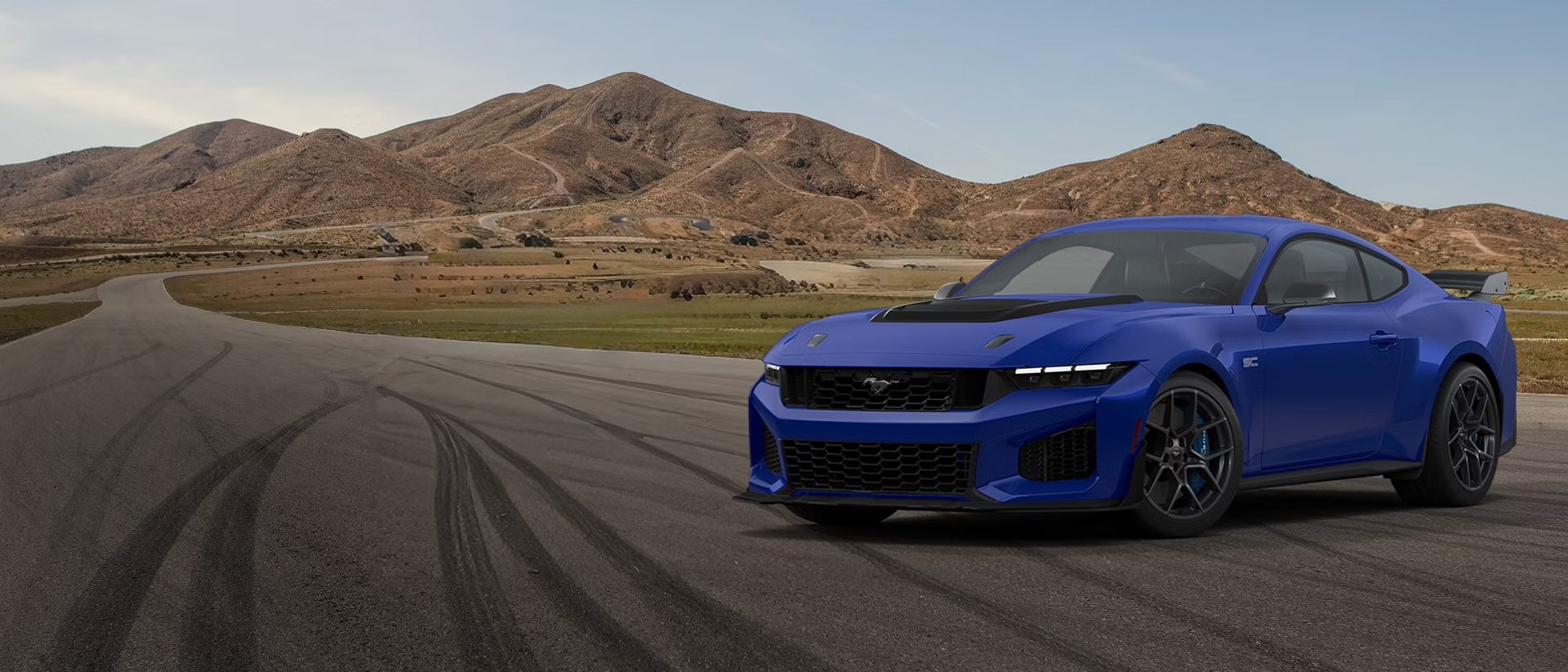
For years, the Mustang faithful have been waiting for Ford to answer one question: who picks up the supercharged torch left behind when the Shelby GT500 rode off into the sunset? The Ford Mustang Dark Horse SC is that answer, and it doesn’t tiptoe into the role, it comes with a 795-horsepower supercharged V8 and GTD-derived hardware with a price tag that makes it clear Ford isn’t playing around anymore.
This is our complete review of the Ford Mustang Dark Horse SC, covering price, engine, performance, interior, wheels, specifications, and everything else you need to know before this car lands in showrooms this summer.
What Exactly Is the Ford Mustang Dark Horse SC?
The “SC” stands for Supercharged, and it is not a subtle badge. Slotted between the naturally aspirated Mustang Dark Horse (500 hp) and the exotic, Multimatic-built Mustang GTD ($327,960, 815 hp), the Dark Horse SC is Ford’s attempt to fill the gap the Shelby GT500 left behind when it exited the lineup a few years ago.
Rather than being a styling exercise, the Dark Horse SC was co-developed by Ford Racing’s motorsports and road-car teams, with testing benchmarks set alongside the Mustang GTD and GT3/GT4 race programs at Sebring and Virginia International Raceway. In other words, it’s not a Mustang GT with a supercharger bolted on for marketing purposes — it’s a car built around race-proven data, wind-tunnel validated aerodynamics, and a chassis that’s been stretched to handle nearly 800 horsepower without falling apart on a hot lap.
It also arrives at an interesting moment for the segment. With the Chevrolet Camaro discontinued and the muscle car field thinning out, the Mustang nameplate has effectively become the last one standing in its traditional form. The Dark Horse SC is Ford’s statement that even without direct domestic rivals, it still intends to push the pony car formula forward rather than let it stagnate.
Quick Snapshot
| Category | Detail |
| Engine | 5.2L Supercharged “Predator” V8 |
| Horsepower | 795 hp |
| Torque | 660 lb-ft |
| Transmission | 7-speed TREMEC dual-clutch |
| 0–60 mph | As low as 3.5 seconds (claimed) |
| Top Speed | 180+ mph |
| Starting Price (US) | $103,490 |
| Starting Price (AED) | Approx. AED 380,000 |
Ford Mustang Dark Horse SC Price: US Dollar & AED
Let’s get straight to the number everyone wants: what does it cost to put a Dark Horse SC in your garage?
Ford officially confirmed the base 2026 Ford Mustang Dark Horse SC price at $103,490 in the United States, after a dealer memo reportedly leaked the figure online and Ford subsequently acknowledged it as accurate. That’s a significant jump over the standard Dark Horse, which starts closer to $64,000, and it puts the SC firmly in territory once occupied, and then some, by the old Shelby GT500.
Converted at roughly 3.67 AED per US dollar, that works out to approximately AED 380,000 for the base Dark Horse SC.
Ford also offers the car with an optional Track Pack, which adds carbon-fiber wheels, Brembo carbon-ceramic brakes lifted from the GTD, and a host of aerodynamic upgrades. Depending on configuration and dealer, reported Track Pack pricing lands anywhere from roughly $140,000 to $145,000 (approximately AED 514,000 to AED 532,000), while a limited-run, fully loaded Track Pack Special Edition has been reported north of $175,000 (around AED 642,000). That trim is a 2026-only run, meaning once allocation dries up, it won’t be coming back for future model years.
Price Breakdown at a Glance
- Base Dark Horse SC: ~$103,490 USD / ~AED 380,000
- Dark Horse SC with Track Pack: ~$140,000–$145,000 USD / ~AED 514,000–532,000
- Track Pack Special Edition (limited run): ~$175,000+ USD / ~AED 642,000+
Is the Price Justified?
Compared to inflation-adjusted GT500 pricing, the Dark Horse SC isn’t cheap. In fact, some analysts have pointed out that if you adjust the 2022 GT500’s roughly $80,000 starting price for inflation, you’d land somewhere around $90,000 today, meaning the Dark Horse SC still carries a real premium over its spiritual predecessor, not just an inflation-adjusted one.
That said, the car also brings a genuinely different level of engineering to the table. The S650 platform underneath it has revised suspension geometry compared to the GT500’s older chassis, the latest-generation MagneRide dampers are more advanced, and, most importantly, the horsepower figure is meaningfully higher. Buyers cross-shopping European performance sedans and coupes in the same price bracket will also find the Dark Horse SC competitive on raw output, even if outright refinement leans more toward muscle car character than luxury-grand-tourer polish.
Ford Mustang Dark Horse SC Engine: The Heart of the Beast
At the center of this car is a hand-assembled 5.2-liter supercharged Predator V8, the same engine family found in the road-going Mustang GTD supercar. Each unit is reportedly built by a single technician at Ford’s Dearborn Engine Plant, a nod to the kind of “one person, one engine” tradition long associated with performance brands like AMG’s dedicated engine builders.
Engine Highlights
- Displacement: 5.2-liter cross-plane crank V8
- Forced Induction: 3.0-liter Roots-style supercharger
- Horsepower: 795 hp
- Torque: 660 lb-ft
- Transmission: 7-speed TREMEC dual-clutch automatic
- Driveshaft: Lightweight carbon-fiber unit
- Drive Layout: Rear-wheel drive
That output eclipses the outgoing Shelby GT500’s 760 horsepower and 625 lb-ft, making the Dark Horse SC the most powerful street-legal Mustang you can buy without stepping up to the GTD. Paired with the quick-shifting dual-clutch gearbox instead of a traditional torque-converter automatic or six-speed manual, the SC is engineered to put its power down efficiently on both the street and the track, with rapid, consistent shifts that hold up over repeated hard launches.
The choice of a dual-clutch transmission over a manual is a notable departure for Ford’s flagship Mustang variant, and it signals where the SC’s priorities lie: outright lap-time performance over old-school driver engagement. Enthusiasts who prefer three pedals will still find manual transmissions available lower in the Dark Horse lineup, but the SC is unapologetically built to be quick above all else.
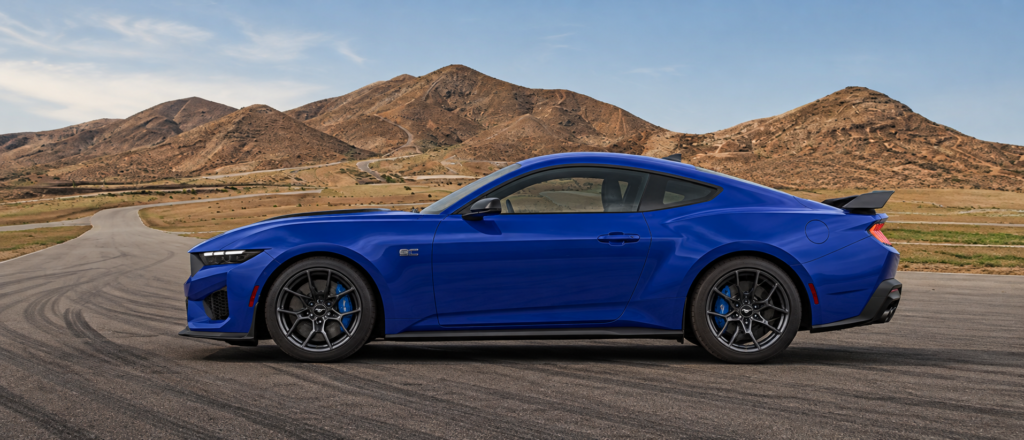
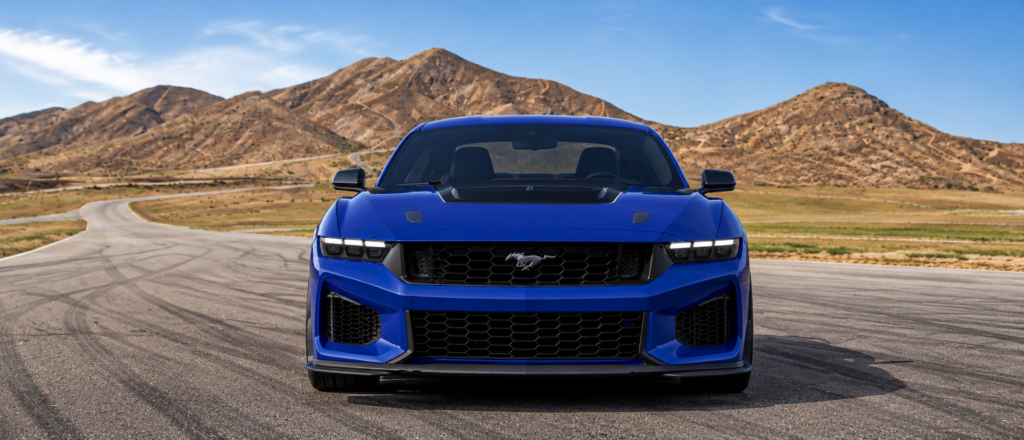
Cooling was also a major engineering focus. Running a supercharged V8 at nearly 800 horsepower for extended track sessions generates enormous heat, so the front fascia was redesigned specifically to improve brake and radiator cooling, while a new aluminum hood houses a large functional vent that feeds the supercharger and manages front-end airflow simultaneously.
Ford Mustang Dark Horse SC Performance & Top Speed
Numbers on paper are one thing, how the Dark Horse SC actually moves is another. Ford’s own figures point to a 0-60 mph sprint in as little as 3.5 seconds, with a top speed estimated at 180 mph or higher once the Track Pack aerodynamics are factored in. Some early industry estimates have even suggested a sub-3.0-second run under ideal conditions, though official independent testing numbers haven’t been fully confirmed at the time of writing.
Performance Highlights
- 0-60 mph: ~3.5 seconds (some early estimates suggest even quicker with optimal launch conditions)
- Top Speed: 180+ mph
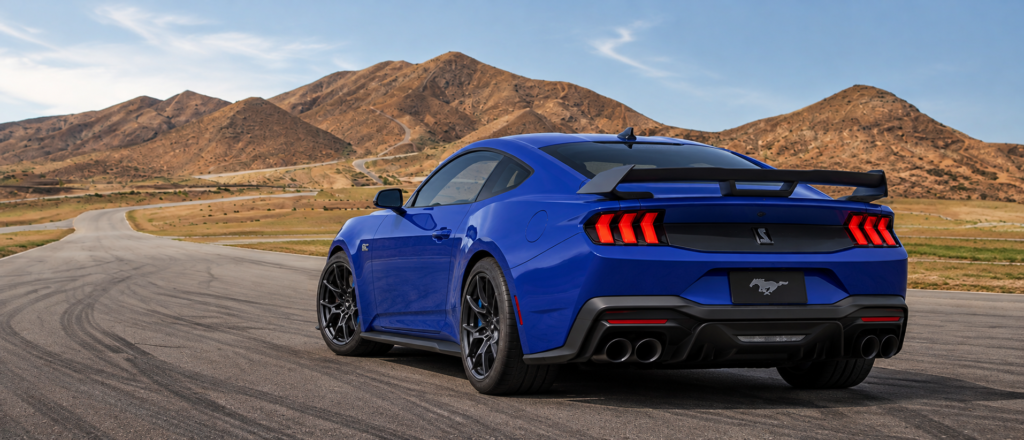
- Downforce: Up to 620 lbs at 180 mph with the Track Pack’s carbon-fiber wing and ducktail decklid
- Aero Improvement: Roughly 2.5x the downforce of the standard Dark Horse when the rain tray is removed
Much of that performance is based on the environment around the engine, not just inside the engine. The front fascia was modified to better cool down the brakes, a new aluminum hood was added with a big vent to feed the supercharged V8 and to control airflow, and a redesigned rear diffuser keeps the rear axle cool during long track sessions. A ducktail decklid is standard with the Track Pack and works in conjunction with the carbon-fiber wing to improve rear wing efficiency by about 10 percent without increasing the wing’s size or angle of attack (which seems more important on a stopwatch than in a parking lot).
It’s the kind of detail-obsessed engineering you’d expect from a car that was benchmarked against actual race cars, not just rival muscle cars. Ford’s development team used lap times from the Mustang GTD and GT4/GT3 race programs as internal targets, which is why much of the SC’s hardware (brakes, wheels, aero) is track-bred and not parts-bin-based.
How the SC Stacks Up on Acceleration
For context, the standard naturally aspirated Mustang Dark Horse already manages a 0-60 mph time of around 4.1 seconds and a top speed of 166 mph, numbers that already beat the standard Mustang GT. The Dark Horse SC’s claimed 3.5-second sprint and 180-mph-plus top end are a huge step up, not an incremental one, and it puts it in the same category with six-figure European sports cars rather than other American muscle coupes.
Ford Mustang Dark Horse SC Wheels, Brakes & Suspension
This is when the standard car and the Track Pack car start to diverge, and when a lot of that six-figure price tag comes off as justified.
Standard Dark Horse SC
- Forged aluminum wheels
- Six- and four-piston Brembo brake calipers.
- The latest MagneRide adaptive dampers.
- Variable traction control for street and track use.
With the Optional Track Pack
- 20-inch carbon-fiber wheels that are about 150 lbs lighter than the standard setup.
- Brembo carbon-ceramic brakes with 16.5-inch front discs borrowed directly from the Mustang GTD.
- Michelin Pilot Sport Cup 2 R tires, 305/30R20 front and 315/30R20 rear.
- Package-specific MagneRide calibration tuned for sharper cornering.
- Optional Notorious Blue Brembo brake calipers for a bit of visual drama
The carbon-fiber wheels alone shave a significant amount of unsprung weight, around 150 pounds of car curb weight when combined with the lighter brake package, which has led to sharper turn-in and reduced rotational mass. That’s the kind of improvement serious track drivers will notice lap after lap, not just on a spec sheet, since less unsprung weight means the suspension can react to road and track surface changes more quickly.
The carbon-ceramic brakes are also worth mentioning. Carbon-ceramic discs resist brake fade far better in repeated hard stops compared to traditional cast-iron rotors, which is a big deal if a car can reach 180 mph on a straight before needing to take a corner. Pulling this hardware from the GTD’s parts bin instead of building a more in-house alternative is a good signal that Ford wanted the Track Pack to be track-ready, not just track-styled.
Ford Mustang Dark Horse SC Interior: Function Meets Focus
Inside, and the Dark Horse SC doesn’t abandon everyday usability, but it definitely leans toward the driver-first, track-day mindset.
Key Interior Features
- 13.2-inch center touchscreen running Ford’s new SYNC 4 software with gaming-inspired graphics, powered by Unreal Engine.
- GTD-derived leather-wrapped flat-bottom steering wheel.
- Optional Recaro leather and microsuede sport seats.
- Personalized seat belt colors, with a teal accent package that extends into the belts, calipers, and badges.
- Track Pack cars replace the Space Gray or Teal interior accents and have a storage shelf for the rear seats, an obvious sign that this setup is designed with lap times, not carpooling in mind.
It’s a cabin that mixes Ford’s modern infotainment push, a huge, driver-centered digital cockpit, with the kind of stripped-down, purpose-built touches fans have come to expect from the brand’s halo performance models. The large touchscreen is not just for show, though; it’s designed to display performance data like lap timers, g-force meters, and supercharger boost readouts that matter far more to a track-day driver than to someone commuting to the office.
The rear seat delete on Track Pack cars is a particularly telling detail. It’s the same philosophy used on dedicated track specials from other manufacturers, trading everyday practicality for weight savings and a more focused cabin. Buyers who want to keep rear seats for occasional passenger use will need to stick with the standard Dark Horse SC configuration rather than opt into the full Track Pack.
Ford Mustang Dark Horse SC Specifications Summary
Here is a condensed look at the core specs in one place:
- Engine: 5.2L Supercharged Predator V8.
- Horsepower: 795 hp.
- Torque: 660 lb-ft.
- Transmission: 7-speed TREMEC dual-clutch.
- Drivetrain: Rear-wheel drive.
- 0-60 mph: ~3.5 seconds.
- Top Speed: 180+ mph.
- Downforce (Track Pack): 620 lbs at 180 mph.
- Wheels: Forged aluminum (standard) / 20-inch carbon-fiber (Track Pack).
- Brakes: Brembo (standard) / Brembo carbon-ceramic (Track Pack).
- Infotainment: 13.2-inch SYNC 4 touchscreen.
- Warranty: 3 years / 36,000 miles bumper-to-bumper.
- Starting Price: $103,490 USD (~AED 380,000).
How Does It Compare to the Rest of the Mustang Lineup?
To put the Dark Horse SC’s positioning into perspective:
- Mustang Dark Horse: ~$64,080 starting price, 500 hp naturally aspirated 5.0L V8.
- Mustang Dark Horse SC: ~$103,490 starting price, 795 hp supercharged 5.2L V8.
- Mustang GTD: ~$327,960 starting price, 815 hp, Multimatic-built exotic.
The SC is essentially the bridge between an already serious performance Mustang and Ford’s no-compromise, supercar-rivaling GTD – with a big jump in output and track capability without requiring buyers to spend GTD-level money. It fills a gap that had been sitting empty since the GT500 was discontinued, and does so with a car that, on paper, comfortably outperforms that outgoing legend in every respect.
It is also worth noting where the SC is in relation to its badge history. The “SC” designation itself is not new to Ford’s performance vocabulary; but this is the first time it has been applied to a modern Dark Horse-based Mustang, and Ford has been careful to differentiate it from the “CS” California Special trim, a much more style-focused option than track-oriented one, which shares a similarly worded name but almost nothing else.
Should You Buy the 2026 Ford Mustang Dark Horse SC?
If you’re looking for a street-legal Mustang with genuine track pedigree, GTD-shared hardware, and a supercharged V8 soundtrack, the Dark Horse SC ticks a lot of boxes. It’s not a budget muscle car anymore, the pricing indicates a car that Ford is positioning against European performance rivals, not just other pony cars.
In any case, buyers who opt for the standard Dark Horse should be careful about how much of the added power and Track Pack hardware they’ll actually use in the SC. For daily street driving, the standard Dark Horse’s 500 horsepower is already very large, and the supercharged SC’s extra power may go largely untapped outside of track days or closed-course events. The SC is for those who want to take their Mustang to the next level, literally, with speeds approaching 180 mph, and are willing to pay for it.
For those who split their time between daily commuting and occasional track days, the base Dark Horse SC (without the Track Pack) could be the sweet spot, as you have the 795 horsepower engine and dual-clutch transmission but don’t have the rear seats, or even the Track Pack price. For dedicated track fans, the carbon-ceramic brakes and carbon-fiber wheels will be worth the extra cost since brake fade and unsprung weight become more obvious when driving hard.
Given the Track Pack Special Edition is a 2026 model-year-only product, buyers who wish to buy that configuration should expect limited allocation and may have to act quickly through their local dealer once order banks open.
Prices and specifications are based on Ford’s official announcements and dealer-reported figures as of mid-2026 and may vary by region, configuration, and dealer markup. Buyers are encouraged to confirm final pricing with their local Ford dealership.
Frequently Asked Questions (FAQs)
Q1. What is the price of the 2026 Ford Mustang Dark Horse SC?
A. The new Ford Mustang Dark Horse SC in 2026 starts at $103,490 in the US, which is approximately AED 380,000. The Track Pack brings the price up to $140,000-145,000 (about AED 514,000-532,000), while the limited Track Pack Special Edition has been reported to be higher than that (around AED 642,000).
Q2. What is the engine powering the Ford Mustang Dark Horse SC?
A. It is powered by a hand-assembled 5.2-liter supercharged “Predator” V8, shared with the Mustang GTD supercar, producing 795 horsepower and 660 lb-ft of torque, with a 7-speed TREMEC dual-clutch transmission and a lightweight carbon-fiber driveshaft.
Q3. How fast is the Ford Mustang Dark Horse SC?
A. The Ford figures point to a 0-60 mph time of around 3.5 seconds and a top speed of 180 mph or higher, in particular with the aerodynamic package of the Track Pack installed. Independent, fully verified testing figures are still emerging as deliveries ramp up.
Q4. What does the Track Pack add to the Dark Horse SC?
A. The Track Pack adds 20-inch carbon-fiber wheels, Brembo carbon-ceramic brakes with 16.5-inch front discs, Michelin Pilot Sport Cup 2 R tires, a revised MagneRide calibration, and a carbon-fiber wing capable of generating up to 620 lbs of downforce at 180 mph. It also swaps rear seats for a lightweight storage shelf.
Q5. How does the Dark Horse SC compare to the Mustang GTD?
A. The Dark Horse SC is less expensive than the GTD in both price and output (795 hp vs. GTD 815 hp) but is a third of the GTD’s $327,960 starting price, so much of that race-derived engineering and shared hardware is available at a much more attainable price point.