
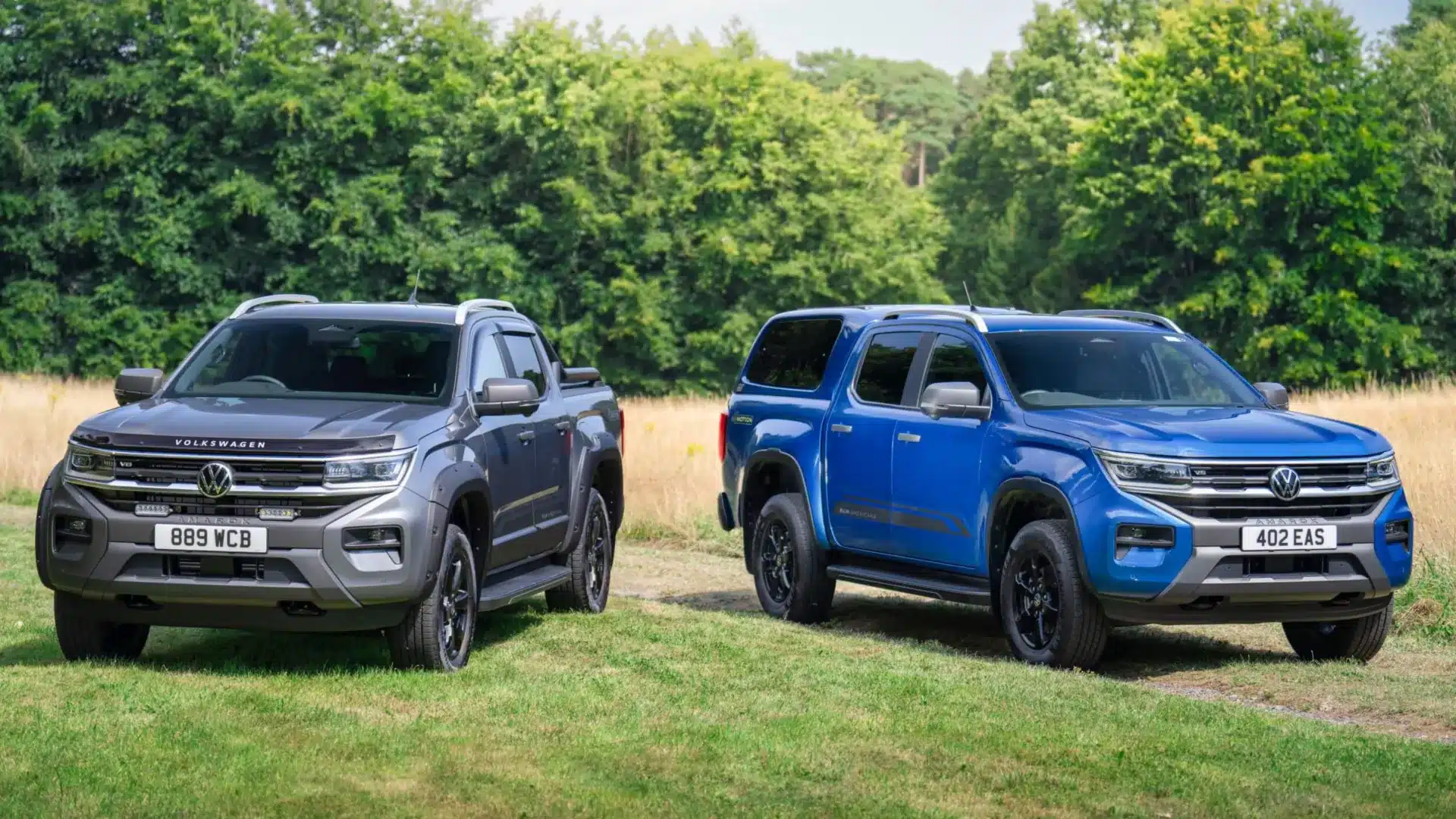
If you searched “VW Amarok USA” hoping to find one at your local dealer, here’s the short version before you read further: you can’t buy a new VW Amarok in the United States. Volkswagen doesn’t sell it there, and it has no plans to. In the Gulf, it’s a different story. The Amarok is on sale across the UAE, Saudi Arabia, and neighboring markets, priced from around AED 132,900 in the UAE and SAR 186,000 for the top trim in Saudi Arabia.
That gap between what American buyers want and what they can get drives most of the confusion online. So this guide splits the difference. For US readers, we’ll explain why the truck stays off-limits and what comes close enough to matter. For Gulf buyers, we’ll cover price, trims, the interior, the engine, and the reliability record you need before signing anything.
Can you buy a VW Amarok in the USA?
No. The 2026 VW Amarok is not sold through any official Volkswagen dealership in the United States, and Volkswagen hasn’t announced a launch.
Three things keep it out. First is the 25% “Chicken Tax,” a tariff on imported light trucks that dates back to a 1960s dispute over frozen chicken. It makes selling a foreign-built pickup in the US financially painful unless you build it locally. Second, re-engineering the Amarok to pass US crash and emissions rules would cost a fortune for a truck that shares showroom space with nothing else in VW’s American lineup. Third, Volkswagen has pointed its US strategy at SUVs and the new Scout electric brand instead of commercial pickups.
There’s an irony here that regular buyers miss. The current Amarok is built on the same platform as the Ford Ranger, which VW co-developed with Ford. So the truck Americans can’t buy is mechanically a close cousin of a truck they can walk in and order today. If you want the Amarok experience in the US, the Ranger is the honest starting point. A 2010s reader poll on a US truck forum found 94 percent of respondents said they’d be interested in an Amarok if it were sold locally, mostly for the diesel efficiency and lower price. That interest never translated into a business case VW could justify.
What about importing one privately? It’s possible under the 25-year rule for older models, but a 2026 Amarok is far too new to import legally. Gray-market imports of new trucks carry no factory warranty, questionable safety certification, and thin parts support. For a daily driver, it isn’t worth the headache.
What US buyers should look at instead
If the Amarok’s mix of car-like comfort and real work capability is what pulls you in, a few mid-size trucks sold in the US chase the same buyer:
- Ford Ranger: the Amarok’s mechanical twin, with the same 2.3L turbo four and a Raptor version for the wild end
- Toyota Tacoma: the reliability benchmark of the class, redesigned recently with a turbo four
- Nissan Frontier: simpler and cheaper, with a strong V6 and no-nonsense build
- Chevrolet Colorado: sharp turbo engine, good tech, competitive off-road trims
- Honda Ridgeline: the most car-like of the group, unibody, best on pavement
None wears a VW badge. But the Ranger in particular gets you 90 percent of the way to the Amarok for a fraction of the aggravation.
What the 2026 VW Amarok is
The Amarok is Volkswagen’s mid-size pickup, first launched in 2010 and now in its second generation. The current truck arrived in 2022 as the product of VW and Ford’s commercial-vehicle alliance. Ford supplied the underpinnings and powertrains; VW handled the styling, the cabin, and the tuning. The result shares DNA with the Ranger but looks and feels distinct.
It grew, too. The second-gen Amarok stretches to about 5,350 mm long with a 3,270 mm wheelbase, a jump of 96 mm and 173 mm over the old model. That extra length shows up as more rear-seat room and a longer bed. It’s a five-seat, double-cab truck aimed at buyers who want to haul cargo during the week and family on weekends without feeling like they’re driving a work van.
Design: rugged without trying too hard
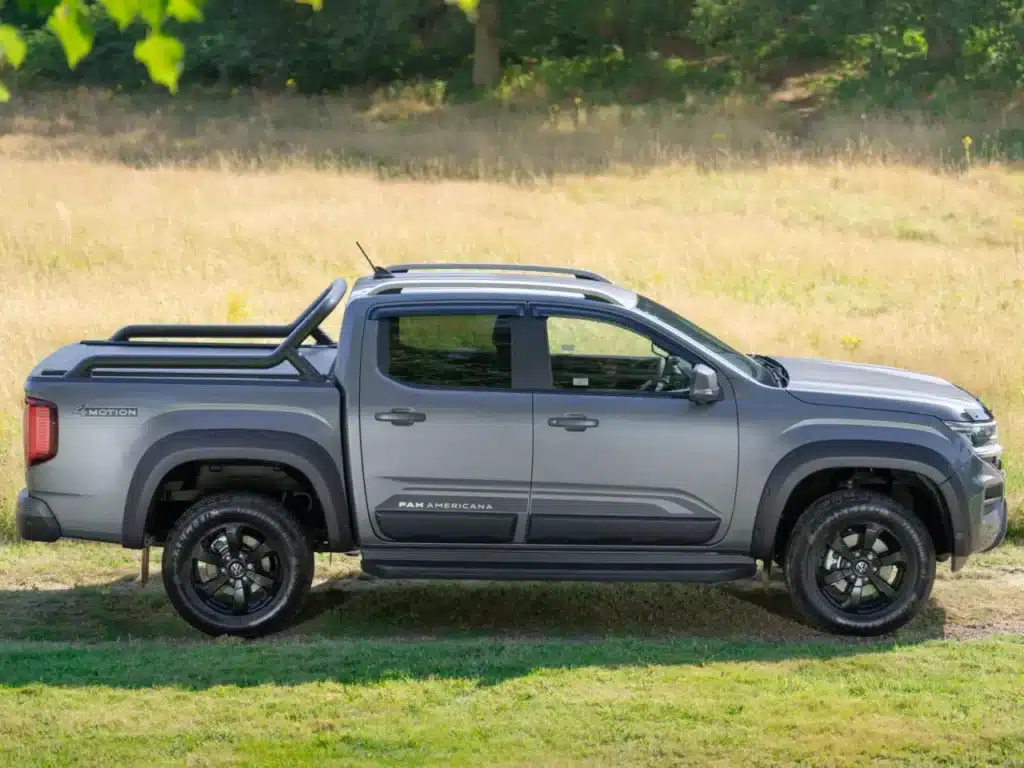
The front end does the heavy lifting. A wide grille with a bold VW badge, matrix LED headlights that adjust around oncoming traffic, and an X-shaped bumper on the PanAmericana and Aventura trims give it presence in a parking lot full of Hiluxes. From the side, the muscular wheel arches and available 17- to 21-inch wheels stretch the proportions out.
The 2026 range added a Dark Label version for some markets, drenching the exterior in matte black: the grille, mirror casings, door handles, side steps, roof rails, and 20-inch wheels all go dark, and the V6 badge stays to signal what’s under the hood. It’s a cosmetic package, not a mechanical one, but it’s the sharpest-looking Amarok yet if you like the murdered-out look.
Interior and technology
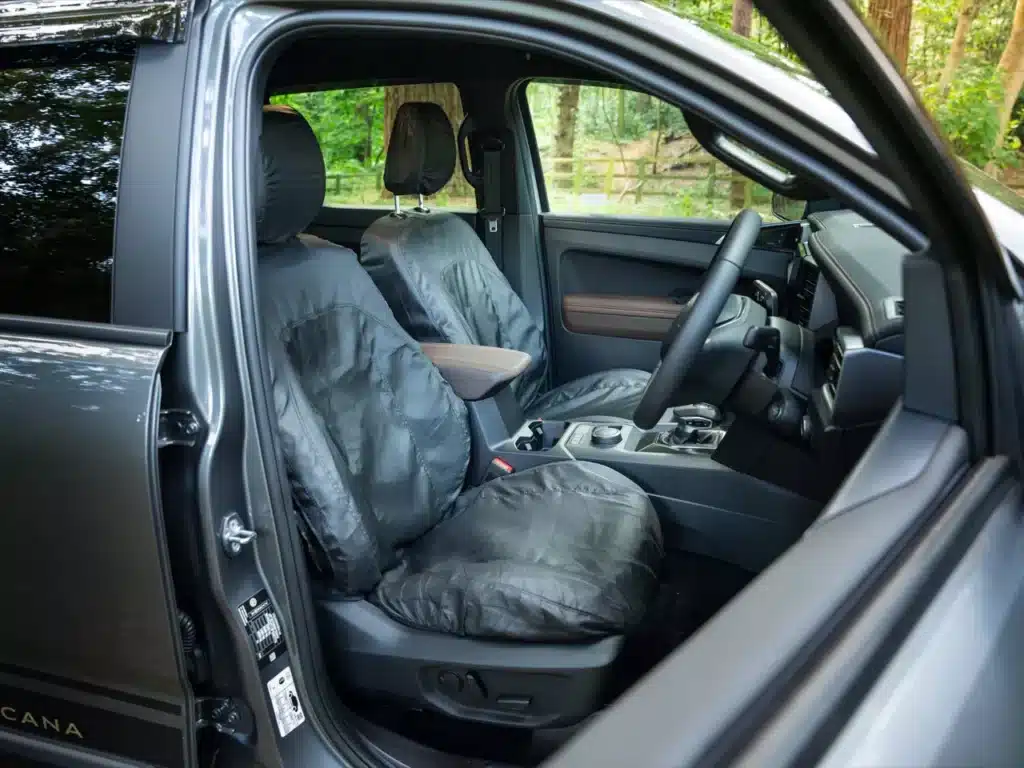
Volkswagen’s first Amarok earned a reputation for a cabin that felt closer to a Golf than a farm truck. The second generation pushes that further.
The dashboard centers on a portrait-oriented touchscreen, 10 inches on lower trims and 12 inches higher up, running VW’s MIB4 software with voice control. A 10.25-inch digital instrument cluster sits behind the wheel. Wireless Apple CarPlay and Android Auto come standard, and higher trims add a Harman Kardon sound system, ambient lighting with 30 color choices, and soft-touch materials that lift the whole space above what you expect from a pickup.
Seats scale with the trim. Lower versions use fabric or microfleece; the PanAmericana and Aventura move to leather. In the Gulf, where cabin heat is a daily reality, the Aventura’s heated and ventilated front seats earn their keep. So does the build quality, which several regional reviewers singled out as solid enough to handle years of desert sun without rattling apart.
Practicality holds up. The double cab seats five with usable rear legroom, the load bed takes a proper payload, and there’s a 12V socket in the bin on adventure-focused trims for camping or work gear.
Engine and performance: petrol in the Gulf, diesel elsewhere
This is where the market split matters most.
In the Gulf, the Amarok runs a single engine: a 2.3-liter turbocharged four-cylinder petrol making around 298 to 301 hp and 452 Nm of torque. It pairs with a 10-speed automatic and permanent all-wheel drive that can shift to rear-wheel drive. Top speed sits near 180 km/h. Volkswagen chose petrol for the region because diesel demand for private pickups is low and the petrol unit suits the fuel and driving patterns better. Reviewers describe it as the quickest and most refined Amarok yet, with a high-revving character that feels more like a hot SUV than a work truck.
Elsewhere in the world, the picture is broader. The UK, Australia, and South Africa get diesel options: a 2.0-litre four-cylinder turbodiesel in several tunes and a 3.0-litre V6 turbodiesel that remains the enthusiast favorite. In its strongest global tune, the diesel range tops out around 237 hp and 443 lb-ft of torque, and the V6 is the one long-distance towers and off-roaders keep coming back to.
For 2026, Volkswagen and Australian tuner Walkinshaw introduced the Amarok W600, a diesel performance version with Koni suspension, wider arches, electric side steps, and a side-exit exhaust. It’s confirmed for Australia, with deliveries expected between July and September 2026. VW representatives have hinted at wider markets but committed to nothing, so treat any US or Gulf W600 rumor as unconfirmed for now.
Towing, payload, and off-road
The Amarok backs up its looks with numbers. Global versions tow up to 3,500 kg and carry a payload up to 1,113 kg. Wading depth reaches 800 mm, a big jump from the previous generation’s 500 mm, which matters if you cross flooded tracks or soft wadis. Up to six drive modes cover Normal, Eco, Slippery, Snow/Sand, Mud/Rut, and Tow/Haul, so the electronics do the guessing on loose surfaces. The PanAmericana adds all-terrain tires for buyers who spend real time off the tarmac.
Safety
The 2026 Amarok comes well equipped with driver aids across the Gulf range. The standard kit includes:
- Adaptive cruise control
- Lane-keeping assist
- Autonomous emergency braking
- Blind-spot monitoring
- Rear cross-traffic alert
- 360-degree camera
- Multiple airbags and parking sensors
The IQ. Light matrix LED headlights, standard on higher trims, adjust the high beam automatically so you keep maximum visibility without blinding oncoming drivers. For a truck that spends time on unlit desert highways, that’s a feature worth having rather than a marketing line.
Hot-weather notes for Gulf buyers
Desert heat punishes trucks in ways cooler markets never test. Two things help. The Aventura’s ventilated seats stop the leather from turning into a griddle after an hour in a mall car park, so if you live in Dubai or Riyadh, that trim jump pays off daily. And the petrol turbo, while it dodges diesel filter problems, still runs hot when you tow or push it hard in summer. The idle-before-shutdown habit that South African reviewers recommend applies double in the Gulf. Give it 30 to 60 seconds after a hard run so the turbo oil doesn’t cook. Watch tyre pressures too, since 50-degree tarmac raises them fast, and the all-terrain rubber on the PanAmericana is sensitive to it.
Fuel economy
Volkswagen’s Gulf figures put the petrol Amarok at roughly 9 to 12 km/L depending on trim and driving, which is reasonable for a 300-hp all-wheel-drive pickup but nothing remarkable. Diesel versions sold elsewhere do better, which is exactly why US forum members wanted them. Expect the real-world Gulf economy to land at the lower end of that range in city traffic and with the air conditioning fighting summer heat.
Price: Gulf official figures vs the US gap
Let’s separate what’s confirmed from what’s an estimate.
Gulf (official dealer pricing):
| Market | Starting price | Top trim | Notes |
| UAE | AED 132,900 | up to ~AED 192,000 | Trims include Style, Comfortline, Highline, and PanAmericana. |
| Saudi Arabia | around SAR 170,000 | SAR 186,000 (Aventura) | Trims: Style, PanAmericana, Aventura |
Prices exclude registration, insurance, and dealer add-ons, and they shift with promotions. Confirm the current figure with your local Volkswagen dealer before budgeting.
United States: there is no US price because there’s no US Amarok. Any “VW Amarok for sale USA” listing you find is either a used gray-market import, a mislabeled Atlas, or a lead-generation page. For a genuine new-truck budget, a US Ford Ranger starts in the low-to-mid $30,000s and climbs from there.
Other markets for context: the Amarok sells strongly in the UK and South Africa, where diesel dominates. South African buyers cross-shop it against the Ford Ranger and GWM P500. UK pricing runs in commercial-vehicle territory. If you’re researching from those markets, the diesel V6 is the one to drive first.
For rough conversion, AED and SAR are both pegged to the US dollar, so AED 132,900 works out to about USD 36,200 and SAR 186,000 to about USD 49,600. Treat those as reference points, not import quotes.
VW Amarok reliability: the honest record
The second-generation Amarok, built on Ford Ranger hardware, has improved serviceability over the older VW-engineered truck. But no pickup is trouble-free, and owner reports flag a few patterns worth knowing.
The most consistent complaint targets the older V6 diesel’s DPF, the diesel particulate filter. One UK owner had theirs fail at 9,000 miles and 14 months, then argued with the dealer over a £2,400 bill before VW covered it, only for the warning light to return shortly after. Short trips clog the filter, and forcing regeneration on a truck that mostly does town driving is a recurring pain point. If you’re buying a diesel Amarok used, ask about DPF history first.
Other reported issues on higher-mileage diesels include oil consumption (one owner burned through oil every 8,000 miles), occasional V6 startup knock around the 20,000-mile mark, water pump problems, and EGR valve faults. Parts availability has frustrated some owners outside major markets, with one reporting a three-week wait for a side window.
The brighter side: the eight-speed automatic and the manual gearbox both hold up well past 100,000 miles with regular servicing, and long-term owners who use the truck the way it’s meant to be used report high satisfaction. What Car? gave the Amarok four stars out of five, calling it strong and practical. The Gulf petrol engine sidesteps the diesel-specific DPF and EGR headaches entirely, which is a quiet advantage for regional buyers. One tip from South African reviewers on the petrol turbo: after hard driving or towing, let it idle 30 to 60 seconds before shutdown so oil circulates through the turbo.
Bottom line: the current Amarok is a solid, reliable truck if you match the engine to your driving and stay on top of maintenance. The horror stories cluster around diesels used for the wrong duty cycle.
Pros and cons
Pros
- Car-like ride and refinement that beats most rivals
- Capable off-road with 800 mm wading depth and six drive modes
- Premium interior with strong tech, especially the 12-inch screen
- 3,500 kg towing and over 1,100 kg payload
- Gulf petrol engine avoids common diesel reliability traps
Cons
- Not sold in the USA, with no plans to change that
- Priced above simpler rivals like the Nissan Frontier equivalent
- Diesel versions carry a known DPF and oil-consumption history
- Parts can be slow to source in smaller markets
- Fuel economy is average for the segment
How it stacks up against rivals
In the Gulf, the Amarok’s main rivals are the Toyota Hilux, Ford Ranger, Nissan Navara, and Mitsubishi Triton. The Hilux wins on bulletproof reputation and resale. The Ranger, its mechanical twin, offers the same bones for often less money and a broader engine range, including the V6 diesel and the Raptor. The Amarok’s pitch is refinement: it feels more expensive inside and drives more like an SUV. If you want the plushest mid-size pickup in the showroom and don’t mind paying for it, it earns the look. If you want the cheapest path to the same mechanicals, the Ranger undercuts it.
Final verdict: who should buy it
The 2026 VW Amarok is the mid-size pickup for the buyer who refuses to choose between capability and comfort. It tows heavy, wades deep, and still coddles you with a cabin that shames most rivals. In the Gulf, the petrol engine sidesteps the diesel reliability worries that haunt the truck elsewhere, and the Aventura’s cooled seats make summer bearable.
It suits Gulf buyers who want a premium, family-friendly pickup and will pay a small premium over a Ford Ranger for the badge and the polish. It suits off-road and towing users who value refinement as much as grunt.
It does not suit US buyers, full stop, because they can’t have it. If that’s you, drive the Ford Ranger and know you’re getting most of the same truck. And if you’re chasing the diesel V6, look to the UK, South Africa, or Australia, where the Amarok has earned its cult following one long, easy highway mile at a time.
Frequently asked questions
Q. Is the VW Amarok available in the USA?
A. No. Volkswagen doesn’t sell the Amarok in the United States and has no launch planned. The 25% chicken tax, high compliance costs, and VW’s focus on SUVs and the Scout brand keep it out. US buyers who want a similar truck should look at the Ford Ranger, which shares the Amarok’s platform.
Q. How much does the 2026 VW Amarok cost in the UAE?
A. UAE pricing starts around AED 132,900 and runs up to roughly AED 192,000 for top trims before registration and insurance. In Saudi Arabia the top Aventura trim lists around SAR 186,000. Confirm current figures with your local dealer, as prices move with promotions.
Q. Is the VW Amarok reliable?
A. The current Ranger-based Amarok is generally reliable with proper maintenance. The main issues appear on diesel versions, mostly DPF clogging and oil consumption when the truck is used for short trips. The Gulf petrol engine avoids those specific problems. The gearboxes are durable past 100,000 miles.
Q. What engine does the Gulf VW Amarok use?
A. Gulf-market Amaroks run a 2.3-liter turbocharged four-cylinder petrol engine producing about 298 to 301 hp and 452 Nm, paired with a 10-speed automatic and permanent all-wheel drive. Diesel engines, including the 3.0 V6, are sold in other regions but not offered in the Gulf.
Q. Is the VW Amarok the same as the Ford Ranger?
A. Mechanically, they’re close cousins. VW and Ford co-developed the platform and share the 2.3L petrol engine and much of the hardware. VW designed its own styling, interior, and tuning, so the Amarok looks and feels different and generally positions itself as the more premium option.