
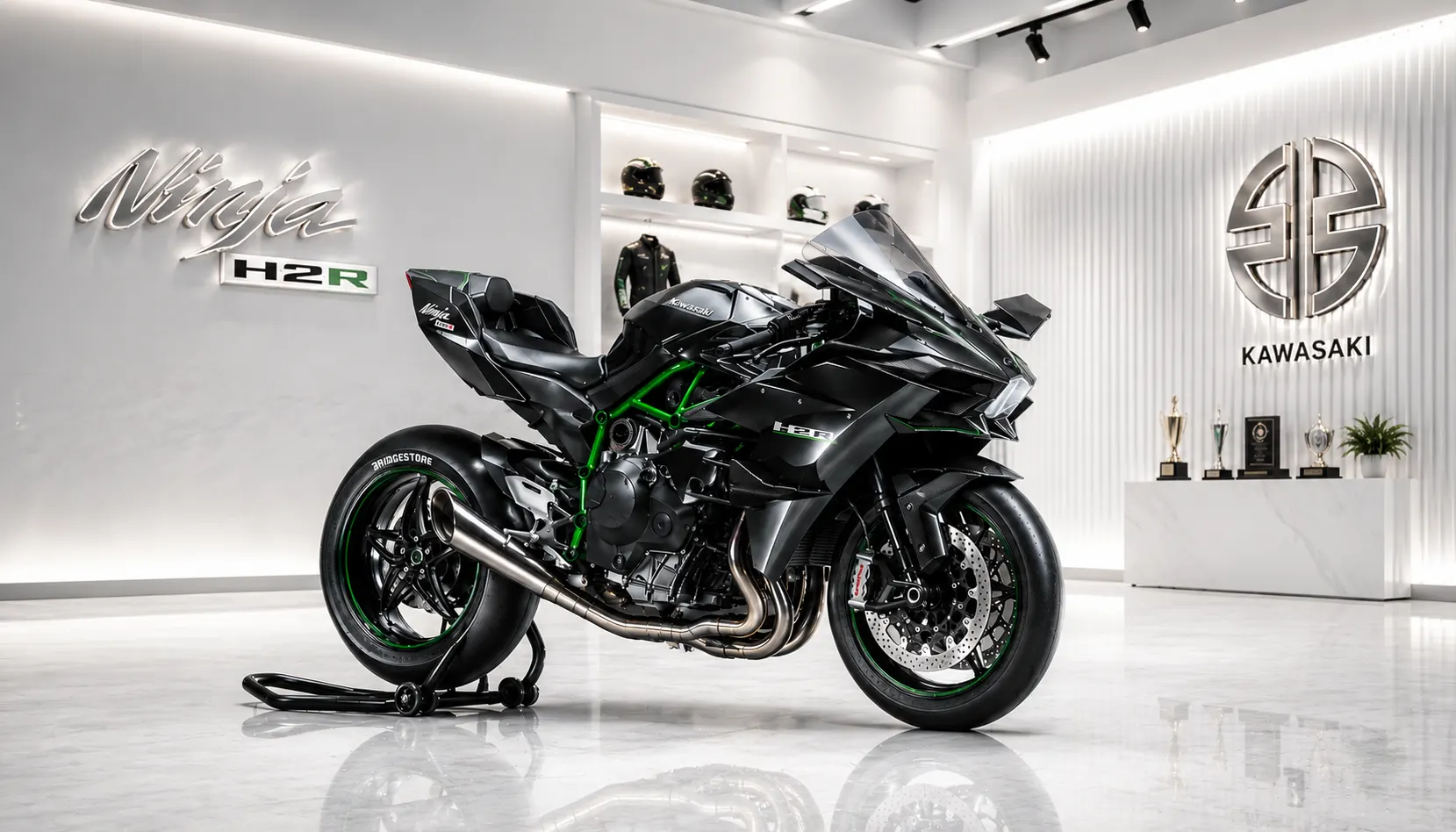
There are hundreds of motorcycles that exist, but then there is the Kawasaki Ninja H2R. Not only is the Ninja H2R an incredible motorcycle, but it also represents a mechanical middle finger to the laws of physics and demonstrates a master class in aerospace-quality engineering! The Ninja H2R is a motorcycle that is the culmination of the collective efforts of Kawasaki Heavy Industries, and it is their pinnacle of forced induction performance. If you want to commute, don’t buy the Ninja H2R. If you want to buy a 310 horsepower supercharged track weapon capable of 240+ mph, then you have found your motorcycle, and this is your definitive review.
Kawasaki Ninja H2R Overview
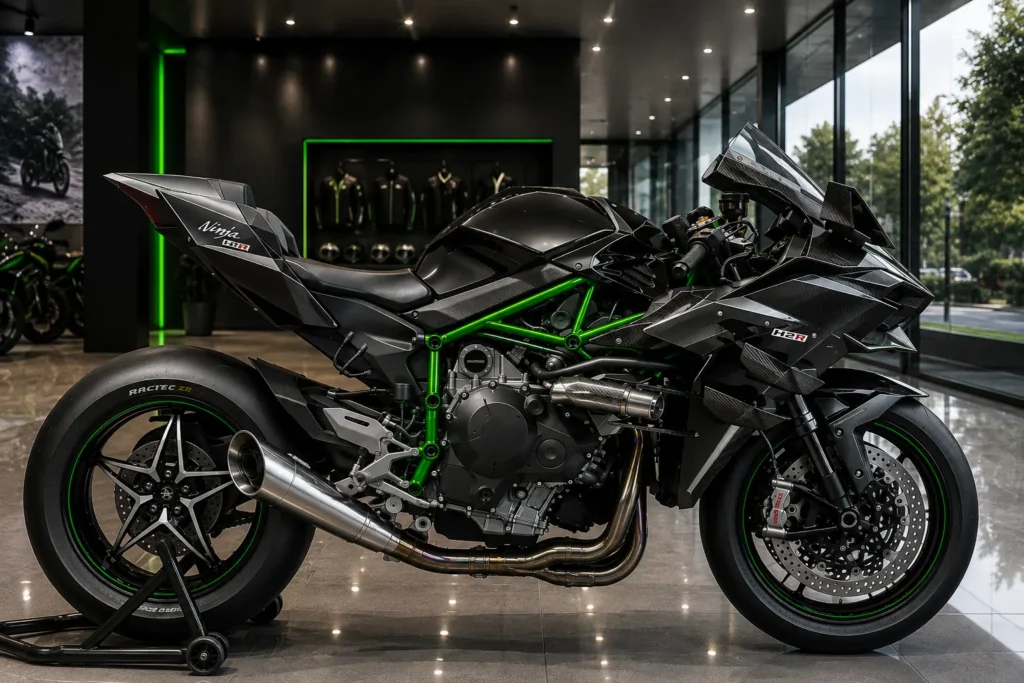
The Kawasaki Ninja H2R was developed collaboratively by multiple teams at Kawasaki Heavy Industries—namely the aerospace and turbine engineering teams. Unlike its road-legal counterpart, the Ninja H2, the Ninja H2R has been designed specifically for track use and is not street legal in many countries
In Kawasaki’s words, this is “the world’s most powerful supercharged hypersport motorcycle.”
Kawasaki Ninja H2R Price and Availability
There are often wild prices between India and the UAE (high tariffs and import taxes). The price for the UAE is a direct conversion from the global MSRP, but the local dealer markup (if there is any immediate stock) can increase the price further still.
| Region | Currency | Estimated Price (MSRP) |
| United States | USD | $59,100 |
| United Arab Emirates | AED | د.إ 217,100 |
| European Union | EUR | €56,500 |
| United Kingdom | GBP | £49,000 |
Note: UAE pricing may vary based on local dealer imports and regional specifications.
Kawasaki Ninja H2R Engine and Powertrain
The heart of the Kawasaki Ninja H2R is its 998 cc, liquid-cooled, 4-stroke inline-4 engine that’s the only production motorcycle to feature a supercharger designed to be entirely manufactured by Kawasaki.
2026 Kawasaki Ninja H2R Performance
Horsepower: ~310 hp (up to 326 hp with Ram Air)
Torque: 121.5 lb-ft (165 Nm) @ 12,500 rpm
Top Speed: Officially recorded at 249 mph on closed circuits
Powertrain: The supercharger has a maximum rotor speed of 130,000 rpm and utilizes a planetary gearing system from the crankshaft.
| Feature | Specification Details |
| Engine Type | 998cc Liquid-cooled, 4-stroke In-Line Four |
| Induction System | Kawasaki Centrifugal Supercharger (130,000 RPM) |
| Maximum Horsepower | 310 hp @ 14,000 rpm |
| Max HP with Ram Air | 326 hp @ 14,000 rpm |
| Maximum Torque | 121.5 lb-ft (165 Nm) @ 12,500 rpm |
| Top Speed | 249 mph (400 km/h) |
| 0–100 km/h (0–62 mph) | 3.07 Seconds |
| 0–300 km/h (0–186 mph) | 12.5 Seconds |
| 1/4 Mile Time | 9.64 Seconds @ 164 mph |
| Transmission | 6-speed, Dog-ring (MotoGP-derived) |
| Final Drive | Sealed Chain |
| Curb Weight | 216 kg (476.2 lbs) |
| Power-to-Weight Ratio | ~1.43 hp per kg (with Ram Air) |
| Braking System | Dual 330mm Brembo Stylema Monobloc Calipers |
| Front Suspension | 43mm Inverted KYB AOS-II fork (Fully Adjustable) |
| Rear Suspension | Öhlins TTX36 Gas-charged shock (Fully Adjustable) |
| Fuel Efficiency (Track) | ~15–20 km/l (Approx. 35–47 MPG)* |
Riders have reported that the power output doesn’t build up smoothly; rather, it comes on with such force that it has been likened to a “violent explosion.” The addition of a dog-ring transmission (common only in MotoGP) allows for instant, clutchless shifting under extreme acceleration.
Kawasaki Ninja H2R Technical Specifications
If you want to get an idea of why the Kawasaki Ninja H2R’s price is extremely high, look at the amazing list of components that went into constructing this extraordinary motorcycle.
Chassis and Drive
- Drive Type: Final chain; high-performance 525 typical chain.
- Wheel Type: Lightweight cast aluminum; unique star pattern design to withstand tremendous centrifugal forces.
- Tires: Bridgestone Racing Battlax V01 slicks (120/600 R17 Front; 190/650 R17 Rear).
- Frames: Trellis frame made of high-tensile steel, specifically engineered to “dissipate” heat created by the supercharger to provide high-speed stability.
Fuel Economy (EPA-Estimated MPG)
Because the H2R is a purpose-built track-only motorcycle, it does not have a regular EPA figure. However, according to real-world data collected by professional riders on a racing track, the H2R has a common mileage of:
Estimated MPG: 10–15 miles per gallon, or 10–15 km per gallon on a US gallon basis.
Fuel Tank Capacity: 17 L (4.5 gallons).
Fuel Requirement: Minimum 95 octane.
| Feature | Specification |
| Engine Type | Supercharged 998cc Inline-4 |
| Bore x Stroke | 76.0 x 55.0 mm |
| Compression Ratio | 8.3:1 |
| Wheelbase | 1,450 mm (57.1 in) |
| Curb Weight | 216 kg (476.3 lbs) |
| Brakes | Dual 330mm Brembo discs (Front); 250mm disc (Rear) |
Kawasaki Ninja H2R Exterior: Aerospace Engineering & “Mirror-Coated” Carbon
The exterior design of the H2R has a strong angular appearance with an emphasis on aerodynamics. The overall look is designed for stability at high speeds, rather than being aesthetically pleasing.
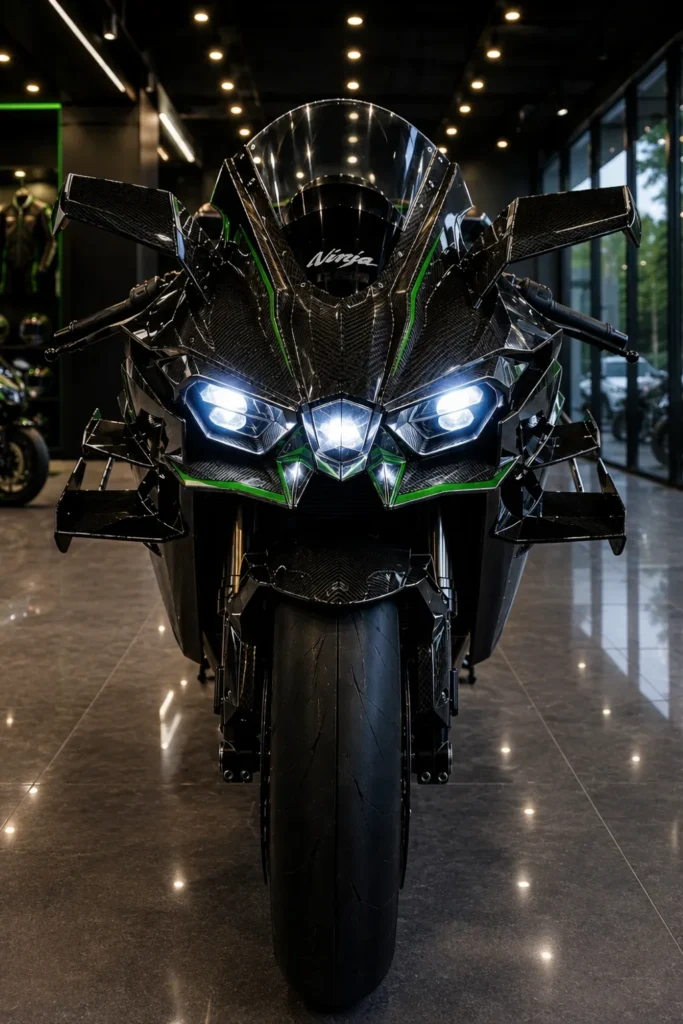
Carbon Fiber Bodywork & Winglets
Unlike the standard Ninja H2, the H2R’s bodywork is made completely from hand-layered carbon fiber. This allows for maximum strength with minimum weight. The most eye-catching exterior is the dual-plane winglets as opposed to mirrors. These winglets generate a significant amount of downforce, ensuring that the front tire is firmly on the road when the bike accelerates hard.
The Silver-Mirror Finish
The H2R has its own proprietary silver-mirror paint. This does not mean that it is a normal silver metallic paint. There is a chemical reaction that occurs that turns into a layer of real silver.
- In Shade: The motorcycle has a very dark, aggressive-looking color.
- In Light: The motorcycle will have a very bright and reflective appearance.
- Functionality: The appearance of the finish is not just for the ‘wow’ factor; it also provides a very smooth surface to reduce skin friction drag when traveling.
Wheels and Chassis
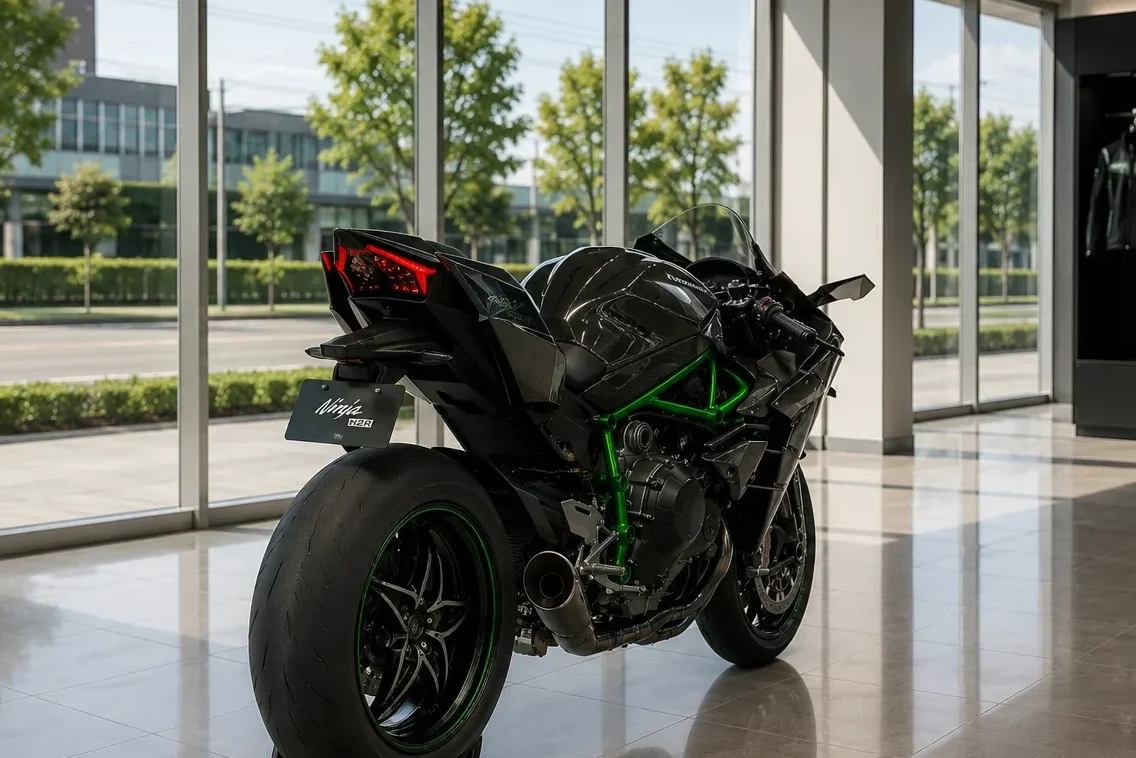
The motorcycle rides on unique cast aluminum wheels that are designed with a five-point star pattern. Not only are these wheels eye-catching, but they are also constructed to support the extraordinary centrifugal forces and torque loads of the motorcycle.
Kawasaki Ninja H2R Interior: Cockpit and Instrumentation
The term “interior” refers to how a rider will connect to control H2R, due to the fact there are no cabins on motorcycles; otherwise, what would happen is H2R has an array of technology (electronics) to provide a way to manage H2R’s extreme power.
The Instrumentation Suite
Underneath the “interior” features for H2R’s instrumentation suite, there is a semi-digital instrument cluster with an analog tachometer and a large multi-function HD TFT display.
Key components of H2Rs “interior” features:
- Boost indicator: A real-time indicator of how much boost is being produced by the supercharger.
- Bank Angle Display: A tracking system that allows the rider to know their maximum “lean angle” during riding.
- IMU Integration: The Bosch 6-axis inertial measurement unit, which is referred to as “IMU,” provides input for the bike’s control elements, allowing the rider to view pitch, roll, and yaw in real-time.
Ergonomics and Controls
The cockpit is designed to allow a rider to have maximum leverage when tucking in while at high speeds with the help of machined triple clamps and clip-on handlebars. Also, the seat of the rider has adjustable hip support pads that will hold the rider in place under heavy G forces when accelerating.
Electronic Rider Aids
Rider assist aids include multiple integrated systems that are operated through a switch located on the handlebars.
KTRC (Traction Control System): 9 levels of intervention, including “Race” settings,
KLCM (Launch Control): Limit to wheelspin and excessive wheelies.
KEBC (Engine Brake Control): A Rider can select the amount of back-torque when off-throttle. Critical when riding into a corner at higher speeds.
Comparison: The H2 Family
The H2R is the flagship model in their lineup. The various Ninja H2s are offered in different configurations for different uses.
| Feature | Ninja H2R | Ninja H2 | Ninja H2 Carbon | Ninja H2 SX SE |
| Usage | Closed-Course Track | Street Legal | Street Legal (Limited) | Sport Touring |
| Max Horsepower | 310 hp (326 hp Ram Air) | 228 hp (240 hp Ram Air) | 228 hp (240 hp Ram Air) | 197 hp (200 hp Ram Air) |
| Max Torque | 121.5 lb-ft | 104.9 lb-ft | 104.9 lb-ft | 101.3 lb-ft |
| Curb Weight | 216 kg (476 lbs) | 238 kg (524 lbs) | 238 kg (524 lbs) | 267 kg (588 lbs) |
| Body Material | Full Carbon Fiber | Plastic/Polymer | Carbon Fiber Front Cowl | Reinforced Polymer |
| Aerodynamics | Dual Carbon Winglets | Traditional Mirrors | Traditional Mirrors | Touring Windscreen |
| Exhaust System | Titanium Straight-Pipe | Street-Legal Muffler | Street-Legal Muffler | Silent Touring Exhaust |
| Top Speed | 249 mph | 186 mph (Limited) | 186 mph (Limited) | 186 mph (Limited) |
| Wheel Type | Cast Aluminum Star | Cast Aluminum Star | Cast Aluminum Star | Alloy Touring Wheel |
| Seat Height | 32.7 in | 32.5 in | 32.5 in | 32.9 in |
| MSRP (2026) | $59,100 | $32,700 | $36,200 | $28,500 |
- Ninja H2: The street-legal cousin of H2R that outputs 197 hp, complete with mirrors, turn signals, and an exhaust capable of illegal usage on public roads.
- Ninja H2 Carbon: A limited edition street-legal version with a carbon fiber front cowl and looks like the H2R.
- Ninja H2 SX: A supercharged sport tourer specifically designed for long-distance comfort with a retuned engine yielding better low-end torque.
Final Verdict: Is It Worth It?
The Ninja H2R was never really intended as “practical,” instead being treated as both a collectible and a driving force behind the evolution of the internal combustion engine. If you can afford the expense and have access to a professional track, no other experience on earth can compare to the sound of the supercharger spinning at 14,000 RPM!
Disclaimer: The specifications, performance data, and pricing are for informational purposes only. Values may vary based on condition, originality, and market trends. Prices are estimates. For accurate details, consult the website and sources.
FAQs
Q. What top speed can the Kawasaki Ninja H2R reach?
A. The Kawasaki Ninja H2R can reach a max speed of 400 km/h when ridden on a controlled track.
Q. How much power can I expect to get from the Kawasaki Ninja H2R?
A. The Kawasaki Ninja H2R can provide up to 305 hp, which can be bumped up to 326 hp with the addition of RAM air.
Q. Can you ride a Kawasaki Ninja H2R on the street?
A. No; in most jurisdictions, you will not legally be able to ride the Kawasaki Ninja H2R on public roads, as it’s designated strictly for use on the racetrack.
Q. What kind of engine can I expect from the Kawasaki Ninja H2R?
A. The Kawasaki Ninja H2R features a supercharged, liquid cooled 998cc In-line rated four cylinder engine that is shifted through a 6-speed transmission.