
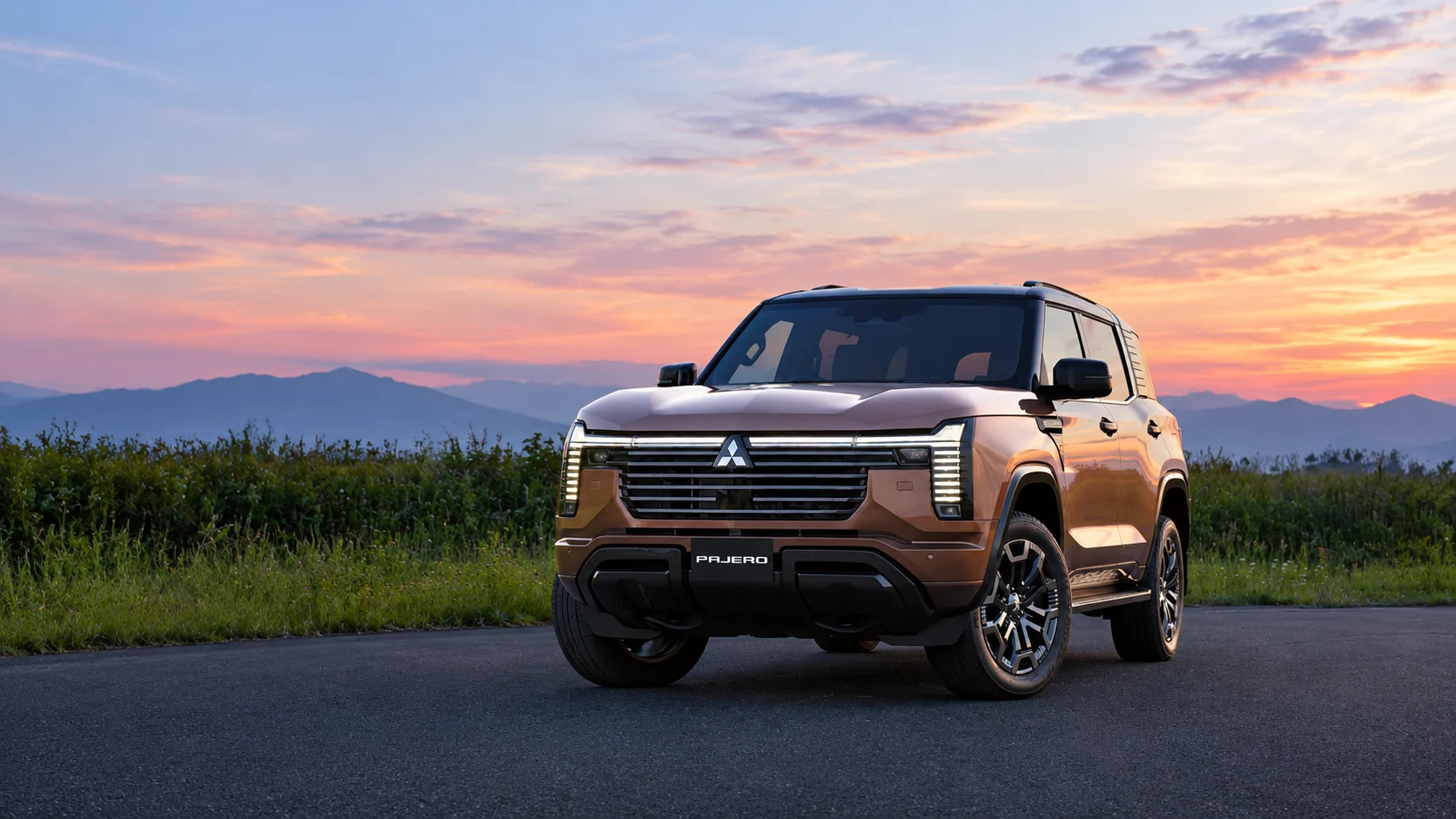
The Mitsubishi Pajero is back. After a five-year gap, Mitsubishi pulled the covers off an all-new fifth-generation Pajero at a world premiere in Tokyo on September 2, 2026, and confirmed it as the brand’s new flagship SUV. For drivers in the Gulf who grew up watching the Pajero win the Dakar Rally, and for Americans who remember it as the Montero, this is the news you have waited for.
This guide walks through the new mitsubishi pajero model, what it costs, how the US and Gulf markets differ, and where the Pajero Sport, the rare Pajero Evolution, and the tiny Pajero Mini fit into the story. Prices and specs here come from Mitsubishi’s own release and established motoring sites, and estimates are labeled clearly so you know what is confirmed and what is not.
The all-new Pajero: everything about the 2027 model
Mitsubishi calls the new mitsubishi pajero its “new-generation flagship,” built around three ideas the company sums up as Confidence, Comfort, and a new one, Prestige. The short version: it is bigger, more capable, and far more upmarket than the model it replaces.
The most important change sits under the body. The old fourth-generation Pajero used a car-like unibody. The new one goes back to a proper body-on-frame (ladder-frame) chassis, adapted from Mitsubishi’s Triton pickup and tuned specifically for an SUV. That is the same recipe Toyota uses for the Land Cruiser, and it tells you Mitsubishi is aiming this Pajero straight at serious off-roaders again.
Production happens in Thailand. mitsubishi pajero will launch it in Thailand first, then Japan and Australia before the end of March 2027, with roughly 100 countries to follow from that point, including Middle East markets. That order matters for Gulf buyers, which we cover below.
Mitsubishi Pajero Design, exterior, and dimensions
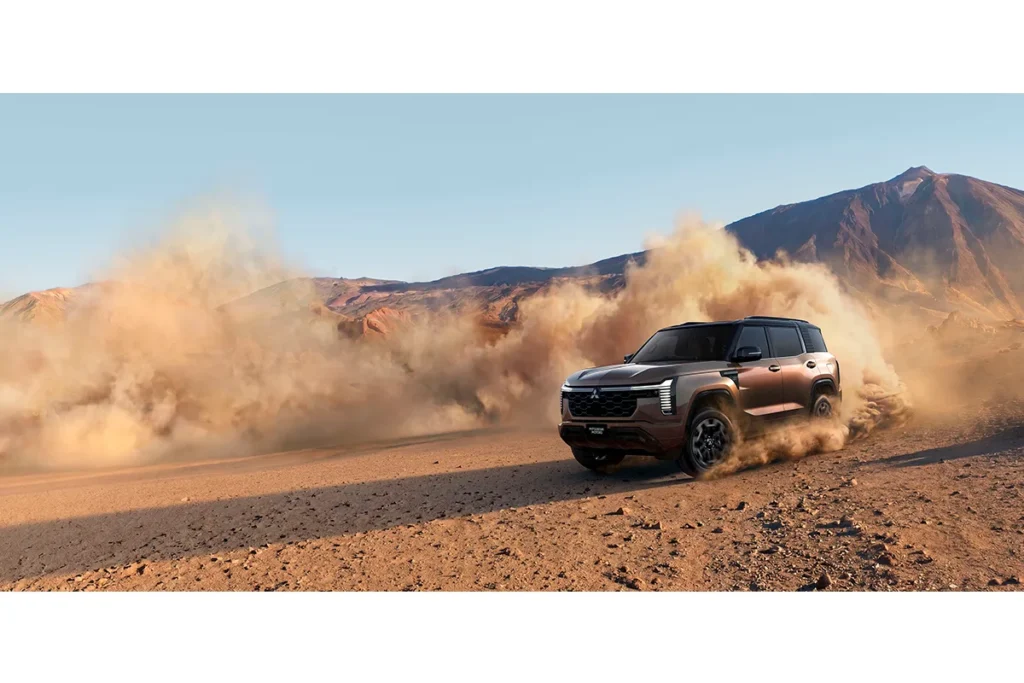
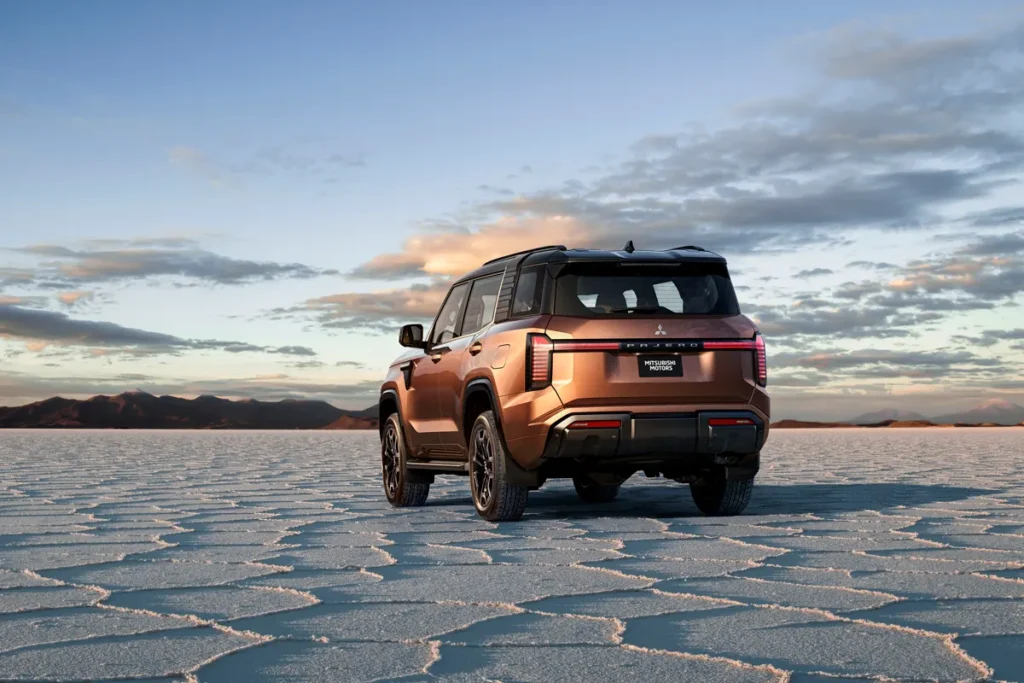
The styling is boxy and upright, with squared-off proportions and real visual weight. Mitsubishi named the design theme “Grand Charisma,” and it borrows a few cues from Pajeros of the past: the distinctive C-pillar echoes the roll-bar shape of the original 1982 model, and a hexagonal motif at the rear nods to the old externally mounted spare wheel. Up front you get Mitsubishi’s T-shaped LED lighting and a big grille the company says was inspired by kendo, the Japanese martial art.
Look at the mitsubishi pajero from the side and the intent is obvious: long body, high ground clearance, pronounced wheel arches, side steps, and chunky mud flaps. Depending on the version, it rides on 255/55 R20 tires (Toyo Open Country H/T or Bridgestone Dueler H/T).
Here are the confirmed dimensions:
| Measurement | New Pajero (2027) |
| Length | 4,920 mm (193.7 in) |
| Width | 1,925 mm |
| Height | 1,910 mm |
| Wheelbase | 2,870 mm |
| Ground Clearance | 230 mm |
| Approach Angle | 30.4° |
| Breakover Angle | 22.6° |
| Departure Angle | 25.8° |
| Weight Distribution (front:rear) | 52:48 |
At just under 4.92 meters long, the Pajero lands right in Toyota Land Cruiser and Land Cruiser Prado territory and is close in size to the Ford Everest and GWM Tank 500.
Mitsubishi Pajero Engine and powertrain
The launch engine is a 2.4-liter variable-geometry turbodiesel (Mitsubishi’s “clean diesel”), paired with a newly developed eight-speed automatic. Mitsubishi quotes 480 Nm of torque, dropping to 470 Nm on some specifications. The company has not published an official horsepower figure yet, but since this is the same unit that powers the Triton pickup, outlets such as Motor1 expect around 204 hp (204 PS) and roughly 354 lb-ft.
Four-wheel drive is handled by Super Select 4WD-II combined with Mitsubishi’s S-AWC (Super All-Wheel Control) torque management. Super Select is the party trick Pajero fans have always loved: it lets you run full-time four-wheel drive on tarmac, then lock things down for sand, rock, or mud. For desert driving in the Gulf, that flexibility is genuinely useful, not just marketing.
Mitsubishi Pajero Interior, features, and technology
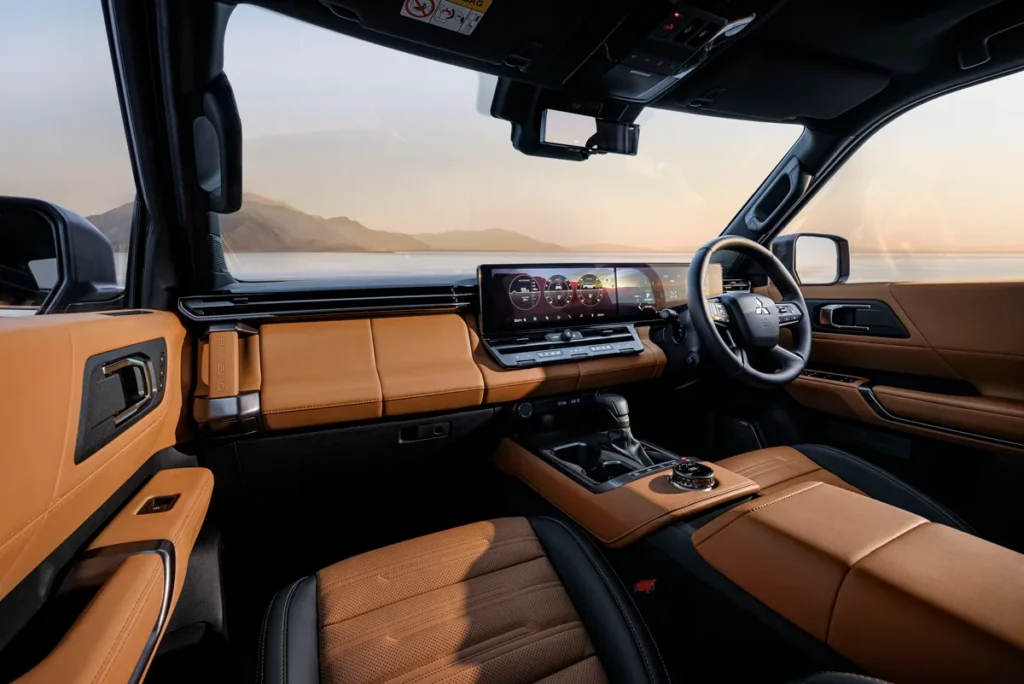
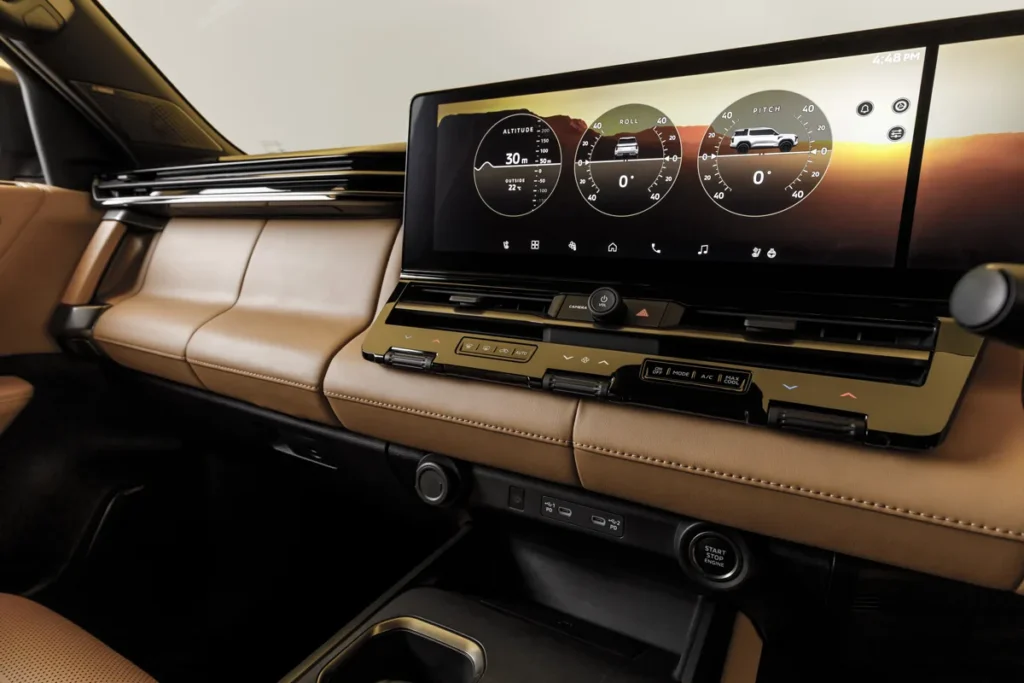
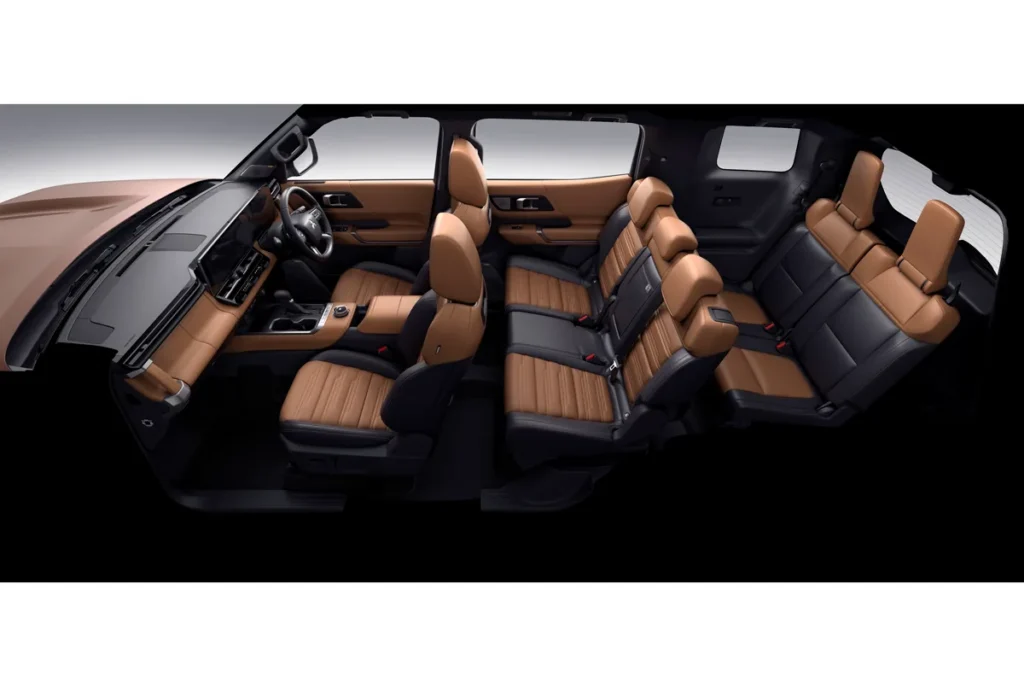
Inside, the cabin moves clearly upmarket. Mitsubishi and early reports from The National list twin 12.3-inch displays, a leather-trimmed dashboard, wireless charging, a 360-degree camera, and heated and ventilated seats. It seats seven across three rows.
One detail longtime fans will appreciate: the return of the multi-meter, now digital. The old triple-gauge cluster is back and shows altitude, compass heading, ambient temperature, vehicle pitch and roll angles, and torque distribution. On a dune run or a remote trail, that readout earns its place.
Mitsubishi Pajero price in the US and the Gulf
This is where US and Gulf buyers need very different answers, so read the section that applies to you.
US price and availability
Here is the blunt truth: the new Pajero is not confirmed for the United States. Mitsubishi has never sold the Pajero under that name in America. The vehicle was sold here as the Mitsubishi Montero, and it was discontinued after the 2006 model year.
There are hints a US version could return. Mitsubishi filed a trademark for the Montero name with the US Patent and Trademark Office in 2024, and CarBuzz reported that US dealers have already seen the new SUV in person. But as of now Mitsubishi has refused to confirm a US launch, so there is no official US price.
If you want a Pajero in the US today, your realistic options are
- A used US-spec Montero (best documented years run 2003–2006).
- A JDM import that is at least 25 years old under the federal 25-year import rule.
Used Montero prices in the US vary widely by condition and rust history, so treat any single figure with caution and inspect the frame carefully before buying.
Gulf and UAE price (AED)
The Gulf story is much happier. Mitsubishi has confirmed Middle East markets are part of the ~100-country rollout, and in the UAE the Pajero is expected to return through Al Habtoor Motors, Mitsubishi’s exclusive distributor since 1983.
There is no official UAE price for the new Pajero yet. Any number you see today is an estimate. As a rough guide, before the reveal, the site AutoTrader UAE estimated an entry point around AED 210,000–250,000, rising to AED 350,000–400,000+ for top trims. Treat those as speculative until Al Habtoor publishes real pricing closer to the 2027 launch.
In the meantime, the outgoing (fourth-generation) Pajero, discontinued globally in 2021, still turns up as remaining stock and, mostly, on the used market. Used listings in the UAE swing hugely with age: YallaMotor shows examples from roughly AED 7,000 for old, high-mileage cars up to about AED 101,000 for the newest ones, while DubiCars has quoted a similar spread.
| Market | New Pajero (2027) Status | Market |
| USA | Not confirmed / no price; only used Montero or 25-year JDM imports available | USA |
| UAE (Gulf) | Est. AED 150,000–310,000+; official price pending, expected late 2027 via Al Habtoor Motors | UAE (Gulf) |
(All 2027 figures are estimates. Official pricing had not been released at the time of writing.)
US vs Gulf: what’s actually different
If you read US and Gulf coverage side by side, the same car can sound like two different vehicles. Here is why.
Availability. The Gulf gets the new Pajero as a mainstream showroom model. The US may not get it at all, and if it does, it will likely wear the Montero badge and arrive later.
Trims and engines. Gulf and Asian markets favor turbodiesel power, which suits the new 2.4-liter diesel perfectly. If a US Montero ever happens, it would almost certainly need a different (likely petrol or hybrid) powertrain to meet American emissions rules and buyer habits, since diesel SUVs are a hard sell in the US.
Hot-weather engineering. For Gulf drivers, this matters more than horsepower. The outgoing Pajero built its reputation partly on surviving extreme heat, sand, and long highway runs between emirates. Mitsubishi says the new ladder frame and retuned suspension are designed to shrug off heavy impacts while staying composed on broken surfaces, exactly the mix you want for wadi tracks and summer motorway drives. Cooling, cabin ventilation, and the ventilated seats will be worth checking on the GCC-spec sheet once it lands.
Naming. Same car, different badge depending on where you are: Pajero across Asia, Latin America, and the Middle East; Montero in Spain, the Americas, and India; and Shogun in the United Kingdom.
Mitsubishi Pajero Sport: review and pricing
While the full-size Pajero disappeared for five years, the smaller Pajero Sport kept the family name alive. Built on the Triton pickup platform, it is a mid-size, seven-seat body-on-frame SUV that sells strongly across the Gulf and Asia. One quirk worth knowing: in the UAE it is badged the Montero Sport, not the Pajero Sport, even though it is the same vehicle.
Mitsubishi Pajero Sport specs and price
In the Gulf, the Pajero Sport typically pairs a 2.4-liter turbodiesel (around 200 hp and 430 Nm) with an eight-speed automatic and selectable four-wheel drive with off-road modes. A 3.0-liter V6 petrol has also been offered in some regional configurations.
On pricing, ArabWheels lists the 2026 Pajero Sport in the UAE from about AED 112,500 for the GLX up to roughly AED 154,000 for the top Elite, quoted as ex-factory prices. A newer, refreshed version has been discussed at an estimated AED 145,000–210,000 by ZigWheels, so expect some movement as stock updates.
Mitsubishi Pajero Sport review: Is it any good?
The owner and site reviews land in “solid, not spectacular” territory. ArabWheels shows an overall rating around 3 out of 5, and owner comments there describe it as a comfortable, capable all-rounder that does most things well without wowing you, with a few noting that ride comfort is only average on long inter-emirate drives. The strengths are the ones that matter to buyers in this class: proven off-road hardware, seven seats, diesel torque, and Mitsubishi’s reputation for durability.
US note: the Pajero Sport has never been federally certified for sale in the United States, so it is not a new-car option there.
The legends: Pajero Evolution and Pajero Mini
Two cult models explain why enthusiasts search for “mitsubishi pajero evolution for sale” and “mitsubishi pajero mini for sale” years after they went out of production.
Mitsubishi Pajero Evolution (the “Evo” 4×4)
The Pajero Evolution is the wild one. Mitsubishi built it between 1997 and 1999, and most sources put production at around 2,500 units (some say 2,693), all for the Japanese market. Its whole reason to exist was homologation: to qualify Mitsubishi’s Dakar racer for the production-based T2 class, the company had to sell a road-legal version to the public.
What you got was a short-wheelbase, wide-body monster. Under the hood sat a naturally aspirated 3.5-liter 24-valve DOHC V6 (the 6G74) with MIVEC variable valve timing and a dual-plenum intake, making roughly 276 hp at 6,500 rpm and about 256 lb-ft. Mitsubishi swapped in double-wishbone front and multi-link independent rear suspension, added Recaro seats, flared arches, skid plates, and that unmistakable wraparound rear spoiler. Silodrome and Carscoops have both covered surviving examples in detail.
For collectors, the timing is now interesting: the earliest Pajero Evolutions passed the 25-year mark and became legal to import into the US from 2022. Values have been climbing as buyers realize how capable and rare these Dakar-bred trucks are. If you find a clean “Pajero Evo” for sale, check the import paperwork and service history closely.
Mitsubishi Pajero Mini
At the other end of the size scale is the Pajero Mini, a proper Japanese kei car that looks like a Pajero shrunk in the wash. Mitsubishi produced it from December 1994 to June 2012, and it was styled as a miniature Pajero to ride the SUV wave of the era. It was later also sold as the Nissan Kix.
Despite the toy-like proportions (about 3.3 meters long), it kept real four-wheel-drive hardware. Power came from a 660cc four-cylinder (the 4A30), offered naturally aspirated or turbocharged, producing anywhere from roughly 50 hp up to around 63 hp in intercooled-turbo form. It was a Japan-only model, never officially sold in the US, UK, or most of Europe.
Today the Pajero Mini is an import curiosity. Japanese exporters list clean examples starting from just a few thousand US dollars, and the older ones now qualify for the US 25-year import rule. It is not a highway cruiser, but as a cheap, characterful, surprisingly capable little 4×4, it has a devoted following.
A quick word on the classics: the 1995 Pajero and the 3.0 V6
Searches for “mitsubishi pajero 1995” and “mitsubishi pajero 3.0 v6” usually point to the second-generation Pajero (1991–1999). Many of these ran the 3.0-liter 6G72 V6 petrol engine, good for around 177 hp, and they remain popular used buys and JDM imports thanks to their tough Super Select 4WD system and old-school durability. If you want a Pajero you can wrench on yourself, this era is the sweet spot.
How the Mitsubishi Pajero earned its name
The Pajero arrived in 1982 (it debuted at the 1981 Tokyo Motor Show) as Mitsubishi’s answer to the Toyota Land Cruiser: a full-blooded 4×4 with the comfort of a passenger car. It helped drive Japan’s recreational-vehicle boom in the 1990s and went on to sell more than 3.25 million units in over 170 countries across four generations.
Then there is Dakar. The Pajero began racing the brutal Paris-Dakar Rally in 1983 and racked up 12 victories between 1985 and 2007, including seven in a row and a famous 1-2-3 finish in 1998. That desert dominance is exactly why the name still carries so much weight in the Gulf.
The generation-by-generation short version:
- Gen 1 (1982–1991): the original, two-door, and later five-door.
- Gen 2 (1991–1999): the 3.0 V6 era, the basis for the Evolution.
- Gen 3 (2000–2006): switched to unibody; this was the last Montero sold in the US.
- Gen 4 (2006–2021): long-running final version, sent off with an 800-unit Final Edition.
- Gen 5 (2027): the ladder-frame comeback covered above.
Mitsubishi Pajero Competitors: Who the new Pajero is fighting
The new Pajero enters one of the toughest segments in the world. Its natural rivals, especially in the Gulf, include
- Toyota Land Cruiser and Land Cruiser Prado: the default choice and the benchmark for resale value and dealer reach.
- Ford Everest: modern, tech-heavy, and strong on-road manners.
- GWM Tank 500: aggressive value and features from China’s growing off-road push.
- Nissan Patrol: the big-engine desert favorite across the GCC (a size up, but cross-shopped).
- Jeep Wrangler / Grand Cherokee: the closest US equivalents if a Montero ever returns.
The Pajero’s pitch against all of them is heritage plus that Super Select 4WD system, wrapped in a more premium package than before.
Mitsubishi Pajero Pros and cons
Pros
- Genuine body-on-frame off-road hardware with Super Select 4WD-II and S-AWC.
- Strong diesel torque (480 Nm) and a smooth new eight-speed automatic.
- Seven seats and a clearly upgraded, tech-rich cabin.
- Return of the beloved multi-meter for off-road and desert navigation.
- Real Dakar heritage and a loyal Gulf following.
Cons
- No confirmed US launch, so American buyers are stuck with used models for now.
- Official pricing is still unpublished, so budgeting is guesswork.
- Diesel-only launch engine limits appeal in petrol-focused markets like the US.
- Later Gulf arrival (2027) than Thailand, Japan, and Australia.
Final verdict: who should care about the new Pajero?
For Gulf buyers, the new Mitsubishi Pajero is one of the most important launches of the year. If you want a seven-seat, body-on-frame SUV with real desert credibility, a torquey diesel, and a badge that means something at the dune camp, it deserves a spot on your shortlist right next to the Land Cruiser and Patrol. The smart move is to hold off on a used outgoing model unless the deal is excellent, and wait for Al Habtoor to confirm 2027 pricing and GCC specs.
For US buyers, the picture is bittersweet. The new Pajero looks like exactly the rugged, honest 4×4 the American market has been missing, but until Mitsubishi confirms a Montero revival, your only paths are a well-kept used Montero, a collectible Pajero Evolution, or a fun little Pajero Mini import.
And for enthusiasts everywhere, the message is simple: the Pajero that won the desert is back on a proper ladder frame. That alone makes it worth watching.
Prices and availability were accurate at the time of writing (September 2026) and can change. Estimated figures are marked as estimates; always confirm with an official dealer before purchase.
FAQs
Q. Is the Mitsubishi Pajero coming back for 2026 or 2027?
A. Yes. Mitsubishi Pajero unveiled the all-new fifth-generation Pajero on September 2, 2026. It launches in Thailand first, then Japan and Australia by the end of March 2027, with about 100 more countries, including the Middle East, following from 2027 onward.
Q. Will the new Mitsubishi Pajero be sold in the United States?
A. Not confirmed. Mitsubishi Pajero has not committed to a US launch. It sold the Pajero as the Montero here until 2006, and it registered the Montero trademark again in 2024, so a US version is possible but unannounced. For now, Americans can only buy used Monteros or JDM Pajeros imported under the 25-year rule.
Q. How much will the 2027 Mitsubishi Pajero cost in the UAE?
A. There is no official AED price yet. Early third-party estimates suggest roughly AED 210,000 to AED 250,000 for entry trims and up to AED 350,000–400,000+ for the top of the range. Wait for Al Habtoor Motors to confirm before you plan a purchase.
Q. What engine does the new Mitsubishi Pajero use?
A 2.4-liter turbodiesel with an eight-speed automatic, producing 480 Nm of torque (470 Nm on some trims). Mitsubishi Pajero has not confirmed horsepower, but it is expected to be around 204 hp, matching the related Triton pickup.
Q. What is the difference between the Pajero, the Mitsubishi Pajero Sport, and the Montero?
A. The Mitsubishi Pajero is the full-size flagship. The Pajero Sport is a smaller, pickup-based SUV (badged Montero Sport in the UAE). “Montero” is simply the Pajero’s name in the Americas, Spain, and India, while the UK calls it the Shogun.