
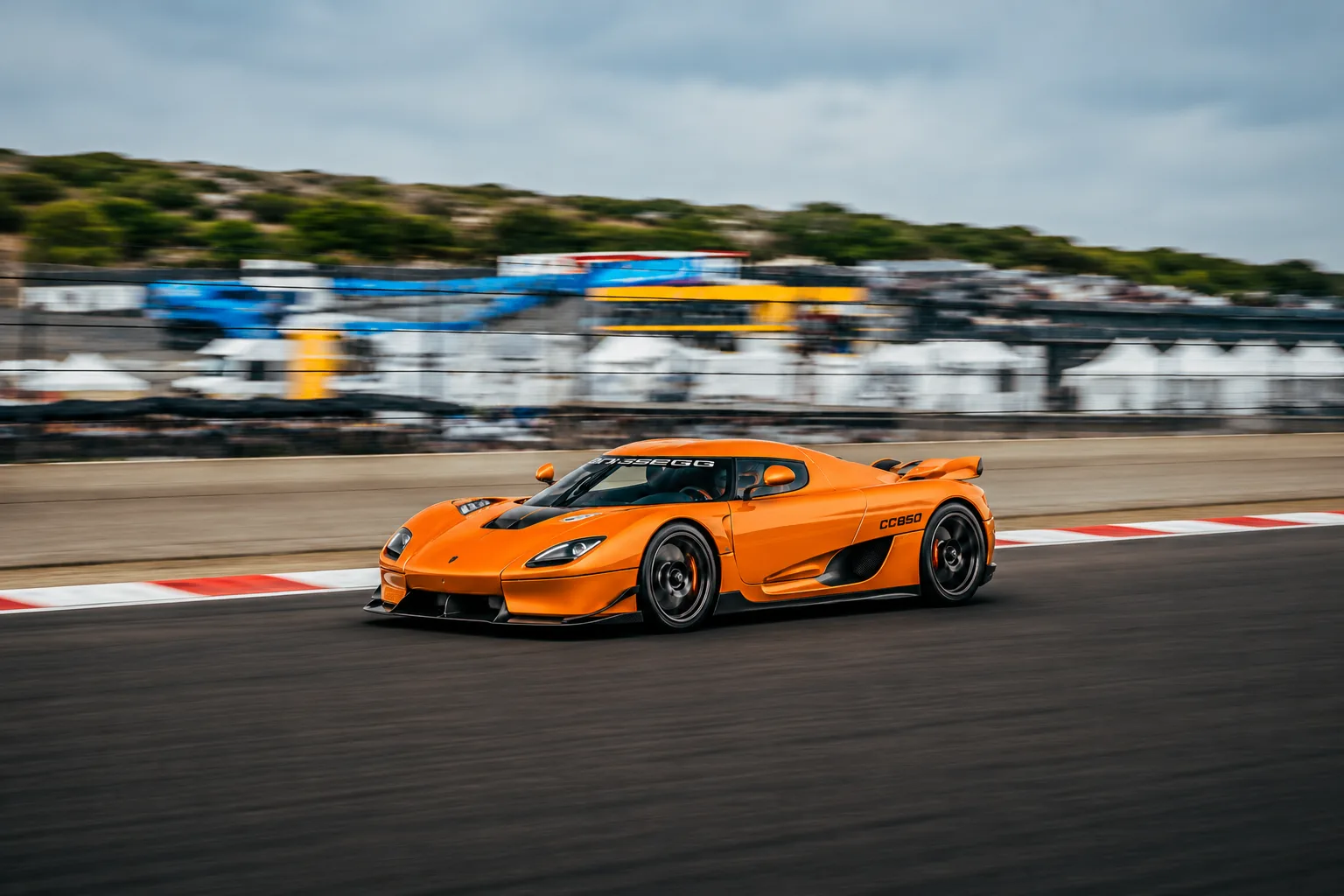
The Koenigsegg CC850 isn’t just another hypercar for bigger numbers. It feels like a statement too. In a world with electric, automated, and screen-obsessed cars, the Koenigsegg CC850 Koenigsegg, which has a gated manual shifter and clutch pedal, rolls up as if to say: let’s not forget why we fell in love with driving in the first place.
In honor of 20 years since we first got the Koenigsegg CC8S and founder Christian von Koenigsegg’s 50th birthday, the CC850 borrows its spirit from that car without trying to relive it. Underneath a surprisingly calm exterior lies engineering that’s almost absurd in its ambition. It’s rare, it’s expensive, it’s ludicrously powerful, and somehow, it’s emotional too.
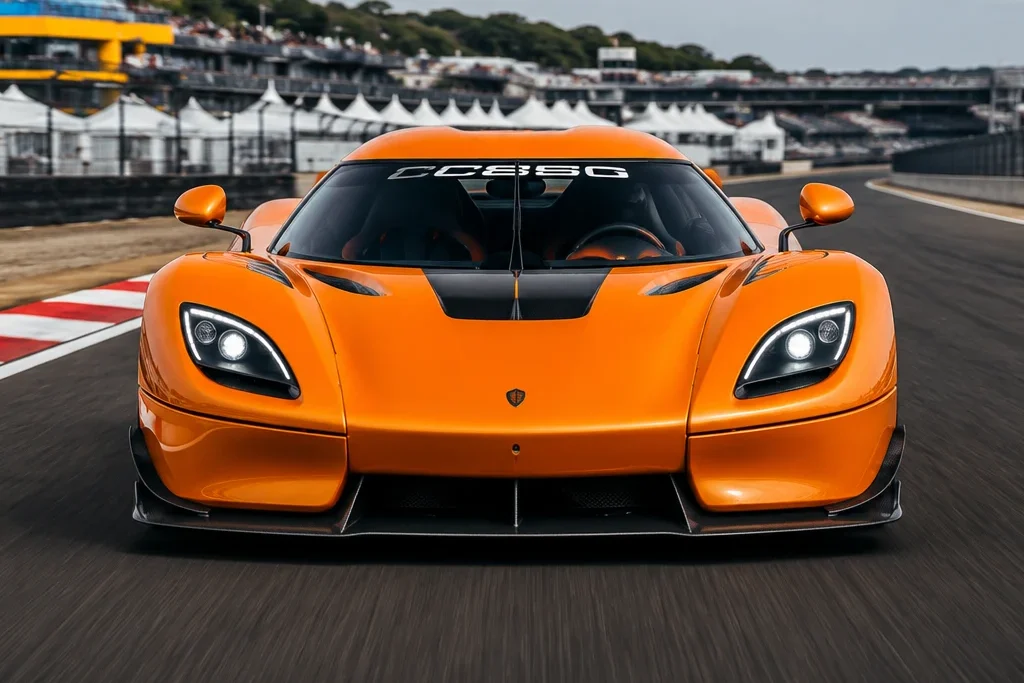
Koenigsegg CC850 Review 2026
| Category | Details |
| Brand / Model | Koenigsegg CC850 |
| Engine | 5.0L (5,065cc) twin-turbocharged V8, in-house Koenigsegg design |
| Power | Up to 1,385 hp on E85; 1,185 hp on regular fuel |
| Torque | 1,385 Nm |
| Kerb Weight | 1,385 kg |
| Transmission | Engage Shift System (ESS), 9-speed auto with simulated 6-speed manual mode |
| Top Speed | Estimated beyond 400 km/h |
| Production Run | Originally 50 units, expanded to 70 due to demand |
| US Starting Price (est.) | Around $3.6–3.7 million |
| Best For | Ultra-elite collectors and manual-driving purists |
Koenigsegg CC850 Price 2026 Breakdown
The Koenigsegg CC850’s base price sits around $3.6–3.7 million USD globally, before customization, and most buyers at this level customize heavily.
| Cost Factor | Estimated Range (USD) | Estimated Range (AED) |
| Base Price (Global) | $3.6M – $3.7M | AED 13.2M – 13.6M |
| Landed Price in the US (including import fees, taxes, and duties) | $3.5M – $4.5M | AED 12.8M – 16.5M |
| With Heavy Customisation | $4.5M+ | AED 16.5M+ |
Production was originally capped at 50 units to mark Christian von Koenigsegg’s 50th birthday, but demand pushed that number up to 70 within days of the car’s unveiling. Even with the expanded run, it remains one of the rarest hypercars on the road.
Owning a Koenigsegg CC850 isn’t really about the money changing hands; it’s about access. Koenigsegg allocates these cars to existing collectors and relationships within its network, which makes the waiting list arguably more exclusive than the price tag itself.
Why does the Koenigsegg CC850 exist?
In order to understand the Koenigsegg CC850, it is useful to know the moment it came in. The hypercar world in 2026 is dominated by hybrid powertrains, electric motors filling torque gaps, and dual-clutch or single-clutch automated transmissions that shift in milliseconds. Bugatti, Rimac, and even Ferrari have done a lot of electrification and driver-assist software. Manual transmissions, which were the standard once, are now a new thing for enthusiast sports cars, not seven-figure hypercars.
Koenigsegg looked at that landscape and decided to zig where everyone else zagged. The Koenigsegg CC850 wasn’t built to out-spec the Chiron or out-accelerate a Rimac Nevera. It was built to remind a generation of buyers (most of whom have never rowed their own gears in anything faster than a track-day Miata) what it feels like to be mechanically connected to more than a thousand horsepower. That’s a bold bet in an era where most manufacturers assume customers want the car to do more of the thinking for them.
Koenigsegg CC850 Engine, Power, and Weight Specs
At the heart of the Koenigsegg CC850 is a 5.0-liter twin-turbo V8, not a borrowed unit but Koenigsegg’s own creation, shared with the Jesko but fitted with smaller turbochargers for a different character.
Here is where it gets a bit interesting:
- On E85 fuel, the engine can generate up to 1,385 hp (1,404 PS) and 1,385 Nm of torque on E85 fuel
- On regular petrol, output drops to a still-absurd 1,185 hp
- Kerb weight comes in at exactly 1,385 kg
That repetition of “1,385” is not a typo; it’s the party trick. Koenigsegg tuned the car so that its horsepower figure and its weight in kilograms are the same number, which gives the Koenigsegg CC850 a 1:1 power-to-weight ratio, a feat it shares with the legendary Koenigsegg One: 1. Combine that with a carbon-fiber monocoque chassis, and you have a car that’s not just powerful but genuinely, mathematically balanced.
And here’s a detail that surprises a lot of people: while CC8S-inspired in name and silhouette, the Koenigsegg CC850 doesn’t actually share components with the original CC8S. Mechanically, it’s based on the Koenigsegg Jesko, the same multilink suspension, the same family of engine, the same rack-and-pinion steering. The Koenigsegg CC850’s job isn’t to be a literal continuation of the CC8S; it’s to channel that car’s spirit through a thoroughly modern platform. That’s arguably a more honest kind of tribute than a nostalgia-driven reboot would have been.
| Specification | On E85 Fuel | On Regular Fuel |
| Horsepower | 1,385 hp (1,404 PS) | 1,185 hp (1,201 PS) |
| Torque | 1,385 Nm | 1,385 Nm |
| Power-to-Weight Ratio | 1:1 (hp to kg) | Slightly lower |
The Engine Bay: Why does Koenigsegg build its own V8?
But remember that Koenigsegg engineers and makes its own V8 in-house, something almost no other low-volume hypercar maker does. Most boutique brands buy engines from larger manufacturers, perhaps Mercedes AMG versions in older Pagani models or Audi-based V10s elsewhere. Koenigsegg has taken the opposite course since the company’s founding, believing engine development to be foundational to its identity rather than a project to outsource.
This is important for the Koenigsegg CC850, as it means that the engine’s character can be tuned to the purpose of the car. The smaller turbochargers compared to the Jesko are not a cost-cutting measure but a calculated choice to make throttle response more responsive and reduce lag, which is vitally important if a driver is tuning a clutch pedal instead of having software do the handoff between gears. A lagger engine with manual transmission would undermine the whole point of the car. Koenigsegg tuned the powertrain to reward a human’s timing, not just a computer’s.
The Transmission: Engage Shift System (ESS)
This is where the Koenigsegg CC850 really earns its reputation. Koenigsegg calls it the Engage Shift System (ESS), and it’s one of the cleverest pieces of engineering theater in modern automotive history.
On the surface, it looks like a classic 6-speed gated manual:
- A real metal shift gate
- A real clutch pedal
- A lever, you physically row through gears
But mechanically, the ESS is built on top of Koenigsegg’s 9-speed Light Speed Transmission, the same multi-clutch automatic gearbox architecture found in other Koenigsegg models. When you want to drive manually, the system simulates the feel and engagement of a 6-speed gated shifter while the transmission underneath handles the actual gear-changing logic. When you’d rather not, you flick a switch, and it becomes a fully automatic 9-speed, complete with seamless, near-instant shifts.
In other words, it gives you the ritual of a manual without sacrificing the efficiency of an automatic. Purists might call it a clever illusion. Koenigsegg calls it choice. Either way, it’s mechanical nostalgia wrapped around modern software, and in 2026, that combination feels almost rebellious.
Why it matters:
- You get genuine clutch-pedal engagement when you want a connection to the car.
- You get effortless, lightning-fast automatic shifts when you don’t.
- You can switch between the two modes on the fly, not just at startup.
How ESS Compares to other “Manual” Attempts
The Koenigsegg CC850 isn’t the first car to give us a sense of manual feel with automated underpinnings, and this may be the most convincing one yet. The early “automated manual” gearboxes (and so many single-clutch systems in the 2000s) were known for jerky, hesitant shifts that didn’t feel like a real manual. Some current performance cars simulate manual engagement with paddle-shift software and artificial clutch-kick effects without even providing a real clutch pedal.
ESS is different because it commits fully: there’s a physical pedal, a physical lever, and a gate, all controlling a transmission that’s mechanically capable of running without them entirely. That dual nature, fake-feeling manual hardware sitting on genuinely automatic internals, is a tightrope walk, and reviewers who’ve driven it consistently note that the shift action doesn’t feel like a gimmick. It feels deliberate, weighted, and mechanical, even though there’s no traditional clutch-and-flywheel relationship underneath.
Koenigsegg CC850 Interior: Simple, But Not Basic
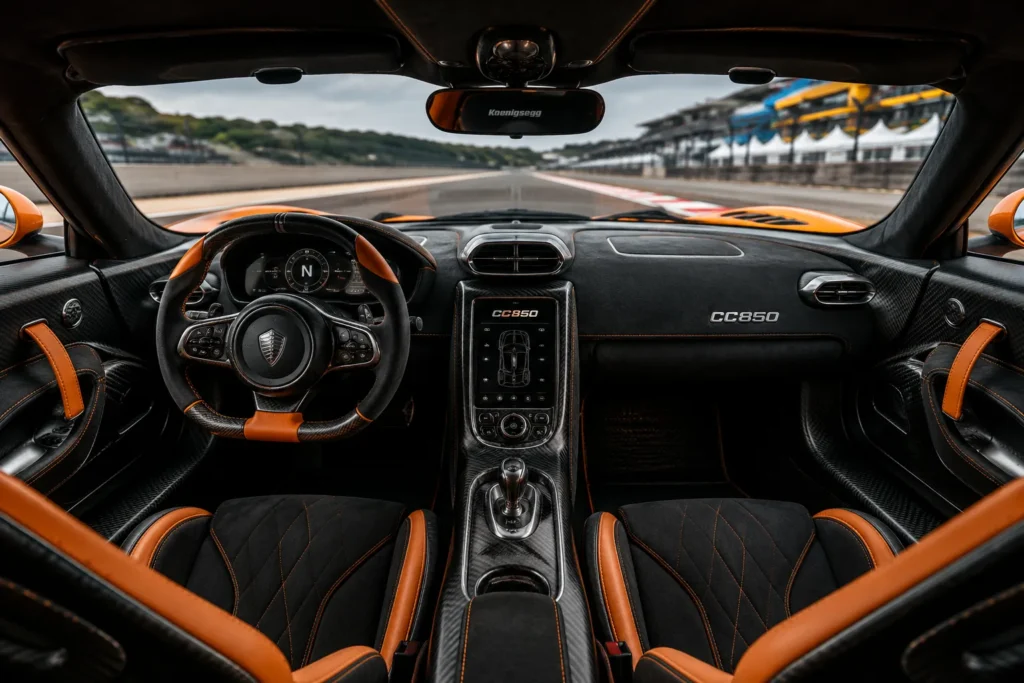
Step inside the Koenigsegg CC850 and the first thing you notice is what’s missing: there’s no oversized touchscreen dominating the dashboard.
- Polished aluminum and exposed carbon-fiber surfaces
- Analog-inspired gauges, with engine speed on the outer ring, road speed on a central dial, and turbo boost readouts in the middle, all designed to be read at a glance
- Bespoke leather trim and a deliberately minimal steering wheel
- The gated shifter sits front and center in the console, almost displayed like a piece of mechanical art
The cabin feels tight, low-slung, and purposeful rather than plush. This isn’t luxury in the traditional sense; it’s a workspace built around the act of driving. You sit surrounded by visible mechanical detail, which makes the whole experience feel intimate and, admittedly, a little intimidating.
Koenigsegg CC850 Performance and Top Speed
Koenigsegg hasn’t made a big production out of publishing an official top speed for the Koenigsegg CC850, but estimates put it comfortably beyond 400 km/h (some figures suggest as high as 430 km/h), which would place it among the fastest production cars ever built.
Acceleration is similarly absurd:
- 0–100 km/h in roughly 2.5–3 seconds
- 0–200 km/h in well under 10 seconds (estimated)
But raw numbers don’t tell the whole story. The Koenigsegg CC850 doesn’t just launch violently and hope for the best; its carbon-fiber monocoque keeps the chassis extremely stiff, while the multilink front and rear suspension (double wishbones, hydraulic dampers, and Triplex dampers at the rear) keeps everything planted rather than nervous. At the upper end of its speed range, the car is engineered to feel composed rather than chaotic, which matters enormously when you’re managing well over 1,300 horsepower.
Aerodynamics and Chassis Engineering
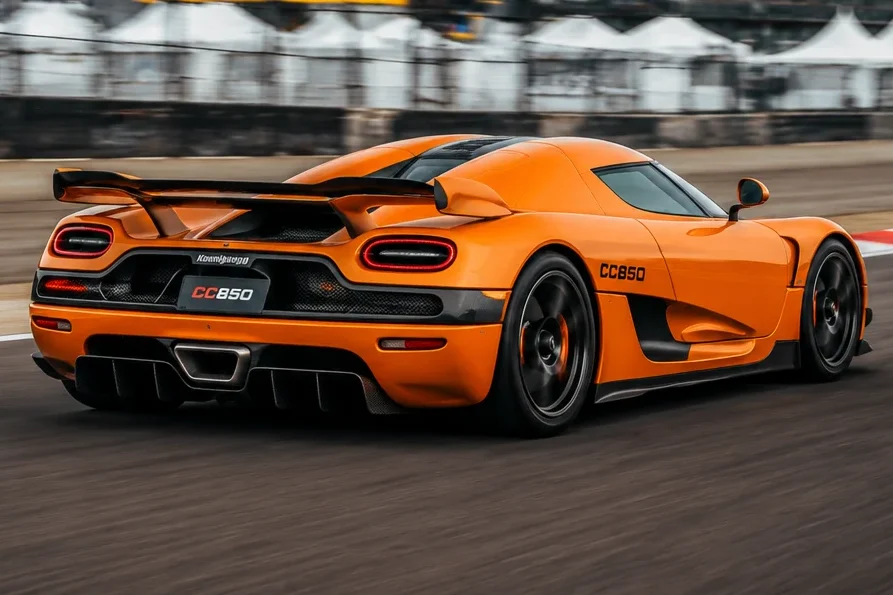
Underneath the Koenigsegg CC850’s restrained design is a surprisingly aggressive aerodynamic process. Active aero elements, deployed and retracted depending on speed and driving mode, generate downforce without the bulky wings and canards of most modern hypercars. The goal is stability at speed without visually screaming about it so that this is in keeping with the larger philosophy of subtlety over spectacle of the car as a whole.
The carbon-fiber monocoque tub is shared in concept with other Koenigsegg models, which gives the CC850 excellent torsional rigidity. That stiffness pays off in two ways: it keeps the suspension geometry consistent under hard cornering loads and it protects occupants in a car capable of speeds most road infrastructure was never designed around. Triplex dampers at the rear (a system Koenigsegg has used in multiple models) are three dampers connecting both rear wheels to help the car to squat and lift during acceleration and braking, which smooths out the car’s response to the most violent events of driving.
Driving Experience
On paper, a 1,385-hp manual hypercar sounds like a recipe for white-knuckle terror. In practice, owners and reviewers describe something far more composed.
At low speeds and in everyday driving:
- The engine doesn’t scream for attention
- The gearbox shifts cleanly, without the clunkiness you’d expect from a “fake” manual
- It’s possible, if a little surreal, to drive it through a city without drawing too much noise complaints.
Once it opens up, everything changes. The turbos build boost hard, and the car covers ground at a pace that feels almost unreal for something road-legal. But the detail that keeps coming up in driving impressions is how different it feels when you’re shifting it yourself. Rowing through the gates with your own hand and a clutch pedal turns the experience from a passive blast of acceleration into something you’re actively participating in. That single design choice is arguably what makes the CC850 feel alive in a way most modern hypercars, built entirely around paddle shifters and launch control, simply don’t.
How the CC850 Stacks Up Against Its Rivals
It is tempting to compare the Koenigsegg CC850 directly to the Bugatti Tourbillon, Rimac Nevera, or Ferrari’s latest hybrid flagship, but that comparison somewhat misses the point. Those cars are chasing outright lap times, top-speed records, or hybrid-assisted launch numbers. The Koenigsegg CC850 is chasing something much more difficult to measure: feel.
Where the Nevera is electric and the Tourbillon mixes a V16 with hybrid motors for maximum output, the CC850 deliberately keeps a human in the loop at every stage of the powertrain, from throttle input to gear selection. It sacrifices a small amount of outright efficiency and consistency for something none of its rivals can provide in the same way: a genuine clutch pedal in a car capable of beyond-400-km/h speeds. To buyers who already own a hybrid hypercar and want something fundamentally different in their collection, that distinction is the entire sales pitch.
Koenigsegg CC850 Exterior Design
The Koenigsegg CC850 doesn’t shout. It borrows heavily from early Koenigsegg models, with smooth body surfaces, gentle curves, and almost no gratuitous vents and wings that dominate today’s hypercar look.
Compared to the aero-heavy hypercars on the market at present, the Koenigsegg CC850 looks almost restrained. But look closer, and the obsessive engineering comes to life: active aerodynamic elements, tight panel gaps, and surfacing that only comes from a team sweating every millimeter.
As Christian von Koenigsegg himself put it, the Koenigsegg CC850 is an homage to the single most meaningful car in Koenigsegg history, and that philosophy shows in a design that’s elegant first, aggressive second.
Conclusion
The Koenigsegg CC850 is not about extreme performance numbers, despite the fact that it has a lot of them. It’s about preserving a feeling. With its outrageous power output, lightweight carbon fiber construction, an in-house V8 and a transmission system that truly lets you choose how connected you want to be to the machine, it provides something most modern hypercars have quietly given up on: connection.
It’s fast enough to compete with the best cars in the world. Expensive and rare enough to stay exclusive. But emotional enough to stand apart from both. That combination is what makes it truly memorable.
FAQs
Q. What are the Koenigsegg CC850 specs?
A. It is driven by a 5.0-liter twin-turbo V8 with up to 1,385 hp (1,404 PS) on E85 fuel with 1,385 Nm of torque and a kerb weight of 1,385 kg (a 1:1 power-to-weight ratio).
Q. What is the Koenigsegg CC850’s top speed?
A. Koenigsegg hasn’t provided an official figure, but estimates place it beyond 400 km/h, with some sources pointing to a range of 430 km/h.
Q. How much does the Koenigsegg CC850 cost?
A. The base price is about $3.6-3.7 million USD. If import fees, taxes, and customization are factored in for the buyers outside Sweden, the on-road price can be anywhere from $3.5 million to $4.5 million or more.
Q. How does the Engage Shift System (ESS) actually work?
A. It’s built on Koenigsegg’s 9-speed Light Speed Transmission, and in manual mode it simulates a 6-speed gated shift with a real clutch pedal and lever. Switch modes, and the same hardware becomes a fully automatic 9-speed gearbox with near-instant shifts.
Q. How many Koenigsegg CC850 units were made?
A. Production was initially limited to 50 units in honor of Christian von Koenigsegg’s 50th birthday, but demand pushed the run up to 70 units shortly after the car’s unveiling.