
Bugatti built only one Destrier and then stopped. No second car, no limited run of ten, no chance to order it. The company gave the keys to a single American collector and then told all other people to admire it from behind the ropes at Pebble Beach. That’s the whole idea of the Destrier, and it leads to the very beginning of why a car that most people will never touch has become one of the most searched Bugattis of 2026.
This is the third of Bugatti’s Programme Solitaire, the coachbuilding arm that produces up to two one-off cars a year. Underneath the sculpted bodywork lies the carbon heart of the track-only Bugatti Bolide, the quad-turbo W16 engine. And above it is something that Bugatti calls pure sculpture. Here is everything confirmed about the new Bugatti Destrier, everything that is still unconfirmed, and what buyers in the US and the Gulf should know about a hypercar that already has an owner.
Bugatti Destrier Quick Snapshot
| Attribute | Detail |
| Model | Bugatti Destrier (2026) |
| Type | One-of-one coachbuilt hypercar |
| Programme | Programme Solitaire (third creation) |
| Engine | 8.0L quad-turbocharged W16 |
| Power | 1,600 PS (~1,578 hp / 1,177 kW) |
| Torque | 1,600 Nm |
| Transmission | 7-speed dual-clutch, all-wheel drive |
| Height | ~1.0 meter (39.4 in), lowest Bugatti ever built |
| Debut | Monterey Car Week (Pebble Beach Concours d’Elegance, August 2026) |
| Production | 1 unit (1/1) |
| Price | Undisclosed (Estimated $10M–$20M+ / AED 36.7M–AED 73.5M+) |
What Is the Bugatti Destrier?
Bugatti unveiled the Bugatti Destrier on 6 August 2026, and then took it to Monterey Car Week later that month for its public debut on the lawns of Pebble Beach. The name comes from the destrier, the armoured warhorse a medieval knight rode into battle. That reference is not decoration. It runs through the whole car, from the muscular rear haunches to the hammered metal finishes inside.
The Bugatti Destrier is part of Programme Solitaire, which Bugatti launched in August 2025 as a strict coachbuilding division. The rules are simple: two one-off cars per year, maximum. The Bugatti Destrier follows two earlier commissions, the Brouillard and the F.K.P. Hommage. As those two were based on specific stories from Bugatti’s past, designers designed the Bugatti Destrier around emotion and proportion first.
The engineering foundation is the Bolide, Bugatti’s most extreme track car. Bugatti Destrier reused the Bolide’s carbon-fibre monocoque and powertrain but placed it in both a completely new body and hand-finished cabin. Frank Heyl, Bugatti’s Director of Design, summed up the idea in one sentence at the launch: the Destrier is a car you feel with your heart and not with your head.
Design chief Heyl also drew a historic parallel that gives the project its logic. The old Type 57 chassis served as the base for the Le Mans-winning Type 57G “Tank” racers from 1937 and 1939, and the Type 57SC Atlantic, still called by many the most beautiful car ever built. One platform, two completely different icons. Bugatti applied the same thinking here: the Bolide is the racer, and the Bugatti Destrier is the art object built on the same bones.
A Body Sculpted for the Eye, Not the Air
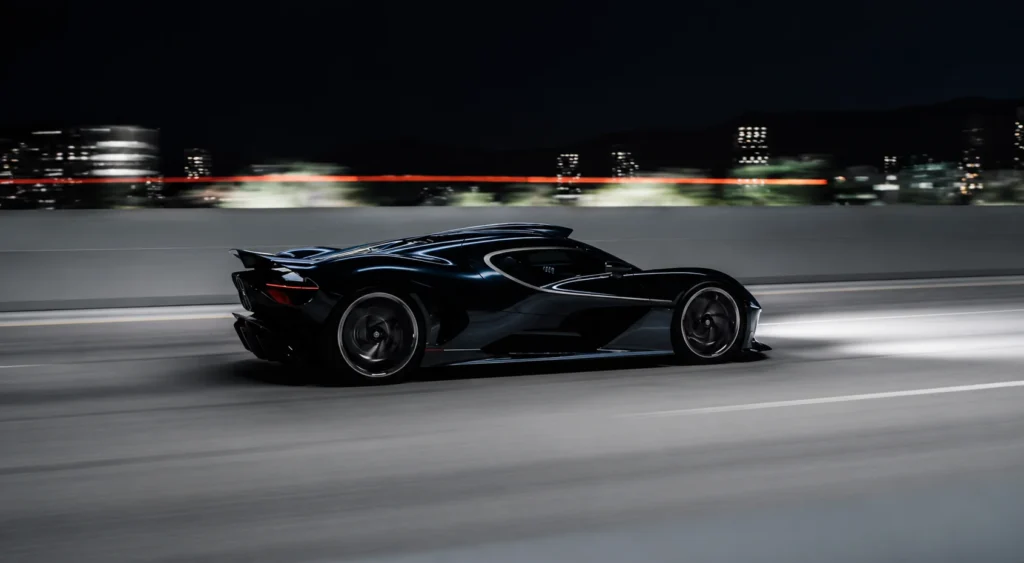
Look at a Bolide, and you see intakes, fins, and a rear wing tall enough to matter at circuit speeds. Look at the Bugatti Destrier, and almost all of that violence is gone. Bugatti’s brief, roughly translated, was “Bolide but no aero.” The result is a shape that reads more like an early clay sketch than a wind-tunnel product.
Several signature details define the look:
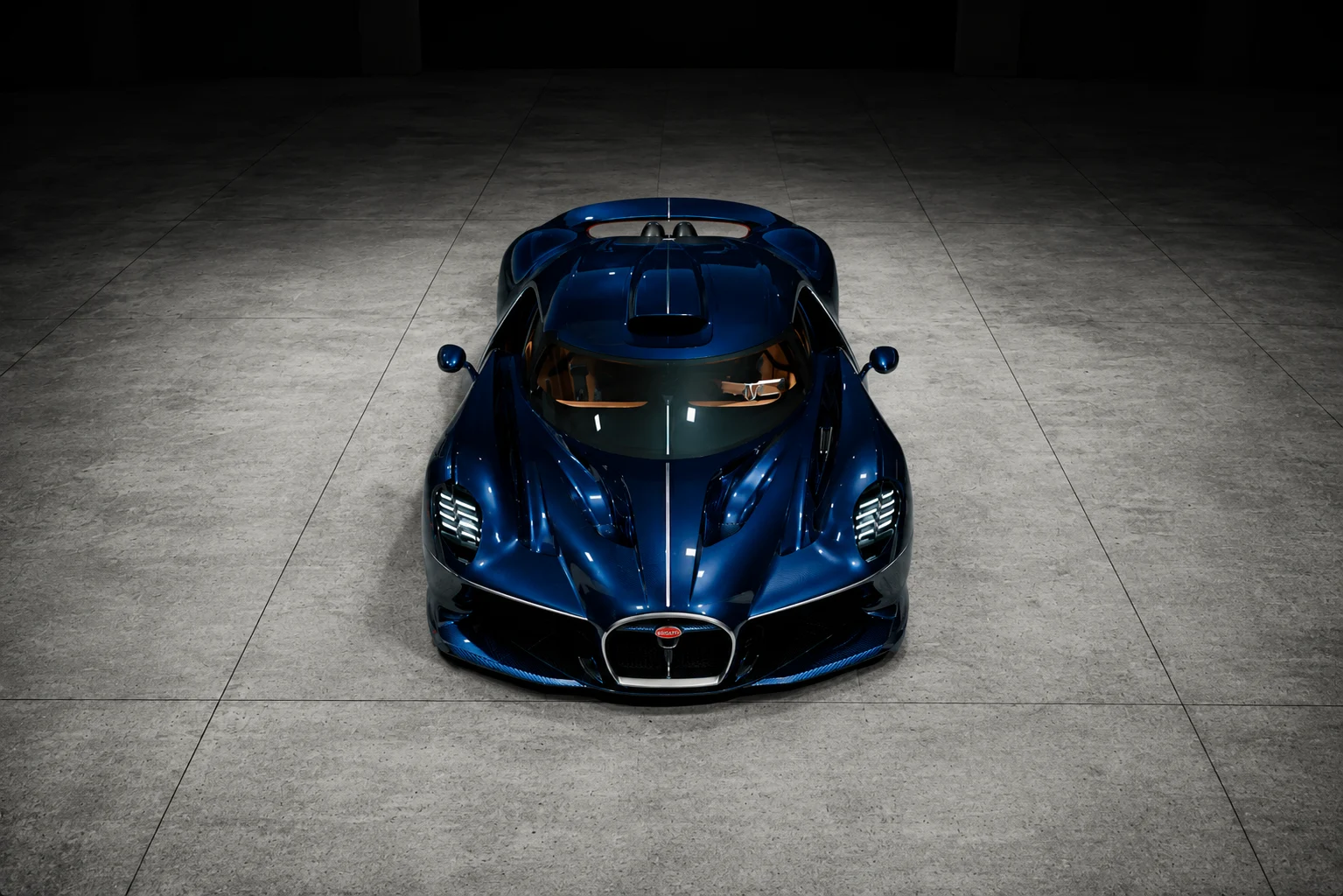
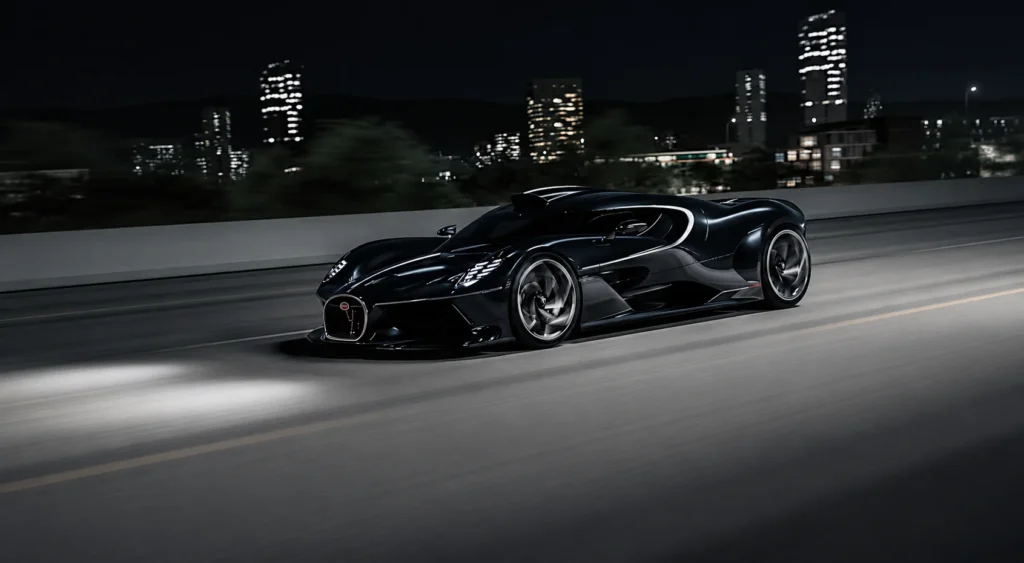
- The reinterpreted C-line. Bugatti’s trademark side curve of brightwork usually runs unbroken. On the Destrier it pauses right before the front wheel arch, lets bare bodywork show through, then resumes its path towards the grille. Bugatti describes the line as one that “breathes.”
- A wider horseshoe grille. The famous egg-shaped grille is larger here than on the Bolide and holds up a face that is more restrained than aggressive.
- A blended rear wing. Instead of the Bolide’s massive aero arm, the rear has a little wing embedded in the haunches that nods to the elegant Chiron Profilée.
- Sapphire Celeste paint. The one-off has a deep blue finish and diamond-like particles that catch light and sparkle. The palette is completed with aluminum trim and tinted carbon fiber.
That color choice carries a story. One of the most famous Type 57SC Atlantic examples, chassis 57591, originally wore a blue shade before a later owner repainted it black. The Bugatti Destrier blue brings that lost color back to life.
The proportions are what stop people in their tracks. The cabin crouches low between the two front wings. In the back doors, the body pinches inward at the waist and then swells dramatically over the rear wheels. Bugatti calls these the most extreme proportions it has ever produced. Big 20-inch front and 21-inch rear wheels, up from the Bolide’s 18s, fill the arches and complete the muscular stance.
Bugatti Destrier Inside the Cabin: Leather, Copper, and Armor
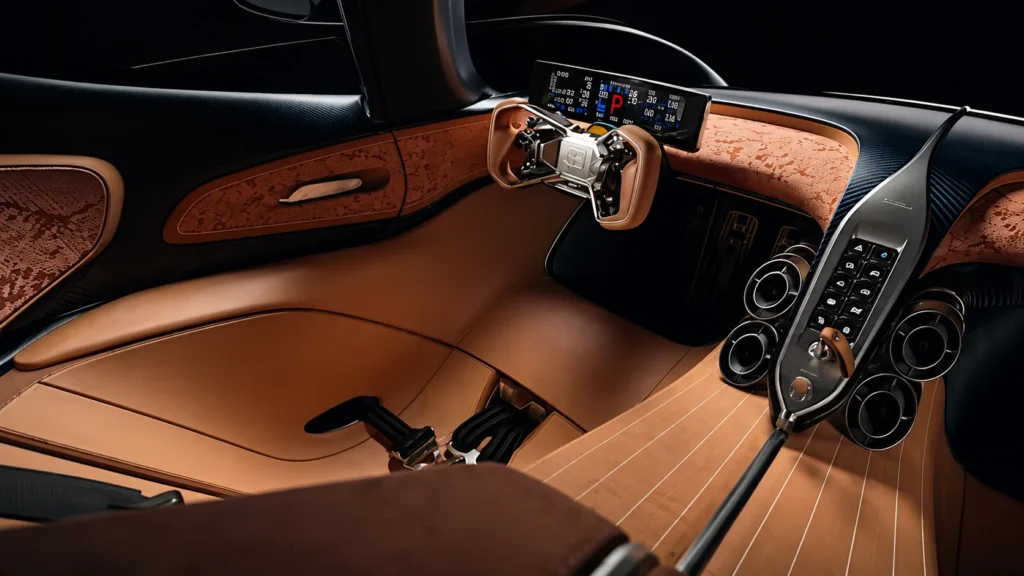
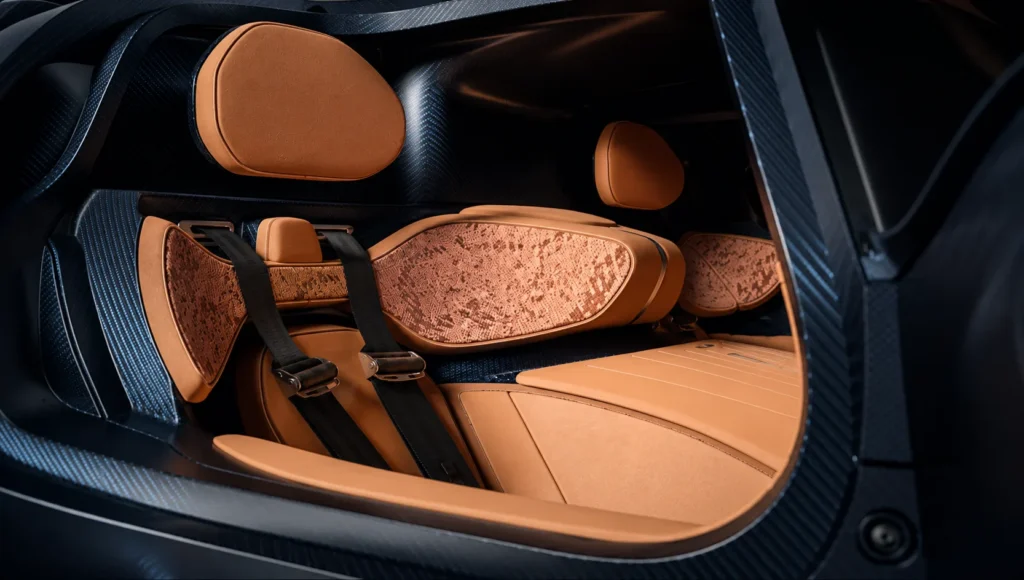
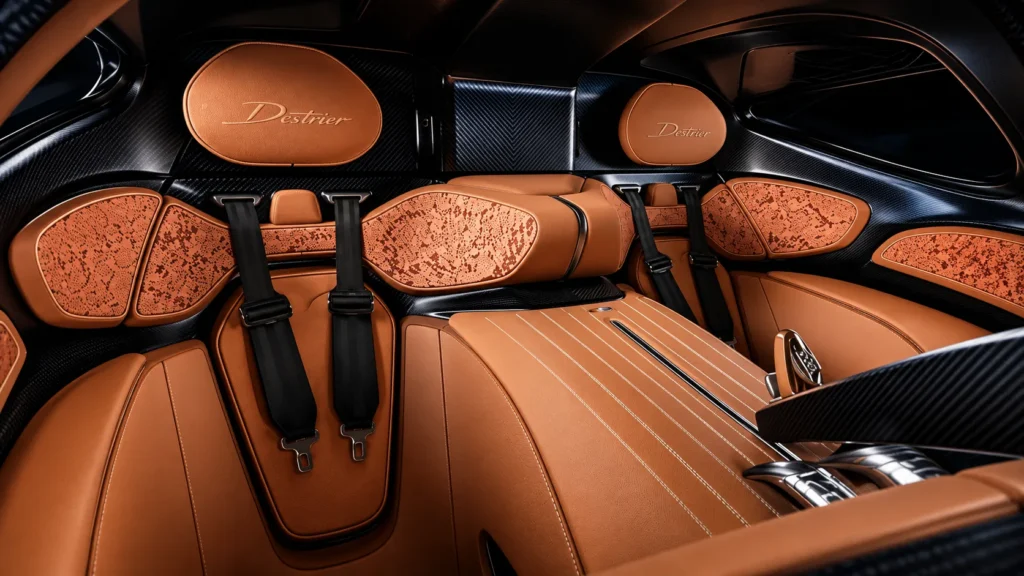
The Bolide’s cockpit is a stripped racing shell built for a driver in a fireproof suit. The Destrier’s cabin moves in the opposite direction. It feels closer to a tailor’s workshop than a race car.
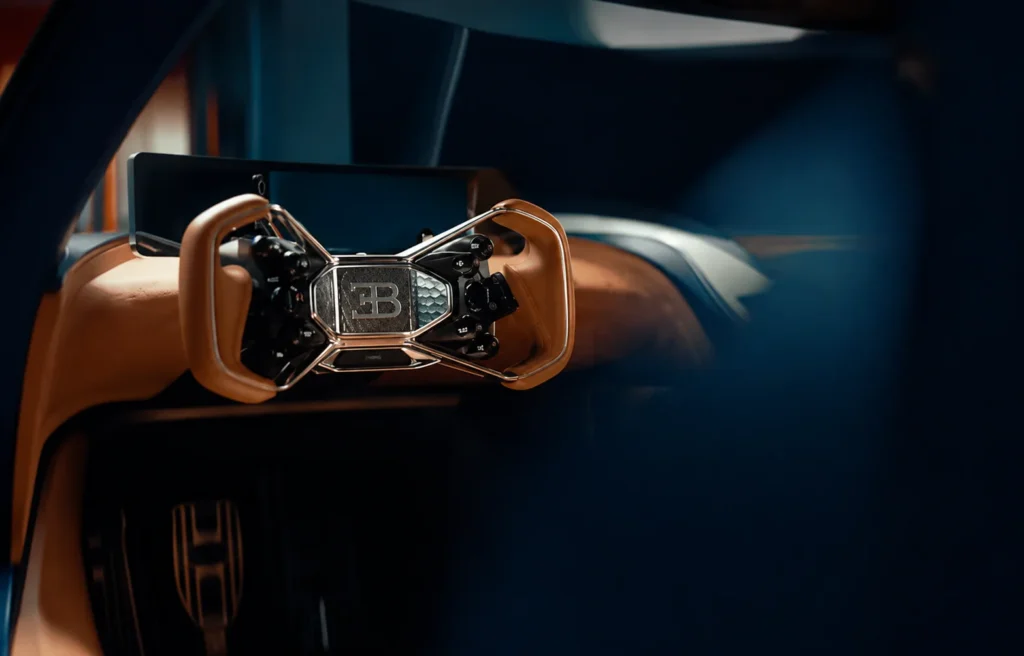
Bugatti Destrier and the owner combined three materials inside: warm brown leather, soft nubuck, and a custom 3D-knitted textile. That knitted fabric is the standout. Copper threads run through it in a circular halo pattern, and the inspiration came from haute couture and performance sportswear. The finish is seamless, with no obvious seams breaking the flow across the surfaces.
The warhorse theme shows up in the metalwork. Hammered aluminum finishes appear on the steering wheel hub, door handles, air vents, and entry sill plates. Each one echoes the beaten armor plate a knight and his horse would have worn into a joust. Most special editions pick a name and move on. This one puts the reference into every surface a passenger touches.
We note that Bugatti has not released a full breakdown of every cabin material or the digital instrument layout. Interior descriptions here are based on launch images and official statements. Check details of the trim against Bugatti’s final press pack before publishing spec-level claims.
The Last Roar of the W16 Engine
The Bugatti Destrier matters to enthusiasts for a reason beyond its looks. It is one of the last cars carrying Bugatti’s legendary W16.
Bugatti Destrier built its last W16 engine in July 2026. Its successor era will be the V16 hybrid powertrain in a new V16 hybrid powertrain that will be in the Tourbillon in July 2026. That timing turned the Bugatti Destrier into a goodbye for one of the most iconic engines of modern motoring history.
Here is what powers it:
| Specification | Figure |
| Engine | 8.0-litre quad-turbocharged W16 |
| Power | 1,600 PS (roughly 1,578 hp / 1,177 kW) |
| Torque | 1,600 Nm |
| Transmission | 7-speed dual-clutch automatic |
| Drivetrain | Permanent all-wheel drive |
| Origin | Shared with the track-focused Bugatti Bolide |
The engine is the same one that drives the Bolide, and Bugatti kept the output identical. That is a signal. Bugatti wants its Bugatti Destrier to be seen as art, and so it buried the engine details in the last paragraph of its own launch release rather than leading with them. For a company that has been selling top-speed records for two decades, hiding the numbers is a statement in itself. For a sense of the scale of the powertrain, this is 16 cylinders in a W shape fed by four turbochargers and 8 liters of power. Bugatti spent years honing it on the Veyron, the Chiron, and the Bolide. The Bugatti Destrier is its final and elegant send-off.
Bugatti Destrier Top Speed and 0 to 60: What We Know
But this is where honesty is really important. Bugatti has not released performance numbers for the Bugatti Destrier. There is no official top speed, no confirmed 0 to 60 mph time, and no lap data. Anyone who claims a Bugatti Destrier top speed is only estimating.
What we can do is look at the donor car. The Bolide shares the same engine, the same monocoque, and the same drivetrain, so its numbers set a reasonable baseline.
| Metric | Bugatti Bolide (donor car) |
| 0 to 62 mph (0 to 100 km/h) | Around 2.2 seconds |
| Top Speed | Approximately 236 mph (380 km/h) |
| Power | 1,600 PS (~1,578 hp) |
| Weight | About 3,100 lb (roughly 1,406 kg) |
Two factors could shift the Bugatti Destrier real-world numbers away from those numbers. The Destrier removes the Bolide’s aggressive aerodynamics, which changes both downforce and drag at speed. The luxury body panels and the fully trimmed cabin will probably add weight over the stripped track car. Bugatti has not mentioned the Destrier’s curb weight, so any acceleration estimate is subject to error.
The safe framing for readers: expect performance in the same league as the Bolide, well beyond 200 mph and into the low-2-second bracket to 60 mph, but treat every specific Destrier figure as an estimate until Bugatti confirms one. On current form, it may never confirm one at all.
Bugatti Destrier Dimensions and Stance
The single most dramatic Destrier statistic is its height. The car stands about a meter tall, or 39.4 inches. That makes it the lowest Bugatti ever built, lower even than the Bolide it is based on.
The confirmed dimensional details are limited, as Bugatti regards the Destrier as a bespoke object rather than a catalogue model. What the company has confirmed:
- Height: about 1 meter (39.4 in), the lowest in Bugatti history.
- Front wheels: 20 inches.
- Rear wheels: 21 inches.
- Body: long, wide, and built around exaggerated waist-and-hunch proportions.
Bugatti has not released any official length, width, or wheelbase figures for the Destrier yet. Because it is built on the Bolide monocoque, its core hard points would be similar to the Bolide, but the redesigned body panels have changed the shape of the body panels and the overall footprint. Anyone expecting to take the Bolide dimensions for a listing or comparison should refer to Bugatti’s technical sheet rather than just the dimensions of the Bolide as a reference for the dimensions of a list or comparison of the original Bolide.
Bugatti Destrier Price in USD and AED
Bugatti has not revealed the Destrier’s price, and the company has made it clear it will not. A Solitaire car is priced as a private commission, not as a product with a sticker.
That leaves us with some reference points and estimates. Note that the UAE dirham is pegged to the US dollar (about 3.6725 AED to 1 USD), so the dirham numbers below follow the dollar directly.
| Reference | US Dollar | UAE Dirham (approx.) |
| Bolide donor car (net, per unit) | ~$4.8M | ~AED 17.6M |
| Lower-end Destrier estimate | ~$10M | ~AED 36.7M |
| Higher-end Destrier estimate | $20M+ | AED 73.5M+ |
Why the wide range? The Bolide was sold in 40 cars at approximately 4 million euros each before taxes. The Destrier needed a completely new carbon-fiber body, a bespoke interior, and one-off engineering, all for a single customer. The Solitaire car program has sold for well over 10 million euros. Some outlets have suggested that the Destrier will be around $20 million (AED 73.5M), and some others are much closer to $10 million (AED 36.7M).
For Gulf buyers used to the economics of ultra-rare hypercars, the practical takeaway is straightforward. There is no price list, no allocation to chase, and no order form. The car is already sold. Any AED figure you see quoted is an estimate built on comparable Solitaire commissions, not a Bugatti-confirmed number.
The cost reality check: Even a low estimate would place the Destrier among the most expensive new cars ever built. At $10M to $20M+ (AED 36.7M to AED 73.5M+), it is well within Bugatti’s La Voiture Noire in the history books and well above almost any production hypercar on sale today.
Is the Bugatti Destrier Street legal?
This is the question the launch did not answer, and it deserves a careful answer rather than a confident guess.
The Destrier is built on the Bolide, and the Bolide is a track-only car. It was never homologated for public roads in its original form. That fact alone raises the question for the Destrier.
At least some media have mentioned that Bugatti engineered and homologated the Destrier for road use, which would make it the only road-legal car built on the Bolide’s carbon monocoque. Other reporters have looked at Bugatti’s own materials and found no supporting evidence. There is no published WLTP fuel or emissions data, no CO₂ figure, no homologation statement, and no road testing program mentioned anywhere in the official release.
So the accurate position is this: Bugatti has not officially confirmed the Destrier’s road-legal status either way. The claim that it is street legal is plausible for a car meant to grace concours lawns for decades, but it remains unverified by Bugatti’s own documentation.
For a US or Gulf audience, the difference is not academic. A road-legal one-off can be registered and driven on the right plates and permits. A track-only or show-only car cannot and would move between events on a transporter. Until Bugatti publishes homologation details, treat road-legal claims as unconfirmed.
Who Owns the Bugatti Destrier?
Bugatti built the Destrier for a single unnamed American customer. The company has kept the owner’s identity private, which is standard for Programme Solitaire commissions.
At Monterey Car Week, Bugatti had a private handover for the owner and his family before the unveiling and then held a Petit Tour on the Monterey Peninsula. The owner and other Bugatti collectors drove from Spanish Bay to Big Sur and back to Maison Bugatti at Pebble Beach. It’s a very nice presentation with Bugatti Rimac CEO Mate Rimac and Managing Director Hendrik Malinowski and other senior figures.
In addition to the American connection, Bugatti has not disclosed any details about the buyer. There is no confirmed link to the Gulf region for this car, but Bugatti has a huge collector base in the UAE, Saudi Arabia, and Qatar.
Where the Destrier Sits in Bugatti’s Future
The Bugatti Destrier arrives at a hinge point for Bugatti. The company has closed the book on the W16 and opened a new chapter around the V16 hybrid tourbillon. That makes every late W16 car a collector magnet, and a one-of-one W16 built as pure sculpture sits at the top of that pile.
Programme Solitaire will continue to produce up to two commissions a year, so more one-off Bugattis will follow. None of them will be a Destrier. That combination, a farewell-era engine and a design Bugatti itself that ranks as its most important, is what puts the estimated value in eight figures.
For collectors and enthusiasts watching from Dubai, Riyadh, Miami, or Los Angeles, the Destrier is less a vehicle to purchase and more a sign of where Bugatti’s coachbuilding ambitions are headed. The next Solitaire commission is the one you should see if you want to own something similar.
FAQs
Q. How much does the Bugatti Destrier cost in USD and AED?
A. Bugatti has not disclosed an official price and says it will not. Industry estimates place the one-off commission at roughly $10 million to $20 million or more, which is about AED 36.7 million to AED 73.5 million or more at a rate of 3.6725. The donor Bolide sold for around $4.8 million (about AED 17.6 million) per unit, and the Destrier’s bespoke build is well above that. All dirham figures are estimates rather than confirmed prices.
Q. Can I buy a Bugatti Destrier in the US or the Gulf?
A. No. Bugatti built only one Destrier, and an American collector already owns it. There is no allocation, no waiting list, and no order process for this particular car. If you want a similar one-off, the path is Bugatti’s Programme Solitaire, which can produce up to two commission cars per year for existing clients. Serious Gulf and US buyers typically work through Bugatti directly or through official regional partners to be considered.
Q. Is the Bugatti Destrier street legal?
A. Bugatti has not officially confirmed its road-legal status. Some sources say it was homologated for the road, which would make it the only street-legal car built on the Bolide’s carbon monocoque. Bugatti’s own launch documents don’t have emissions data, no CO2 number, and no homologation statement to support this. The Destrier is a show car in the US and the Gulf until Bugatti publishes the paperwork, so until then, buyers should treat it as a show and concours car unless proven otherwise.
Q. What engine and power does the Bugatti Destrier have?
A. The Destrier uses Bugatti’s 8.0-liter quad-turbocharged W16 with a 1,600 PS output (about 1,578 horsepower) and 1,600 Nm of torque in a 7-speed dual-clutch gearbox and permanent all-wheel drive. It is the same powertrain as the Bolide, and it is one of the last W16 engines Bugatti ever built, since they finished W16 production in July 2026.
Q. How fast is the Bugatti Destrier?
A. Bugatti has not provided official figures. Based on the shared Bolide powertrain, expect a top speed well above 200 mph and a 0 to 60 mph time in the low 2.2 second range. The donor Bolide reaches around 236 mph (380 km/h) and 0 to 62 mph in about 2.2 seconds. The Destrier’s different aerodynamics and heavier luxury body could change those numbers, so take any exact Destrier speed as an estimate.