
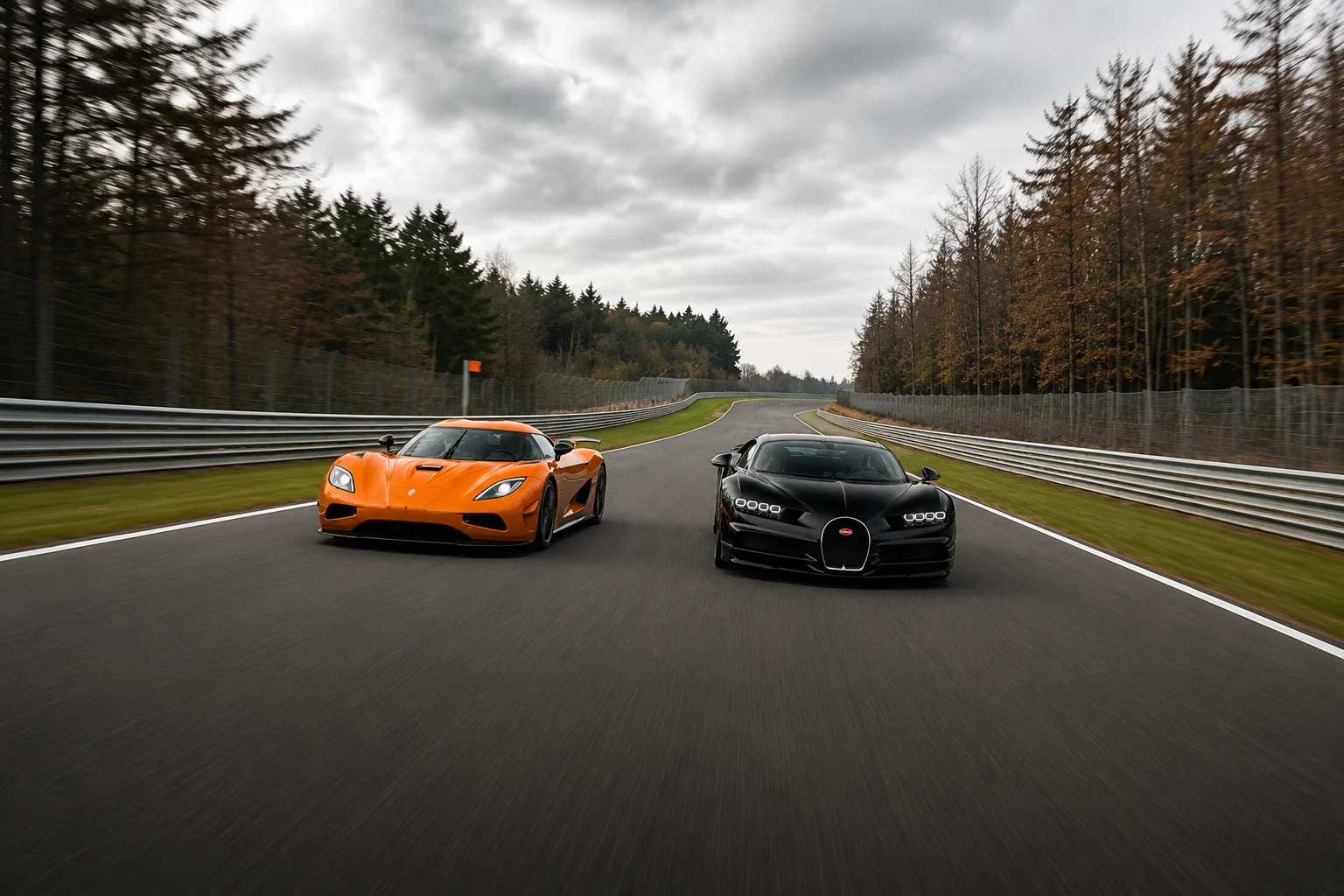
And I’m really not the only one typing “koenigsegg cc850 vs bugatti chiron” into Google at midnight. This is one of the most prevalent hypercar rivalries of 2026, a tiny Swedish tribute car versus a French W16 legend. One is built in a small workshop, handmade in Ängelholm. The other is made by an atelier that has produced some of the fastest production cars on earth. Here is the whole koenigsegg cc850 vs bugatti chiron breakdown: no fluff, just numbers, the design differences, and the verdicts you actually came here for.
Koenigsegg CC850 vs Bugatti Chiron: Design & Styling
Koenigsegg CC850 vs Bugatti Chiron The two cars are very different from the outside of the picture. The Koenigsegg CC850 vs Bugatti Chiron is designed to play down its drama, whereas the Chiron is built in such a way that it’s revealed from a block away. Here’s how the styling philosophies actually break down.
Koenigsegg CC850:
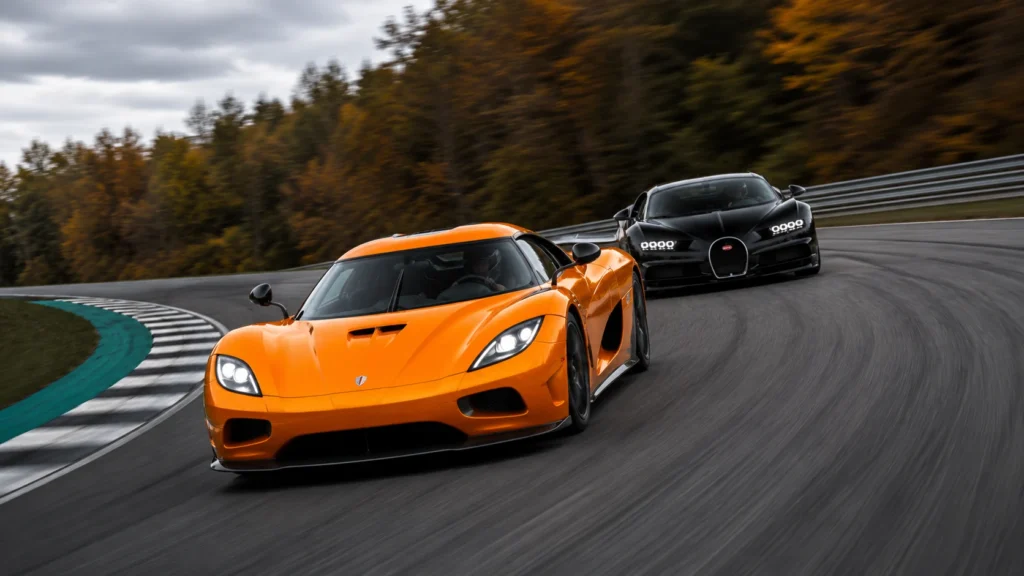
- Retro-inspired silhouette paying tribute to the original CC8S.
- Removable hardtop with roof storage.
- Restrained body lines and less aggressive vents than rival hypercars.
- Active aero hidden beneath a clean, classic shape.
Bugatti Chiron:
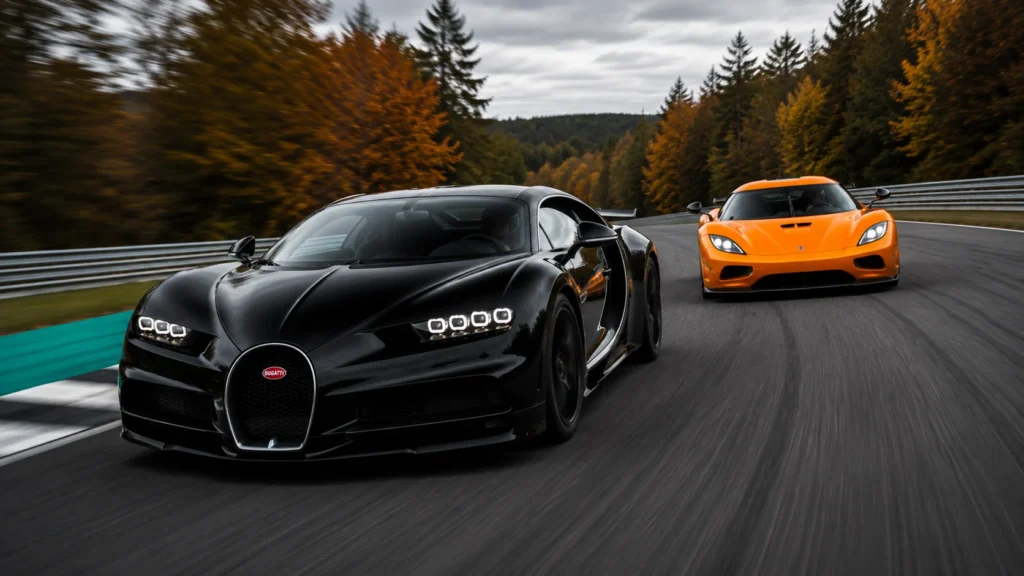
- Horseshoe grille and signature “C-line” side profile.
- Jet-inspired active rear wing that deploys automatically.
- Longtail aero variants (Super Sport 300+) are built purely for stability.
- Not only does it look fast standing still, it also looks fast at 250 mph.
Verdict: The CC850 is understated and classic. The Chiron looks like a spaceship that learned to drive.
Quick Overview: Koenigsegg CC850 vs Bugatti Chiron
Koenigsegg CC850 vs Bugatti Chiron Before I go into each category, here is the cheat-sheet version: These are the headline specs most people are actually searching for when they type “koenigsegg cc850 vs bugatti chiron” into Google.
| Specification | Koenigsegg CC850 | Bugatti Chiron |
| Engine | 5.0L Twin-Turbo V8 | 8.0L Quad-Turbo W16 |
| Horsepower | 1,185–1,385 hp | 1,500–1,578 hp |
| Torque | Up to 1,385 Nm (1,022 lb-ft) | Up to 1,600 Nm (1,180 lb-ft) |
| Transmission | 9-speed Light Speed Transmission (LST) with manual mode | 7-speed Dual-Clutch Automatic |
| Drivetrain | Rear-Wheel Drive (RWD) | All-Wheel Drive (AWD) |
| 0–60 mph | ~2.5 seconds | ~2.4 seconds |
| Top Speed | 250+ mph (estimated) | 261 mph (electronically limited) |
| Weight | ~1,385 kg (3,053 lbs) | ~1,995 kg (4,398 lbs) |
| Power-to-Weight Ratio | ~1 hp/kg | ~0.75 hp/kg |
| Price (New) | ~$3.65 million | ~$2.6–$3.9 million |
| Units Built | 70 | ~500 (all variants combined) |
| Production Status | Still being delivered | Production ended in 2023 |
| Interior | Driver-focused, analog-inspired cockpit with modern digital tech | Ultra-luxury cabin with premium leather and advanced technology |
| Wheels | Lightweight forged aluminum wheels | Lightweight forged alloy wheels |
| Fuel Type | Premium gasoline / E85 compatible | Premium gasoline |
| Launch Year | 2022 | 2016 |
| Best For | Driving enthusiasts seeking a manual-like hypercar experience | Buyers prioritizing luxury, speed, and exclusivity |
Koenigsegg CC850 vs Bugatti Chiron Engine Comparison
Koenigsegg CC850 vs Bugatti Chiron Engine philosophy is where these two brands diverge the most. Koenigsegg pushes drama via lightness and efficiency, squeezing vast output from a relatively small V8. Bugatti loves drama with brute force, piling four turbos on a sixteen-cylinder powerhouse that most automakers would never even dream of.
Koenigsegg CC850:
- 5.0L twin-turbo V8 (shared roots with the Jesko).
- 1,185 hp on regular fuel, 1,385 hp on E85.
- Curb weight is 1,385 kg, a true 1:1 power-to-weight ratio.
- Transmission: Light Speed transmission with gated manual feel.
Bugatti Chiron:
- 8.0L quad-turbo W16 — 16 cylinders, 4 turbos.
- ~1,500 hp standard, 1,578 hp on Super Sport 300+.
- Top speed unlocked only with the physical Speed Key.
- Transmission: 7-speed dual-clutch automatic.
Verdict: The Chiron wins outright power and top speed. The CC850 wins power-to-weight and driver feel.
Koenigsegg CC850 vs Bugatti Chiron Price Comparison
Koenigsegg CC850 vs Bugatti Chiron Most people searching this comparison aren’t actually shopping— they’re curious about how two multimillion-dollar machines stack up against each other on paper. And the honest answer is that pricing is not static; it changes as production status, demand increases and how the collector market treats each car over time.
| Price Comparison | Koenigsegg CC850 | Bugatti Chiron |
| Starting Price (USD) | $3.65M–$3.7M | $2.6M–$3.0M (Base) |
| Starting Price (AED) | AED 13.40M–13.59M | AED 9.55M–11.02M |
| Top Variant Price (USD) | N/A (Single Specification) | $3.9M (Super Sport 300+) |
| Top Variant Price (AED) | N/A (Single Specification) | AED 14.32M (Super Sport 300+) |
| Current Market Status | Still being delivered to customers | Production ended; available only through collectors and resale markets |
| Resale Trend | Market value still evolving due to limited deliveries | Strong appreciation, considered a collector’s investment |
- CC850 wins on rarity: only 70 units exist worldwide.
- Chiron wins on variety: multiple trims and special editions. Used prices are rising fast since Chiron production ended in 2023.
Koenigsegg CC850 vs Bugatti Chiron Interior Comparison
Koenigsegg CC850 vs Bugatti Chiron You step inside either car, and the brand philosophy becomes obvious immediately. Koenigsegg treats the cabin like a piece of mechanical art you’re meant to interact with, and Bugatti treats the cabin like a private lounge built around a very fast engine.
CC850 cabin highlights:
- Analog second-gen Chronocluster dial looks like fine watchmaking.
- Leather or Alcantara trim with custom stitching.
- Exposed gated shifter mechanism.
- Adjustable pedals and steering column.
Chiron cabin highlights:
- Center console made from a single aluminum block.
- Hand-stitched leather throughout.
- Speedometer dial marked up to 500 km/h.
- Quieter, more isolated cockpit feel.
Verdict: CC850 feels like a race car in a tuxedo. Chiron feels like a private jet on wheels.
Koenigsegg CC850 vs Bugatti Chiron Features Comparison
Koenigsegg CC850 vs Bugatti Chiron Besides horsepower, the smaller attributes of a car often determine which one suits your driving style. One car wants you directly involved in every gear change; the other one wants every system handling the chaos so you can just enjoy the ride.
| Feature | Koenigsegg CC850 | Bugatti Chiron |
| Manual-style shifting | Yes (clutch pedal + gated feel) | No |
| Active aerodynamics | Limited | Yes, auto-deploying rear wing |
| Drive modes | Wet / Normal / Track | EB / Handling / Autobahn / Top Speed |
| Lift system | Front + rear hydraulic lift | Standard ride height control |
| Infotainment | Apple CarPlay, digital manual | Premium console-based system |
| Top speed unlock | Not key-based | Requires physical Speed Key |
- CC850 is oriented towards driver involvement and tactile control.
- Chiron wants technological choreography at extreme speed.
Koenigsegg CC850 vs Bugatti Chiron Wheels Comparison
Koenigsegg CC850 vs Bugatti Chiron Wheels and tires rarely make headlines, but at these speeds they’re doing some of the hardest work in the entire car. The engineering priorities here tell a lot about how each manufacturer expects its car to actually be driven.
CC850 wheels:
- Forged aluminum, 20×9.5″ front / 21×12.25″ rear.
- Michelin Pilot Sport 4S tires.
- Tuned for agility and cornering feedback.
Chiron wheels:
- Ultra-high-load wheels built for 260+ mph stress.
- Bespoke tires rated for top-speed runs.
- Tuned for stability and endurance, not playfulness.
Verdict: CC850 wheels are designed to feel fun. Chiron wheels are built to survive.
Koenigsegg CC850 vs Bugatti Chiron Reviews Comparison
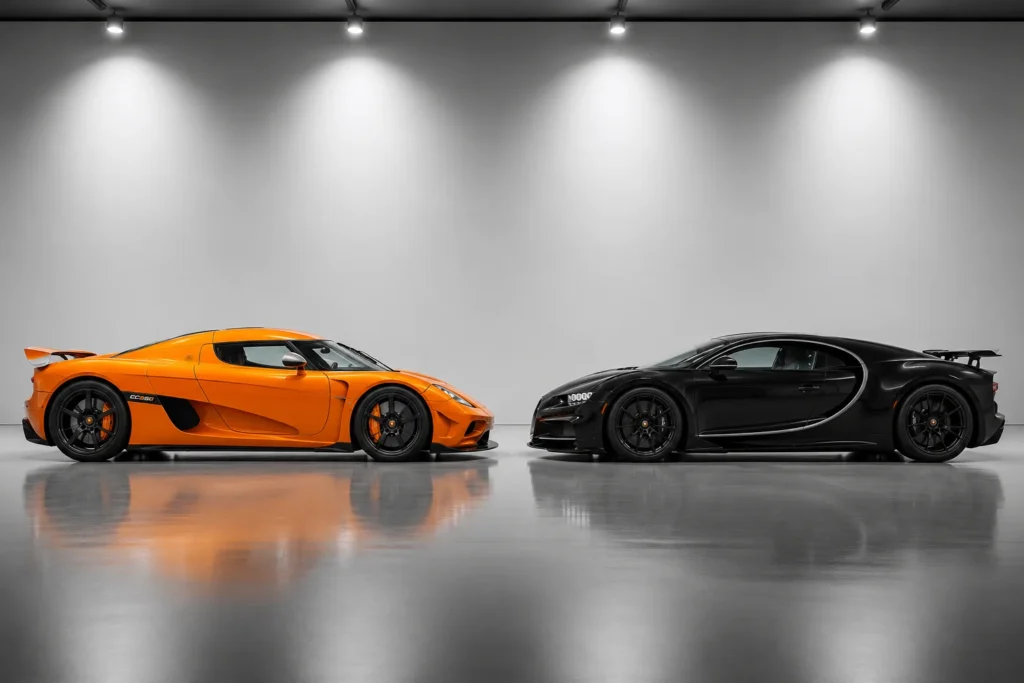
Koenigsegg CC850 vs Bugatti Chiron Spec sheets tell only half the story, so it’s worth looking at how actual owners and journalists describe driving these cars. The reactions nearly perfectly match up to the emotional-versus-technical line we’ve encountered throughout this comparison.
What do owners and reviewers say most often?
- CC850 owners love the tactile clutch pedal and the raw V8 sound.
- CC850 reviewers call it “the last great driver’s hypercar.”
- Chiron owners describe a surreal sense of control at insane speed.
- Chiron reviewers focus on awe and engineering, not emotion.
Bottom line: CC850 wins on emotional connection. Chiron wins on its jaw-dropping engineering reputation.
Koenigsegg CC850 vs Bugatti Chiron: Fun Facts
In addition to the spec sheets, both cars come with stories that are worth telling, the sort of trivia that is relevant in any hypercar debate.
- The CC850 is named after 20 years of production plus founder Christian von Koenigsegg’s 50th birthday.
- The Chiron name is a nod to the French race car driver Louis Chiron, a Bugatti legend from the 1920s–30s.
- A Chiron Super Sport 300+ reached 304.773 mph in testing, unofficially the fastest production car ever.
- The CC850’s gated manual feel is considered one of the last “real” shifting experiences in any modern hypercar.
- Both companies hand-build every unit, no robotic assembly lines here.
New Car Launch Trends: What’s Next in 2026
The hypercar world never sits still. A few things to know if you’re tracking the next big new car launch:
- Bugatti has already replaced the Chiron with the hybrid Tourbillon.
- The W16 engine era is officially over for Bugatti.
- Koenigsegg has been teasing new cars every year.
- Enthusiasts are eagerly awaiting the next CC850 successor.
- Many brands are previewing new hybrid power-forward vehicles that combine the old-school drama of those from the past with modern-day racing to come.
- If you follow new car launch news, 2026–2027 is going to be a huge turning point for hypercars.
- Expect upcoming cars will be driven by efficiency without losing out on the drama for customers paying millions to buy them.
- Watch manufacturer events and auto shows for the next generation of new car manufacturers in this category.
Koenigsegg CC850 vs Bugatti Chiron: Ownership & Maintenance
Koenigsegg CC850 vs Bugatti Chiron Buying either of these cars is the easy part; owning one long-term is where the real differences come into play. Service access, parts supply, and insurance all vary significantly between a 70-unit Swedish hypercar and a globally distributed Bugatti.
| Ownership Factor | Koenigsegg CC850 | Bugatti Chiron |
| Service network | Mobile technicians, limited regions | Established global dealer network |
| Parts availability | Low; extremely limited production | Better; larger production run |
| Insurance cost | Very high, niche underwriters only | High, but more insurers familiar with it |
| Fuel requirement | Premium or E85 ethanol blend | Premium unleaded only |
| Daily usability | Surprisingly composed for short trips | Comfortable but attention-grabbing everywhere |
- CC850 owners get more fuel flexibility (E85 boosts power).
- Chiron owners have easier access to parts and trained technicians.
- Both cars require serious garage space, climate control, and patience.
Pros and Cons: Koenigsegg CC850
Putting it all together, here’s the simplest way to weigh a car’s strengths against its trade-offs.
| Pros | Cons |
| 1:1 power-to-weight ratio | Limited service network |
| Real manual-feel driving experience | Only 70 units, nearly impossible to buy |
| Lighter, more agile chassis | Less brand recognition outside enthusiast circles |
| Strong resale due to rarity | Higher running-cost uncertainty (newer platform) |
Pros and Cons: Bugatti Chiron
| Pros | Cons |
| Higher top speed and horsepower | No manual-feel option |
| Iconic, globally recognized nameplate | Heavier, less playful at low speeds |
| Stronger dealer and parts network | Production ended, no more new units |
| Multiple variants to choose from | Higher fuel consumption |
Which Hypercar Wins: Koenigsegg CC850 vs Bugatti Chiron?
Koenigsegg CC850 vs Bugatti Chiron After comparing engines, pricing, interiors, features, wheels, and real owner feedback, the answer isn’t really about which car is “objectively” better; it’s about which philosophy of speed matches what you actually want from a hypercar.
Choose the Koenigsegg CC850 if you want:
- A true 1:1 power-to-weight ratio.
- A genuine manual-feel driving experience.
- Maximum exclusivity (only 70 units exist).
- A car that feels alive in your hands.
Choose the Bugatti Chiron if you want:
- Record-setting top speed and W16 drama.
- Old-world, jet-cabin luxury.
- A legendary, proven nameplate.
- More trims and variants to choose from on the resale market.
There’s no wrong answer here, just two different definitions of “the best hypercar money can buy.”
Who Should Actually Buy Which?
If the spec sheets still leave you torn, think less about numbers and more about the kind of driver you actually are.
The CC850 fits you if:
- You drove a manual car growing up and miss the connection.
- You value rarity over raw numbers.
- You want a car that rewards skill, not just confidence.
- You’re comfortable with a smaller, more specialized service network.
The Chiron fits you if:
- You want the heaviest-hitting numbers in the room.
- You care about legacy and brand prestige.
- You’d rather have effortless, computer-assisted speed.
- You want easier long-term ownership support.
Final Verdict
Both cars are masterpieces built for completely different kinds of owners:
- Koenigsegg CC850: raw, intimate, mechanical theater.
- Bugatti Chiron: monumental, historic, engineering spectacle
But whatever side you stand on, you’re looking at two of the greatest hypercars ever built, and that’s a great place to be parked.
Disclaimer: The specifications, performance data, and pricing are for informational purposes only. Values may vary based on condition, originality, and market trends. Prices are estimates. For accurate details, consult the website and sources.
FAQs
Q. Is the Koenigsegg CC850 faster than the Bugatti Chiron?
A. Not quite. Chiron’s 261 mph top speed is still short of the CC850’s estimated 250+ mph, and high-output Chiron versions like the Super Sport 300+ are as fast as 300 mph in testing. The CC850 wins on power-to-weight ratio and acceleration feel.
Q. Which is more expensive, CC850 or Chiron?
A. The CC850 starts at about $3.65 million (about AED 13.40 million). The original Chiron launched around $2.6-$3 million (about AED 9.55-11.02 million), but resale prices have been rising since standard production ended in 2023, so the two are now quite well priced on the collector market.
Q. Can you still buy a new CC850 or Chiron in 2026?
A. No. Both are completely sold out. All 70 CC850 units and every Chiron variant are already allocated to owners.
Q. Does the CC850 have a real manual transmission?
A. Not exactly; it uses the Engage Shift System that pairs a real clutch pedal with a 9-speed automatic gearbox for a manual-like feel.
Q. What replaced the Bugatti Chiron?
A. The Bugatti Tourbillon, which moves the brand toward hybrid power and ends the W16 engine era for good.