

Some cars get a launch. The McLaren W1 had a moment. When McLaren unveiled its long-anticipated P1 successor, it didn’t just launch another hypercar, it changed the conversation around what a modern McLaren flagship will look like. If you’ve spent any amount of time on enthusiast forums or comparing notes on one of the year’s biggest new car launch announcements, you’ve already seen that number that hits people in the heart mid-scroll: a McLaren W1 price tag of $2.1 million for a car that’s already sold out before most customers have even seen it.
Everything that matters in this review is the McLaren W1 horsepower figures, the McLaren W1 top speed, the car’s cabin, the tech and whether the price is right once you really get to know what’s behind it. If you’re looking for a future buy, comparing it to other upcoming cars in the seven-figure segment, following a lot of new hypercars in the wider sector as well as why this particular McLaren W1 2026 model has automotive journalists so excited, you’re in the right place.

What Is the McLaren W1, Exactly?
The W1 is McLaren’s spiritual successor to the F1 and the P1, two cars that defined entire eras of supercar engineering. It is a plug-in hybrid, rear-wheel-drive hypercar built around a new carbon-fiber monocoque McLaren calls the Aerocell, the most advanced tub the brand has ever produced.
Here’s the quick-glance version before we go deeper:
| Specification | McLaren W1 |
| Engine | 4.0L Twin-Turbo V8 + Electric Motor (Hybrid) |
| Combined Power | 1,258 hp / 988 lb-ft Torque |
| 0–60 mph | 2.7 Seconds |
| Top Speed | 217 mph (349 km/h) |
| Dry Weight | 3,084 lbs (1,399 kg) |
| Doors | Anhedral (Gull-Wing Style) |
| Production | 399 Units (All Allocated) |
| Starting Price | From $2.1 Million |
| Drivetrain | Rear-Wheel Drive (RWD) |
| Transmission | 8-Speed Dual-Clutch Automatic |
| Battery | High-Performance Hybrid Battery Pack |
| Body Structure | Carbon Fiber Monocoque |
| Launch Year | 2026 |
| Category | Hybrid Hypercar |
Only 399 examples will ever exist, and every single one was claimed before the wider public even had a chance to configure one. That scarcity is a big part of why this new car launch attracted so much attention in the automotive press.

McLaren W1 Price 2026: What You’re Actually Paying For
Let’s talk about the elephant in the room first, since “McLaren W1 price” is probably the name that brought most readers here. The car starts at around $2.1 million before options, and McLaren Special Operations (MSO) customization can push that figure considerably higher for buyers who want bespoke materials, finishes, or one-off detailing.
In comparison to its rivals, such as the Ferrari F80 and the Porsche Mission X, the McLaren W1 is the more aspirational, at least in comparison to today’s most exclusive upcoming cars. That’s a strange sentence for a two-million-dollar car, but in the hypercar world, context matters. You’re not just paying for horsepower here. You’re paying for hand-built carbon-fiber construction, F1-derived aerodynamics, and a level of exclusivity that money can’t always buy. McLaren has even vetted buyers as carefully as it designed the car itself.

McLaren W1 Engine and Horsepower: The Heart of the Hybrid System
Under all that dramatically built bodywork is a 4.0-liter twin-turbocharged V8 that we call the MHP-8, with a high-output electric motor borrowed from McLaren’s Formula 1 program. Combined, the McLaren W1 horsepower output is 1,258 hp, with 988 lb-ft torque, which makes it the most powerful road-legal McLaren.
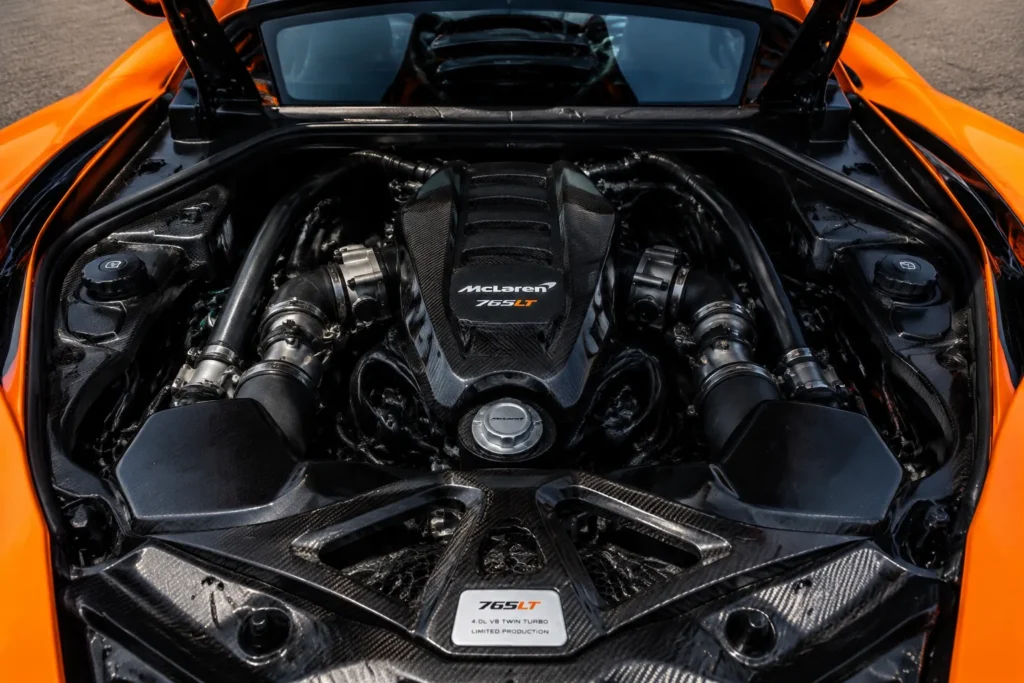
Power goes to the rear wheels only through an eight-speed dual-clutch transmission. There is no all-wheel-drive safety net here, which is a deliberate choice. McLaren wanted the W1 to feel raw and analog even with a hybrid system doing some of the heavy lifting. The car even retains traditional hydraulic power steering rather than switching to electric assistance, something almost all rivals have abandoned in favor of efficiency over feel.
The plug-in hybrid setup also provides a small electric-only range of about 1.6 miles, not built for daily commuting but enough to ease the car quietly out of a garage or through a residential street before the V8 wakes up.
McLaren W1 Top Speed and Straight-Line Performance
McLaren claims a 0-60 mph time of 2.7 seconds, while 0-186 mph follows in about 12.7 seconds. The McLaren W1 top speed is electronically limited to 217 mph, which puts it in the same category as the fastest production hypercars that exist at present anywhere in the world.
What’s more impressive than the numbers, though, is the way McLaren made them. The W1’s active aerodynamics, from the McLaren Active Long Tail, which extends the rear of the car by 300mm in race mode, produce up to 1,000 kg of downforce. That’s five times what the car generates in its normal road setting and is why McLaren says the W1 gets around Nardò’s handling circuit about three seconds quicker than the McLaren Senna.
McLaren W1 Interior 2026: Built Like a Race Car, Trimmed Like a Flagship
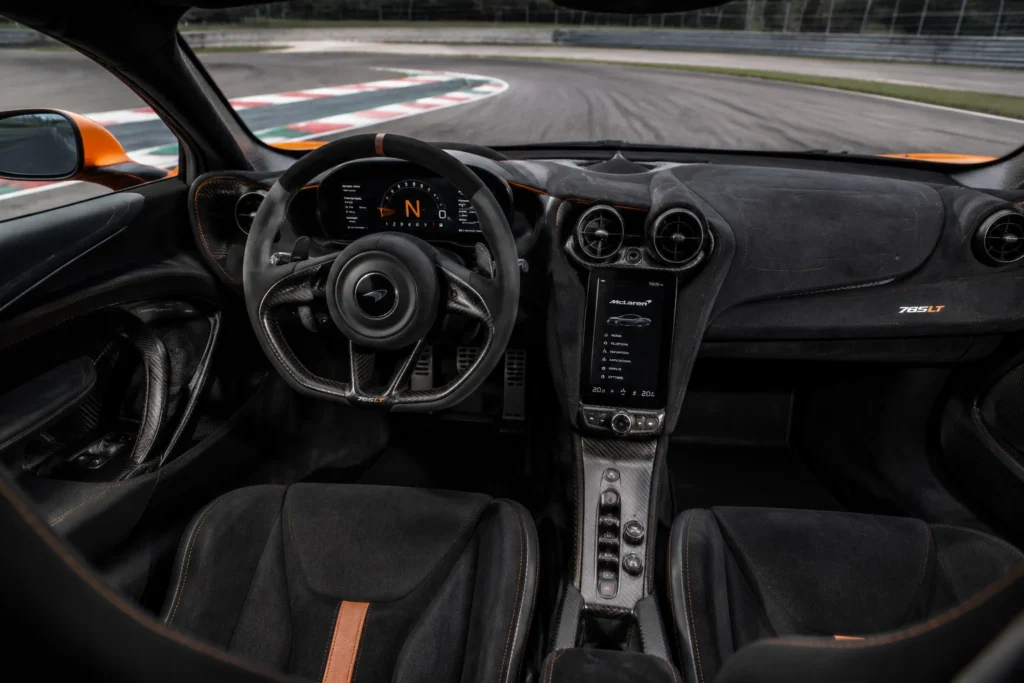
Inside, from the inside of the McLaren W1, you instantly get that this isn’t a car for comfort-first thinking. The seats are embedded directly into the carbon-fiber tub, not as individual, adjustable parts. Instead of changing the seat to fit the driver, the pedals, steering column, and primary controls move in that direction, in keeping with Formula 1 cockpit philosophy.
A flat-top, flat-bottom steering wheel ahead of the driver has only two buttons on it: one for powertrain boost and one for active aero. Everything else is within easy reach, including an 8.0-inch portrait touchscreen angled toward the driver that supports Apple CarPlay.
Material-wise, McLaren provided something genuinely new here: InnoKnit, a flexible, lightweight woven material that can be shaped into almost any texture, color, or pattern, even extending into speaker grilles. For people looking for a more traditional feel, leather and Alcantara instead, with 1K carbon-fiber accents on switchgear for anyone who wants to have a motorsport feel.
McLaren W1 Features 2026: Aerodynamics, Brakes, and Wheels
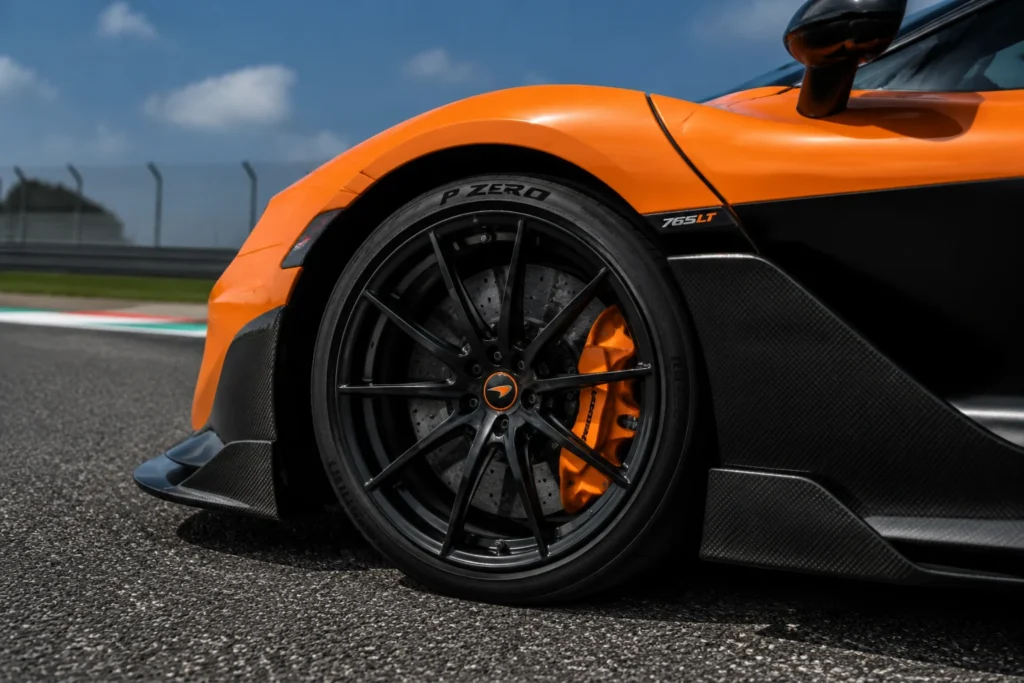
In between the more superficial exterior features of the McLaren W1 and the engineering details are where this car earns its price tag.
Active Aerodynamics: The Active Long Tail and ground-effect underbody work together in real time and adjust according to driving mode.
Braking: McLaren Carbon Ceramic Racing+ discs with six-piston front calipers and four-piston rears with cooling ducts based on the F1-style brake cooling.
McLaren W1 Wheels: designed to improve airflow around the carbon-ceramic brakes and keep unsprung weight as low as possible, a point that is crucial at 217 mph.
Doors: McLaren’s first-ever Anhedral gull-wing doors replacing its classic butterfly side doors.
Chassis: Aerocell monocoque with McLaren’s next-generation ART carbon-fiber process.
All these choices are related to the same goal: shave weight, boost downforce, and keep the driver connected to what the car is actually doing.
How the W1 Fits Into 2026’s Biggest New Car Launch Conversations
Every year brings its share of upcoming cars worth watching, but few new car launches get the sort of cross-industry attention the W1 has brought in. It’s been mentioned alongside the Ferrari F80 in nearly every roundup of 2026’s most significant new car launch stories, and for good reason, both brands are racing toward the same hybrid hypercar future, just from different engineering philosophies.
For readers tracking upcoming new cars more broadly, the W1 also clues in on where McLaren may go next with its lineup. This car’s technology, particularly around active aero and hybrid integration, will be transferred into the next few generations of McLaren cars in the same way P1 technology did when it was far below its original price point. It’s a nice reminder that even niche upcoming cars on the very top of the market will play an important role in the new cars that the rest of us will eventually be able to afford.
McLaren W1 vs. Its Closest Rivals
| Model | Power | 0–60 mph | Top Speed | Starting Price |
| McLaren W1 | 1,258 hp | 2.7 sec | 217 mph | ~$2.1 Million |
| Ferrari F80 | Hybrid V6 (TBD Output) | ~2.5 sec (Est.) | 217+ mph (Est.) | Higher than W1 |
| Porsche Mission X | All-Electric Powertrain | TBD | TBD | TBD |
| Rimac Nevera | 1,914 hp | 1.74 sec | 258 mph | ~$2.2 Million |
| Bugatti Tourbillon | 1,775 hp Hybrid V16 | <2.0 sec (Est.) | 276 mph (Limited) | ~$4.1 Million |
Where final rival figures are still emerging as those cars approach production, the McLaren W1 has a head start over other upcoming new cars in this class: it’s already built, already delivering, and already proven on track.
Is the McLaren W1 Worth It?
If you’re comparing this with other upcoming cars in the hypercar space, the honest answer is that “worth it” is not a price-per-horsepower equation at this level. Owners are not just looking for performance; they are getting a piece of McLaren’s halo-car heritage, a surer collector’s item on the horizon of some of the most anticipated new cars of the future, and a driving experience that is truly driven by motorsport-grade obsession.
And for everyday car buyers, this is not a realistic purchase, and McLaren never intended it to be. But as a benchmark for where hybrid hypercar technology is headed, and as one of the most talked-about new car launch moments in recent memory, the W1 earns every bit of its reputation.
McLaren W1 For Sale 2026: What Buyers Need to Know About McLaren’s New Hypercar
The McLaren W1 has quickly become one of the most talked-about hypercars on the market, and anyone searching for a McLaren W1 for sale is chasing an extremely rare opportunity. Unveiled in October 2024 as the spiritual successor to the P1, the W1 marks the 50th anniversary of McLaren’s first Formula 1 World Championship win and represents the brand’s most powerful road car to date. Production is capped at just 399 units, and every allocation sold out directly through McLaren before the car even reached customer hands.
That means a McLaren W1 for sale today is almost always coming from the resale market, not from a dealership order book, and buyers should expect prices well above the original list figure given the scarcity and demand surrounding the car.
Underneath the bodywork, the W1 pairs a twin-turbocharged 4.0-liter V8 with a hybrid electric module borrowed in spirit from McLaren’s Formula 1 program, delivering a combined output north of 1,270 PS. It rockets from 0-100 km/h in just 2.7 seconds and can push on toward a top speed near 350 km/h, all while generating up to 1,000 kg of downforce through its active aerodynamics and Active Long Tail rear wing.
The carbon fiber monocoque, dihedral doors, and F1-inspired suspension give it both the look and the engineering pedigree buyers expect from a modern McLaren halo car. For someone hunting a McLaren W1 for sale, these numbers explain why the car commands such intense interest among collectors and hypercar enthusiasts alike.
McLaren W1 Market Snapshot
| Category | Detail |
|---|---|
| Original list price | Roughly $2.1-2.6 million (varies by market and specification) |
| Resale/secondary market price | Frequently several million dollars above list, given sold-out allocation |
| Availability | Not available through standard dealer order; resale or broker channels only |
| Delivery status | Deliveries underway following 2025 production start |
| Customization | Extensive personalization available through McLaren Special Operations (MSO) |
If you’re actively searching for a McLaren W1 for sale, working with a reputable hypercar broker or an established McLaren retailer is the safest path to verifying authenticity and securing a fair deal in a market where demand still far outweighs supply.
Conclusion
The McLaren W1 isn’t supposed to be practical, cheap, or even especially easy to live with, and that is the point. It’s a hypercar designed for a small audience, engineered with such obsessive attention that it creeps right down to every wheel, every carbon-fiber panel, and every line of that integrated seat. Between the McLaren W1 horsepower numbers, the McLaren W1 price to buy, and an interior that feels more like a race car than a road car, this is one of those rare upcoming new cars that truly lives up to the hype surrounding its reveal. Few upcoming cars will be able to do that. Whatever McLaren brings next, the W1 has set a very high bar for itself.
FAQs
Q. What is the price of the McLaren W1?
A. The McLaren W1 starts out at around $2.1 million, with McLaren Special Operations customization adding significantly more for bespoke builds.
Q. How much horsepower does the McLaren W1 have?
A. The McLaren W1 has 1,258 hp combined, generated by a 4.0-liter twin-turbo V8 and an electric motor.
Q. What is the McLaren W1 top speed?
A. The McLaren W1 top speed is electronically limited to 217 mph, with a 0–60 mph time of 2.7 seconds.
Q. How many McLaren W1 units will be produced?
A. McLaren is building only 399 examples of the W1, and all units were allocated to buyers before public ordering opened widely.
Q. Does the McLaren W1 have an electric-only driving mode?
A. Yes. As a plug-in hybrid, the McLaren W1 can drive a short distance (about 1.6 miles) on electric power alone, mainly intended for quiet, low-speed maneuvering.