
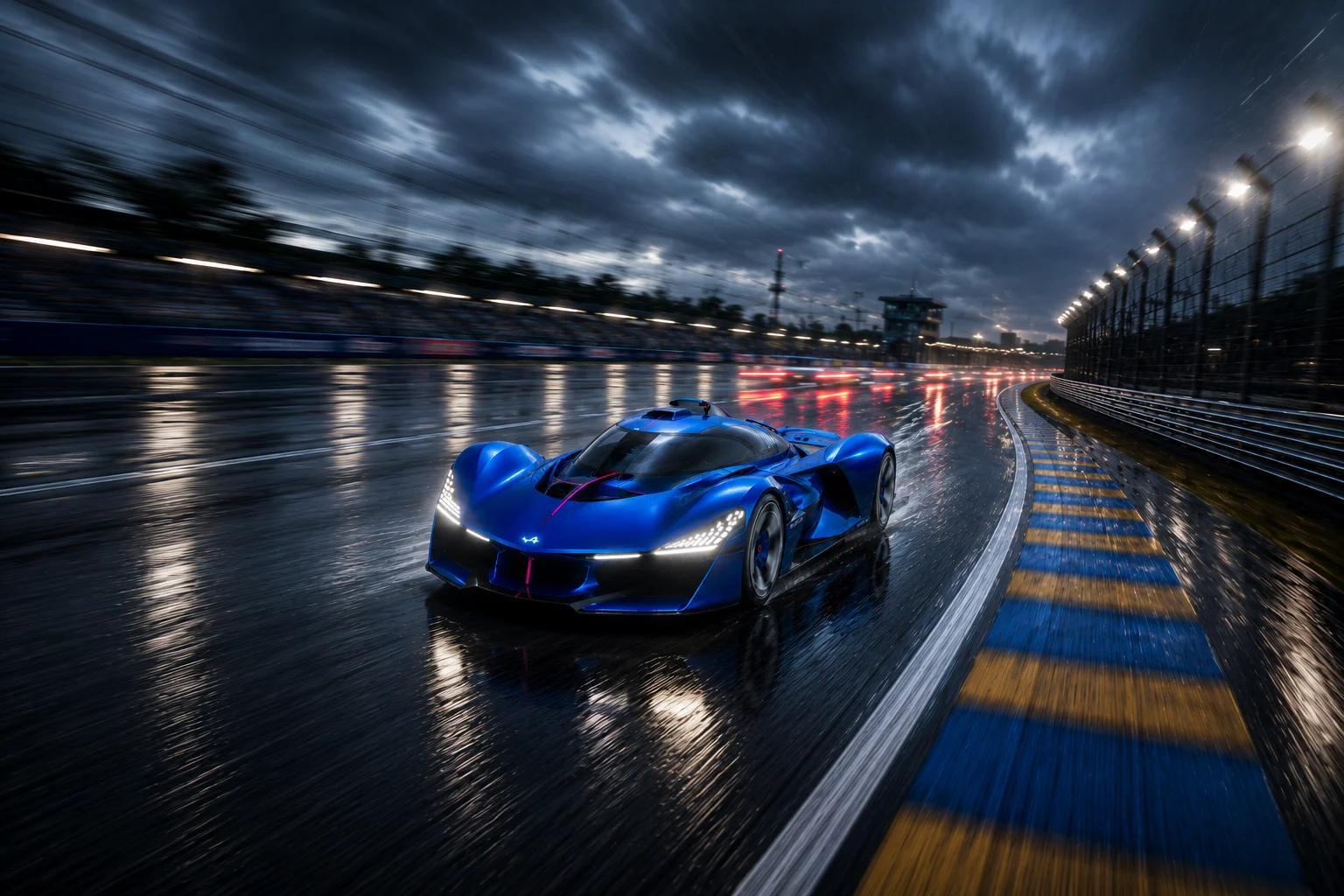
There are concept cars. And then there are ideas that inspire you to truly believe the future of motorsport will be loud, fast, and completely reinvented. The Alpine Alpenglow Hy4 falls firmly in that second category.
When Alpine Alpenglow Hy4 rolled this machine onto the Spa-Francorchamps circuit in May 2024, it wasn’t merely displaying a pretty design study. The point was to make hydrogen-powered racing doesn’t need to be quiet, sanitized, or soulless. This thing screams. It has a racing heartbeat under a carbon bonnet and hydrogen instead of petrol.
Whether you’re a motorsport purist concerned you won’t get the raw emotion of combustion back from owning something else, or a forward-thinking enthusiast eager to experience new neatness with clean-energy tech, the Alpine Alpenglow Hy4 is a car meant to appeal to both of you. Let us explore all of what it’s got inside of you.
A Alpine Alpenglow Hy4 Specs Overview
| Vehicle Attribute | Specification / Core Detail |
| Model Designation | Alpine Alpenglow Hy4 Concept |
| Vehicle Class | Hydrogen-Powered Endurance Racing Prototype (“Rolling Lab”) |
| Chassis Structure | Carbon Fiber Monocoque (Built on a modified Ligier LMP platform) |
| Powertrain Type | Hydrogen Internal Combustion Engine (HICE) |
| Engine Configuration | 2.0-Liter Turbocharged Inline-4 (Direct Injection) |
| Maximum Power Output | 340 hp (250 kW) @ 7,000 RPM |
| Top Speed | 168 mph (270 km/h) |
| Transmission Type | 6-speed sequential racing gearbox |
| Drivetrain Layout | Rear Mid-Engine, Rear-Wheel Drive (RWD) |
| Fuel Storage Medium | Gaseous Hydrogen ($H_2$) |
| Fuel Tank Capacity | 3 Tanks / Total storage of ~6.3 kg (approx. 3 x 55-liter tanks) |
| Tank Storage Pressure | 700 Bar (10,150 psi) in sealed, ventilated side pods |
| Primary Tailpipe Emission | Pure Water Vapor ($H_2O$) |
| Exterior Dimensions | Length: 5,210 mm | Width: 2,150 mm | Height: 1,100 mm |
| Exterior Features | Cosmic-dust light signature, active rear diffuser, forged carbon centerboard |
| Wheel Tech | Custom aerodynamic rims with completely transparent outer polymer structures |
| Cabin Layout | Re-engineered 2-seater cockpit (evolved from the original 1-seat concept) |
| Interior Materials | Raw exposed carbon fiber, technical mesh, and Alcantara racing controls |
| Market Availability | Not for public sale (Active multi-million dollar R&D development platform) |
| Future Pipeline | To be succeeded by the 740 hp twin-turbo V6 evolution (Alpenglow Hy6) |
What Is the Alpine Alpenglow Hy4?
The Alpine Alpenglow Hy4 is no remote dream for a designer. It’s a practical rolling lab—a concrete race car designed to show how performance and sustainable technology can coexist without sacrifice.
The name itself tells the story: “Hy” is short for hydrogen, and “4” is for its four-cylinder engine. “Alpenglow” comes from a natural phenomenon—warm, glowing light filtering through mountain peaks right before the sun rises. Alpine picked it wisely. It is emblematic of the beginning of a new future in motorsport.
First unveiled as a concept at the 2022 Paris Motor Show, the Hy4 had been developed into a live prototype by 2024, debuting publicly at the WEC 6 Hours at Spa-Francorchamps and making demonstration runs at the signature 24 Hours of Le Mans. This isn’t just a show car. It runs, it races, and it communicates what’s next.
Alpine Alpenglow Hy4 Design: Built to Make You Stop and Stare
The Alpenglow Hy4 is an attention-grabbing design at first glance. Its silhouette is long, low, and powerful, like a Le Mans prototype combined with a forward-looking prophecy. Key design details include:
Length: 5.20 m
Width: 2.15 m (with widened tracks of 2.10 m)
Height: 1.10 m
Body construction: Carbon monocoque chassis.
And the wide stance and ultra-low profile aren’t just for style. They connect the car aerodynamically, producing downforce and indicating no-frills speed at a stop. The wheel rims were sculpted to make the rolling version feel dynamic, and in the overall bodywork we all associate with the Alpine A424 in the high profile Hypercar category.
Alpine Alpenglow Hy4 Interior
Inside the Alpenglow Hy4 is a driver-conscious cockpit. The 2-seater layout features a good race steering wheel, stripped-back controls, and instrumentation designed for track rather than road. It’s motorsport-spec all up and down; everything is performance-driven, not passenger-comfort-driven.
Alpine Alpenglow Hy4 Engine: Hydrogen, But Make It Thrilling
That’s where Alpenglow Hy4 really separates itself when it comes to concept space. Within that carbon bonnet sits a turbocharged 2.0-liter inline 4-cylinder engine—but instead of petrol, it runs on compressed hydrogen. Its output is 340 bhp (250 kW) with the sounds and sensations fans of motorsport relish. No electric whirr. No silence. Only combustion, drama and purpose.
How the Hydrogen System Works
The Hy4 carries three tanks of hydrogen that hold 2.1 kg of hydrogen gas at an extraordinary 700 bars of pressure. These tanks are placed in the side pods and aft of the cockpit and contained in ventilated, sealed compartments for safety.
Pressure is decreased by a regulator from 700 bars to 200 bars and again down to 40 bars before hydrogen is pumped into the combustion chamber. It’s a complex, precision-engineered system that is maintaining the power explosion of old-school engines and cutting carbon emissions completely.
Alpine Alpenglow Hy4 Horsepower and Performance
The Alpenglow Hy4 is a 340-hp, race-spec, sequential gearbox, with no light show event of that kind. It offers real performance results that is a fair approximation of serious motorsport prototypes.
Alpine may not be releasing a clear Alpine Alpenglow Hy4 top speed, but it’s the 340 bhp hydrogen-combustion engine, ultra-low carbon bodywork and aerodynamic downforce package putting it somewhere in the ballpark of modern LMP-class racers. Track testing at Spa and Le Mans confirmed that it behaves like a real race car at speed — not a publicity stunt on wheels.
The sound? This is a big part of the story too. One of the main goals set for the Alpine Hy4 top speed was to show that hydrogen combustion retains all the acoustical and emotional character of traditional motorsport. At Le Mans and Spa, that was confirmed exactly by spectators. A hydrogen racing car that sounds like a racing car. Mission accomplished.
Alpine Alpenglow Hy4 Price: Can You Buy One?
The question that everybody searches first. How much for the Alpine Alpenglow Hy4?
The answer is; the brief version is — it’s not for sale. The Alpenglow Hy4 is essentially a rolling laboratory and prototype, a technology demonstrator rather than a commercial product. Alpine has not published any production equivalent and retail pricing for this model.
But it is one part of the Renault Group’s larger hydrogen development strategy. Alpine intends to bring hydrogen-powered vehicles into production by the early 2030s, which means what you see from top to bottom with the Hy4 today will likely inform production hardware within this decade.
The price, to put it mildly, isn’t a car you can purchase yet; it’s a sneak peek at the cars you’ll eventually be able to purchase—and looking at what’s out there, that’s a very exciting prospect.
Why the Alpine Alpenglow Hy4 Matters for the Future of Motorsport
Alpine’s VP of Motorsports, Bruno Famin, has had great vocalization about hydrogen’s ability to decarbonize endurance racing and even Formula 1. The Hy4 is the real proof of that vision.
Below is why this car actually matters other than the spec sheet:
1. It keeps the feeling alive. Critics of electric motorsport often cite a loss of sound and tactility. The Hy4 responds to that critique head-on: hydrogen combustion preserves the sensory experience of racing.
2. It produces actual engineering knowledge. Optimizing hydrogen combustion temperatures, fuel injection pressure, and high-density energy delivery are the details of this work that, by the way, is directly informing Alpine’s next-generation engine development.
3. It’s a cue for the industry to move in a specific direction. With the FIA tightening its emissions requirements and many manufacturers turning to hydrogen combustion to fill the vacuum left behind by pure EV technology, hydrogen combustion is growing into a serious conversation at the very highest level of the sport.
The Alpenglow Hy4 is not a manufacturer-exclusive experiment. It is a data point in one of motorsport’s most powerful ongoing debates.
Alpine Alpenglow Hy4 vs. the Competition
How does the Alpenglow Hy4 stack up to other hydrogen motorsport projects?
Alpine’s 340 bhp Hy4 sits next to a small but growing group of hydrogen-powered racing prototypes that are each taking slightly different routes to the same end. Toyota’s GR H2 Racing Concept may be the closest to the spirit side to that kind but is also a hydrogen engine with an estimated output of around 500 bhp but is still a concept. Production intentions have not yet been confirmed.
In a whole new direction, BMW has switched the scene entirely to a fuel cell powertrain called iX5 Hydrogen. Instead of burning hydrogen in situ, a cleaner but less emotionally charged option, it generates 374 bhp by producing electricity for driving motors. At the same time, the MISSIONH24 program is dedicated to hydrogen combustion for endurance racing, an innovation that acts more as a collaboration from industry than as something that is produced by a single manufacturer’s prototype.
What makes Alpine unique in this regard is an intentional philosophical choice. Instead of chasing hydrogen fuel cells’ conversion of that car, in essence, to an electric vehicle fueled by hydrogen chemistry, Alpine opted for direct combustion. Hydrogen burns inside the engine just like petrol, but with no carbon dioxide emissions. That decision keeps all the things motorsport purists care about: the mechanical drama, the acoustic environment, and the sensation of a classic race car at full throttle. For the engineers, it also means drawing on decades of combustion expertise instead of being forced to start from square one. For the fans, it is hydrogen racing that actually sounds like it would be racing.
Conclusion
The Alpine Alpenglow Hy4 Concept is proof that the future of motoring doesn’t need to be clinical, heavy, or utterly silent. Alpine is showing the world that a true fuel-fueled driving passion can carry on living in a zero-emission world, successfully marrying clean hydrogen energy with the soul-stirring frame of an internal combustion engine. It is quick and gorgeous and, perhaps more importantly, it continues to sound amazing.
What is your view towards hydrogen internal combustion? Would you opt for a roaring hydrogen supercar rather than a quiet electric hypercar? Please leave feedback in the comments below and check out Autocram for the newest premium breakdowns for the next time we will see high-performance automotive tech.
Disclaimer: The specifications, performance data, and pricing are for informational purposes only. Values may vary based on condition, originality, and market trends. Prices are estimates. For accurate details, consult the website and sources.
FAQs
Q. Does the Alpine Alpenglow Hy4 run on electricity or gas?
A. Neither. It operates on compressed hydrogen gas. Unlike quiet electric fuel-cell vehicles, though, it burns hydrogen straight inside a combustion engine, maintaining the classic roar and mechanical feel of a gas race car with zero carbon emissions.
Q. What’s the top speed of the Alpine Alpenglow Hy4 Concept in the real world?
A. A 4-cylinder Hy4 reaches an official top speed of 168 mph (270 km/h). Alpine’s twin-turbo V6 upgrade (the Hy6) offers an option to clear 200 mph.
Q. How much does the Alpine Alpenglow Hy4 Concept cost to purchase?
A. It is not for sale. It’s a one-off racing prototype with an estimated development worth well into the millions of dollars.
Q. What comes out of the Alpenglow Hy4 exhaust pipe?
A. Pure water vapor. We burn hydrogen mixed with ambient oxygen: You get zero greenhouse gases in the tailpipe.
Q. So how come the wheels of the Alpenglow Hy4 are special?
A. They have clear polymer rims. The see-through aspect drives unique aerodynamics, as cooling air is directed to the racing brakes under intense track usage.