
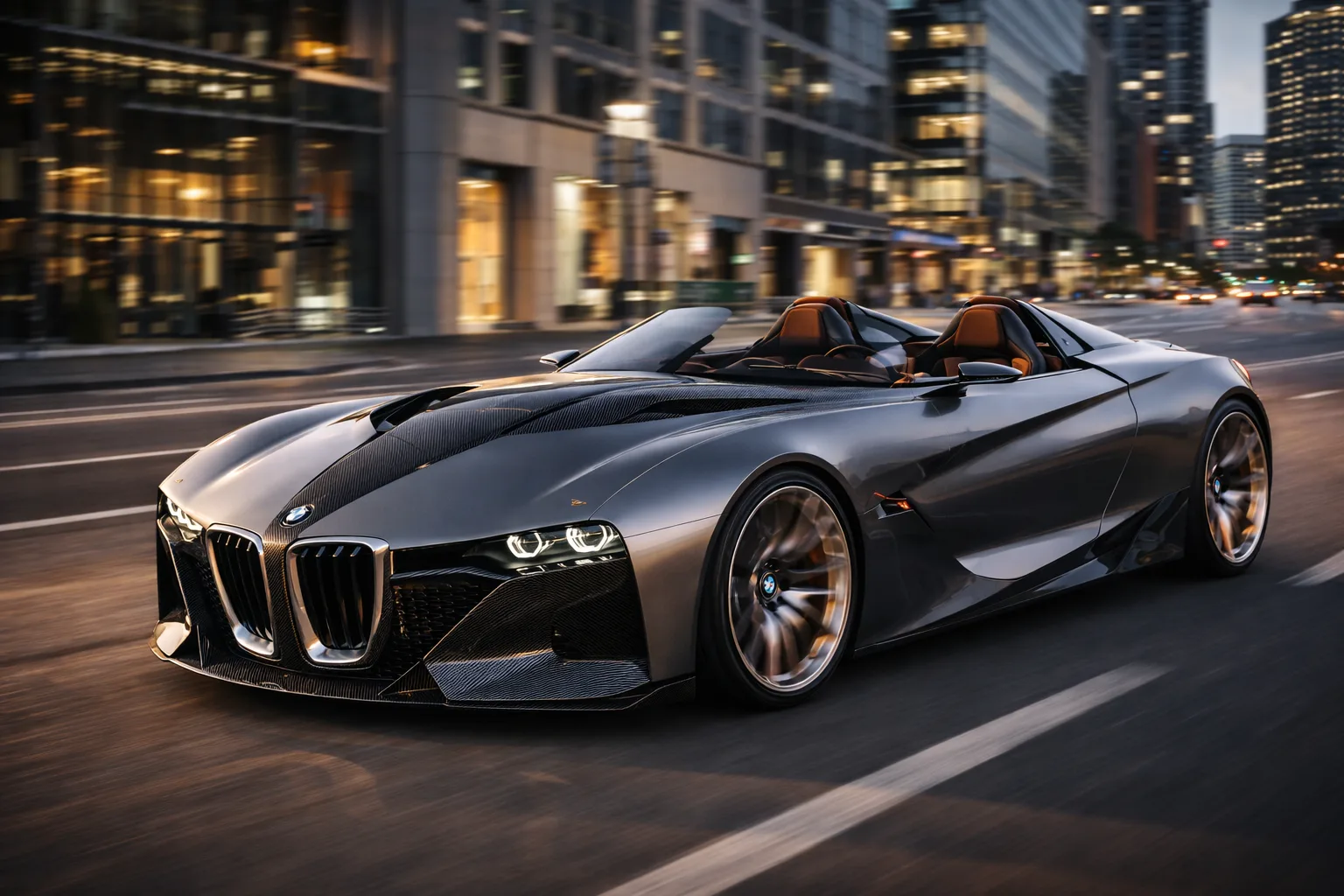
The automotive industry often seems to focus on what’s next; still, every so often there is a machine that comes around to inspire awe by looking back at the best of the past. The BMW 328 Hommage fits this bill perfectly – it’s an all-carbon fiber creation that pays tribute to one of the most successful and most iconic sports cars ever made, The BMW 328 built during the 1930’s.
To honour BMW’s legendary 75th birthday, they have created something much more than just another static display of design; instead, BMW has re-imagined what made the original BMW328 roadster so successful on the racetrack, by using modern high-tech materials to create a masterpiece that combines the aesthetics of a pre-war vehicle with modern technology.
In this blog which we are writing for Autocram, we will take an in-depth look at how 328 BMW has done this by combining the pre-war beautiful style of the vehicle with CFRP material, to create something that looks as if it will be going 200 MPH just by standing still.
BMW 328 Hommage: The Introduction
BMW’s Original 328 was not only an example of pre-war lightweight construction but also won the 1940 Mille Miglia race. The success of the original BMW 328 set a precedent for how to create lightweight performance vehicles and established a benchmark for future lightweight performance standards. As an hommage to this immutable heritage the Hommage version of the BMW 328 uses a nominal amount of aluminum and magnesium as compared to the original BMW 328 which was built almost exclusively from CFRP (Comprehensive Fiber Reinforced Plastic). This allows for an ultra-low curb weight similar to that of the original BMW 328 yet still maintaining the structural integrity needed for maintaining typically higher speeds in today’s performance vehicles.
As a complete visual treat all aspects of the car represent the combination of aerodynamics and heritage – starting with the vertical kidney grilles that represent the aesthetic of 1930’s design, to the leather straps that hold down the hood.
Key Features: The Engineering Marvel of the BMW 328 Hommage
The BMW 328 Hommage is more than just a design exercise; it is a technical master class on how to convert racing victories from the 1930s to the performance of the 21st-century car. 328 BMW has stripped away the digital excess of modern supercars, and instead focused on ‘functional aesthetics’.
Here’s an in-depth look at what makes this carbon fiber beast:
Advanced CFRP Architecture (Carbon Fiber Reinforced Plastic)
The original 1936 BMW was made of magnesium and aluminum to keep it lightweight; the Hommage builds upon the original using CFRP (Carbon Fiber Reinforced Plastic) in many ways. It is as much about design as it is about weight; it tells a story through its use of materials.
- The Weight Factor: By using CFRP, the entire vehicle weighs only 780 kg, giving you an incredible power-to-weight ratio, practically the same as some of today’s asphalt-dominating supercars.
- Visible Weave: The carbon fiber of the Hommage is not painted like most of today’s production cars. It is clearly coated with a high gloss that exposes the intricate weave of the material. This shows how the “skin” of the car is also the “skeleton”.
- Sustainable/Strength: CFRP has greater structural rigidity than steel, so even though there is no roof or traditional door on the Hommage, it has enough structure to withstand the high-G loads on the chassis from cornering.
The “Wind-Sculpted” Asymmetrical Cockpit
The exterior styling of the vehicle adheres to the “Air Curtains” design philosophy, but it also exhibits a bold innovation in using an asymmetrical design for the cockpit.
- The Windshield: The windshield is split into two different sized sections, with the driver’s side having a lower profile than the passengers’ side, allowing for an intimate connection with the prevailing weather conditions. The design pays hommage to the open-cockpit race cars of the Mille Miglia, creating a true “wind-in-your-hair” experience.
- Aerodynamic Airflow Management: The substantial vertical ducts at the back of both front wheels and the back of both headrests have been designed to control airflow and reduce turbulence, thereby moving air efficiently across the flat rear deck of the vehicle.
Functionally Fasteners Inspired by Heritage
One of the most creative design features of the vehicle is the use of high-quality, tanned leather straps that transition from the exterior of the vehicle to the interior.
- Hood Straps: These leather strap fasteners are not just for looks—they also serve as an additional locking mechanism for the front of the vehicle’s hinged hood. They represent a time when mechanical dependability could be felt and seen!
- Interior Strap Fasteners: The leather strap design is extended inside by the use of leather pull straps and silver finished aluminum eyelets. These eliminate traditional glove box latches and door handles.
“Crossed” Lighting Technology
The design of the headlamps is an attractive blend of the historic design of race cars with the modernity of LED technology.
- Tape Motif: In the early 1930’s many racers taped their glass headlamps with an “X” to prevent glass shrapnel from flying onto the race track after an accident. The way the Hommage uses LED technology internally in the lamp to create an “X” illumination mimics this historical process.
- Vertical Kidney Grills: The internal kidney grill pattern is very tall and skinny and runs basically from the hood line to the leading edge of the splitters and mimics pre-WWII vehicles’ cooling needs while providing modern electronics for sensor operation and vehicle air intake flap operation.
Multi-Piece Heritage Wheels (Evolution of Style 328)
The wheels are an evolutionary, multi-part version of BMW style 328 wheels.
- Construction: The wheel construction consists of a dark concave center and polished aluminum spokes which extend radially from the center, towards the wheel rim.
- Cooling Fins: The configuration of the spokes is manufactured in an orientation that will act like a turbine to draw hot air from the high-performance ceramic brakes while the vehicle performs heavy braking.
- Hub: A center-lock (single bolt) is utilized for the wheel hub instead of using a typical five-bolt pattern. This is carried over from the professional endurance racing design.
The “Tripmaster” Interface for Passengers
328 BMW has replaced a traditional infotainment screen with an improved “analog-digital” hybrid display.
- Dual Smartphone Integration: Two different iPhone cradles will be found on the passenger side of the dashboard.
- The Tripmaster Application: One device will work as a digital stopwatch and lap timer, while another will be a GPS roadbook. The combination of devices will allow the passenger to navigate, creating an effect similar to the two-man racing teams used in classic road races!
Performance and Speed
The Power Plant: The Inline Six Legacy
The inline six cylinder engine , 3.0 litres in capacity, is commonly accepted as providing the “heart” of 328 BMW automobile. The 328 Hommage has employed this engine arrangement as a means of revisiting the long front engine layout of the original 328 BMW.
- Smooth Flow: With no primary or secondary imbalance caused by the inline six engine’s inherent balance characteristics, smooth rev-up to maximum speed is achieved without rotary engine vibration.
- Expected Output: The estimated output is approximately 340 horsepower. The engine will give a strong pull and very quick response compared to a traditional heavy V8 because the engine has been located rearward to the firewall position, thus providing between the front and rear wheels with a more balanced weight.
- The Sound: The engineering of the Hommage’s exhaust system has produced an exhaust note that is free of the dampened, soft-edged notes commonly found on many contemporary luxury sedans; the Hommage has an unrefined, rasping metallic roar at higher RPMs that emulates the raw/mechanical growl of the 1930s bmw 328 roadsters.
The Power-to-Weight Phenomenon
Power-to-weight ratios are typically used to measure vehicle performance; however, the Hommage blows away the competition due to its extremely light weight.
- 780 kg Weight Difference: The 2,700 lb Hommage weighs almost one-half as much as the current bmw 328i (F30).
- The Ratio: The Hommage will produce 340 hp, which means its power-to-weight ratio will be approximately 435 hp per tonne. To put things into perspective, this power-to-weight ratio puts it on par with many of today’s modern Ferraris and Lamborghinis!
- The “Lunge” Effect: There is very little mass to accelerate, resulting in negligible inertia; therefore when throttle is applied, the vehicle will not gradually accelerate; rather, it will instantly accelerate from the start of throttle application.
Acceleration and Speed Metrics
The vehicle has top speeds and acceleration that are both limited electronically and capable of providing a physical thrill through acceleration, respectively.
- 0-100 km/h (62 mph): Achievable in under 4.5 seconds; however, due to the fact that it is an open car (i.e. no sideshields or a recessed windscreen), and based on the fact that you will be driving in a very aerodynamic manner with little or no wind resistance, it feels like 200 km/h (124 mph).
- Max speed: 250 km/h (155 mph); while the engine could have produced a greater speed, the vehicle has been designed for “twisties,” or winding roads through the mountains or along the coast. In this case, the acceleration aspect is of greater importance than is the maximum speed aspect.
Handling Dynamics
Handling performance is not limited to straight line driving; handling is also defined by how the vehicle interacts with the road (tarmac).
- Low center of gravity: A significant portion of the vehicle’s mass is concentrated in the chassis, thereby allowing maximum use of CFRP (carbon-fiber-reinforced plastics) throughout the upper body construction. This provides a low center of gravity that will help reduce body roll.
- Dart factor: Because of the extremely light front end, the steering response time is dramatic, as there is no plow or under-steer present with heavier vehicles.
- Braking effectiveness: Since the total weight of the 780 kg vehicle is less than that of a standard 1500 kg sedan, it requires considerably less force to stop and therefore will allow for improved brake temperature and performance over a longer period of time and provide quick and consistent acceleration.
Interior: Minimalist Luxury
Entering the BMW 328 Hommage is like stepping into a next-generation, advanced aircraft cockpit where there’s no large touchscreen and no plastic pushbuttons, etc.
- Cabin Materials: The three primary materials in the cabin are: carbon fiber, fine leather, suitable for use as the trim on the seats; and polished aluminum.
- Colour Combination: The colour scheme in the car’s cabin is one of dark carbon fibre, tan leather, and polished silver; all three materials are in direct contrast.
- Integrated iPhones: The passenger side of the dashboard has a built-in iPhone, which is mounted vertically, and used for GPS, lap times, and telemetry.
- The Seats: The racing seats are designed to keep you in place during sharp turns by having sufficient lateral support.
- Seat Belts: All of the seat belt harnesses are four-point (2 shoulder and 2 pelvic) providing you with maximum security and comfort while pushing the limits of the vehicle at speed.
Review: The Driving Experience
For those lucky enough to experience (or simply see) the BMW 328 Hommage, they will enjoy maximum sensory stimulation. The car does not have any doors, so getting in requires jumping over the side of the car as was done with the original bmw 328 roadster. Without a roof or windshield over your head, the connection you feel with the world is unlike anything you feel in a current production car.
The steering provides exactly what you would expect from a sports car; because of its lightweight CFRP (Carbon Fiber Reinforced Plastic) construction, the front end responds quickly and with great precision. Whether you picture yourself driving along the coast of the United Arab Emirates or flying through a canyon in the United States of America, this vehicle is engineered for a purist who prefers mechanical enjoyment instead of relying on electronic aids.
Price Range: The Value of a Legend
Since the BMW 328 Hommage is an experimental car, there is no sticker price in the classical way. However, if you are a collector of 328s as well as someone interested in the BMW 328 history and/or what is currently offered in the BMW 328 market like various 328 models and the BMW 328 convertible or BMW 328 GT, you will quickly find that pricing varies widely.
| Model Variant | Estimated Price (USD) | Estimated Price (AED) | Status |
| BMW 328 Hommage Concept | $1,500,000+ (Valuation) | 5,500,000+ AED | Museum/Private |
| Classic 1930s BMW 328 | $600,000 – $1,000,000 | 2,200,000 – 3,670,000 AED | Auction Only |
| Modern BMW 328i (Used) | $12,000 – $25,000 | 44,000 – 92,000 AED | Market Value |
| BMW 328 Roadster (Replica) | $50,000 – $80,000 | 183,000 – 294,000 AED | Custom Build |
The Evolution: From 328 Diesel to Performance Mods
Although the BMW 328 Hom,age pays hommage to the past, the 328 nameplate still exists today on both the E90 and F30 models. Owners of contemporary-day BMW 328 models today would recognize the 328d as an amazing daily driver given its inhaus torque and fuel economy as well as the fact that it has become a very popular vehicle for long-distance cruising in the United States. The tuning community has fully embraced all forms of tuning anything related to the BMW 328 vehicle platform; this includes installing larger-sized turbos and upgrading the suspension on their 328 BMWs to achieve M-Series performance levels.
If you are interested in the aesthetics of your 328 BMW, you may be one of many enthusiasts who choose to replace your OEM-style wheels with BMW 328-style wheels, which feature a multi-spoke design that straddles the line between luxury and performance.
Comparison Table: 1936 vs. Hommage vs. Modern 328i
| Feature | 1936 BMW 328 | 328 Hommage Concept | Modern 328i (F30) |
| Engine | 2.0L Inline 6 | 3.0L Inline 6 | 2.0L Turbo Inline 4 |
| Horsepower | 80 hp | ~340 hp | 240 hp |
| Material | Aluminum/Magnesium | Carbon Fiber (CFRP) | Steel/Aluminum |
| Weight | 830 kg | ~780 kg | 1,540 kg |
| Top Speed | 150 km/h | 250 km/h | 250 km/h (Limited) |
| Key Tech | Triple Solex Carbs | Integrated iPhones | iDrive System |
Final Thoughts
Not only is the BMW 328 Hommage a car; it is also an expression of who you are. You can demonstrate to people that you can decrease your vehicle’s weight significantly and add more performance by doing so. The experience of being behind the wheel if you live in the United States and are looking for a bmw 328 convertible for your nice weekend out with friends and/or are looking for a bmw 328 gt in the United Arab Emirates, represents all that is bmw 328 – “The joy of driving”!
The 328 hommage serves to remind us that as cars continue to change with the times, the way we feel when we get into a roadster with the top down (or up) or when the straight-six engine roars to life will always remain spectacular!