
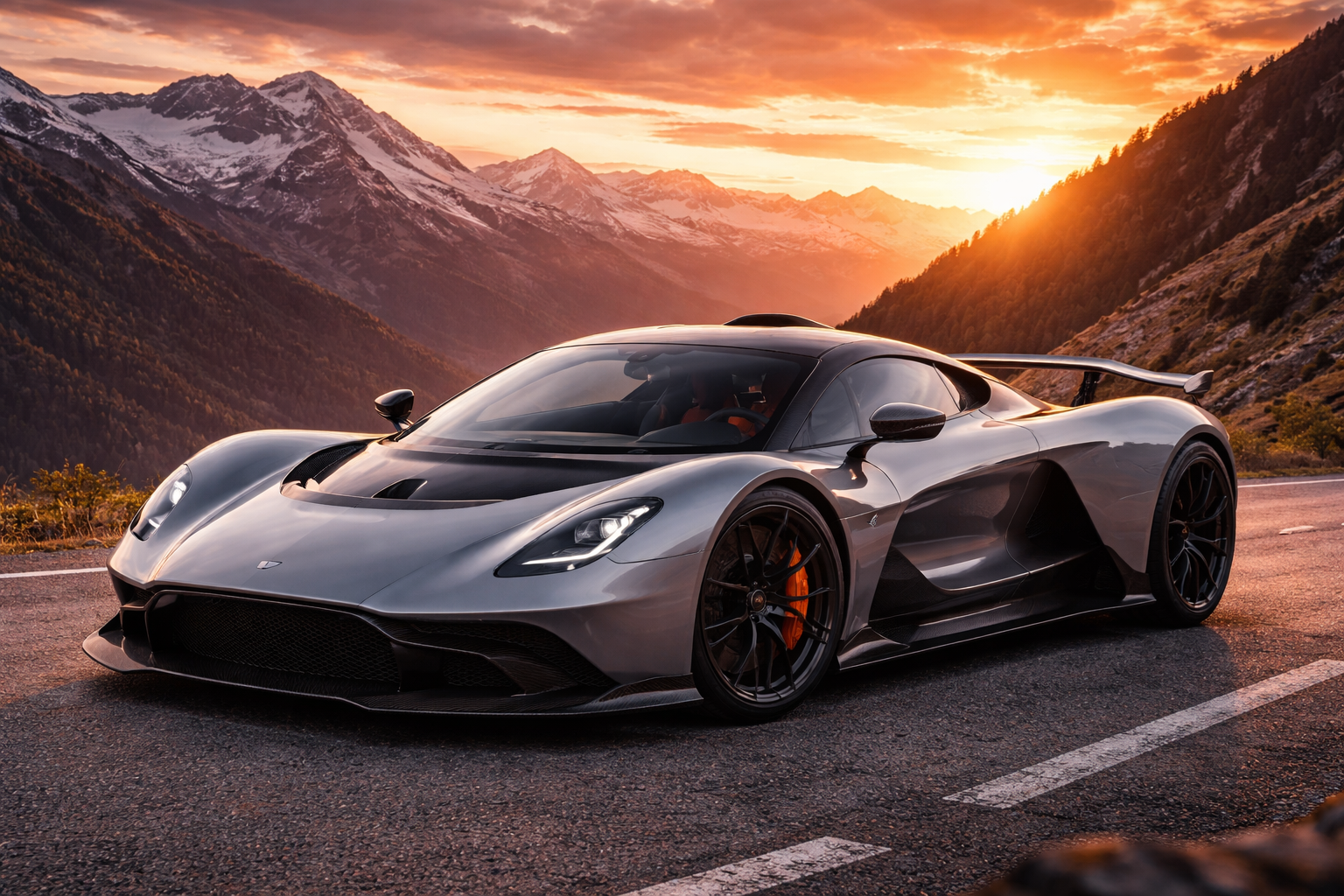
Aston Martin has long been the brand you bought to look like James Bond: Aston Martin. You weren’t purchasing one to pursue lap times; you were purchasing one because it was lovely and sounded like thunder. But things have changed. The brand has finally awakened and chosen violence.
Enter the Aston Martin Valhalla. This isn’t just a prettier DB11. It is a mid-engine declaration of war against Ferrari and McLaren. It sits right below the alien-looking Valkyrie, but unlike its big brother, you can actually drive this one without needing a team of engineers and a chiropractor on standby. It’s the “sensible” hypercar, if such a thing even exists. So let’s look into what it looks like when British luxury turns to F1-level obsession.
What is the Aston Martin Valhalla concept?
The Valhalla started life as the AM-RB 003 concept. When sketches first appeared, it had the promise of a bespoke V6 engine and a sci-fi prop, much more akin to a prop than a car at that. Thank goodness reality improved it. While in development, Aston Martin discarded the proposed V6 for a monstrous V8 and adjusted the architecture to be viable on roads. The entire concept was a design study, but the production car is a working weapon. It retained the wild aerodynamics—the vast venturi tunnels that suck the car down through the ground—while incorporating practical elements like side mirrors you can actually see from the outside.
The Heart of the Beast: Aston Martin Valhalla Engine
Let’s be real—nobody buys a hypercar for the fuel economy. You buy it for the noise and the kick in the back. The Aston Martin Valhalla engine delivers both in spades. Aston dropped a flat-plane crank 4.0-liter twin-turbo V8 right into the middle of the chassis. But here’s the scoop: it’s a hybrid. This is not a Prius system—it’s a performance booster. You have the screaming V8 driving the rear end of things, with two electric motors driving the front end.
. Torque Fill: Turbos have lag, and they have it naturally. That gap is filled immediately by the electric motors. Floor it, and the electric motors punch first, then the turbos pile on.
. The Result: Together they make 998 horsepower (1,012 PS), which is honestly a bit insane.”
The Drive Experience: How It Feels
Given that the front wheels are electric motors, this car utilizes “torque vectoring” to bring you into corners. It seems as though the car is reading your brain. When you turn the wheel, the nose zips right in. The most surprising part? The silence. In EV mode, you’ll be able to slip through traffic without making noise. But flip it into ‘Track’ mode, and the V8 gets up. It lets out a sharp, almost shrill scream—the kind that tells you this engine was built to go fast, not take it easy. A bit tight for a hybrid, responsive, and surprisingly mechanical.
Speed and Specs
We can talk about “feeling” all day, but in this league, bragging rights matter. The numbers this car displays are genuinely alarming.
. 0-100 km/h: 2.5 seconds.
. Top Speed: Aston Martin Valhalla’s top speed is 350 km/h (217 mph).
. EV Range: Approximately 15 km.
Inside the Cockpit: Aston Martin Valhalla Interior
Opening the doors is an event in itself. They swing up and forward—classic supercar drama. But once you slide inside, the Aston Martin Valhalla interior is a surprise. They’ve gone for a “cockpit” vibe rather than a lounge. Here is the weird part: the seats don’t move. Opening the doors is a bit of a spectacle. They swing up and forward—standard supercar drama. But once you slip within, the Aston Martin Valhalla interior is a surprise. They aim for a “cockpit” feel instead of an upscale lounge. Here’s the interesting part: the seats don’t move.
They’re fixed to the carbon-fiber chassis to shave off weight. Adjusting your position is simple—pull a lever, and the pedals and wheel come to you. It forces you into a “feet-up” position, similar to a Formula 1 driver. It sounds uncomfortable, but it actually feels incredible once you are moving. You feel connected to the car’s center of gravity. The dashboard is minimal—just a digital screen for you and a central touch screen for the maps. No clutter, just focus.
Aston Martin Valhalla Price and Cost in India
The Aston Martin Valhalla price goes strictly in the “if you have to ask…” category. In global markets, it hovers around $800,000 to $900,000. But thanks to import duties in India, that number balloons fast.
· Estimated Cost: ₹10 Crore – ₹12 Crore (Ex-showroom)
· On-Road Reality: With insurance and registration, the Aston Martin Valhalla will exceed ₹14 Crore.
Is it worth it? This is technically a “bargain,” relative to the multi-million dollar Valkyrie. But for the rest of us, it is a beautiful dream.
Conclusion
The Aston Martin Valhalla is proof that the old-school British carmaker has learned new methods. It’s just a matter of not only catching up to Ferrari; you could say they have perhaps even taken a step closer to the style pole. It’s a hybrid that doesn’t feel soulless and a track weapon that you can actually fit on a public road. It’s expensive, it’s rare, and it’s just crazy. This is the way a supercar should be.
FAQs
1. Is the Valhalla faster than the Valkyrie?
A. No. The Valkyrie is essentially a road-legal race car and is faster. The Valhalla is the “usable” sibling designed for slightly more comfort.
2. Can I actually buy one in India right now?
A. Technically yes, realistically… it’s tough. Only 999 cars exist, and allocations usually go to long-time Aston Martin customers first
3. Is the Aston Martin Valhalla road legal?
A. Yes, it’s road legal. That’s the whole point of the Valhalla, actually. It looks like something that belongs only on a circuit, but Aston Martin built it to be driven on normal roads too.
